Quoth the Raven, Forever More
By Bryding Adams
Bits and pieces of the history of Highlands Biological Station spin around in my head as I catalog photographs, documents, and objects in the archives. This story is an excellent example of how those pieces can come together to reveal a fuller picture.
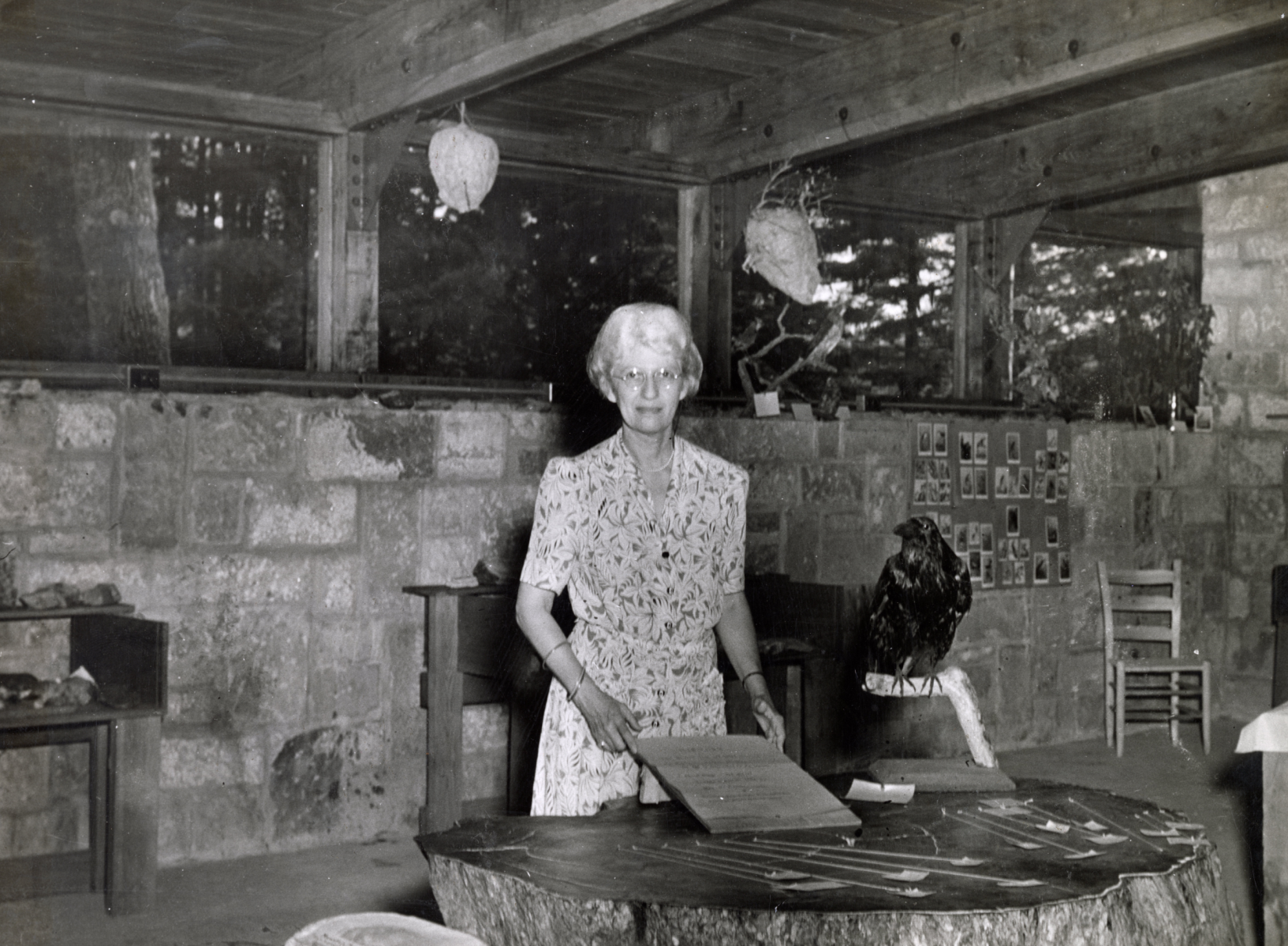
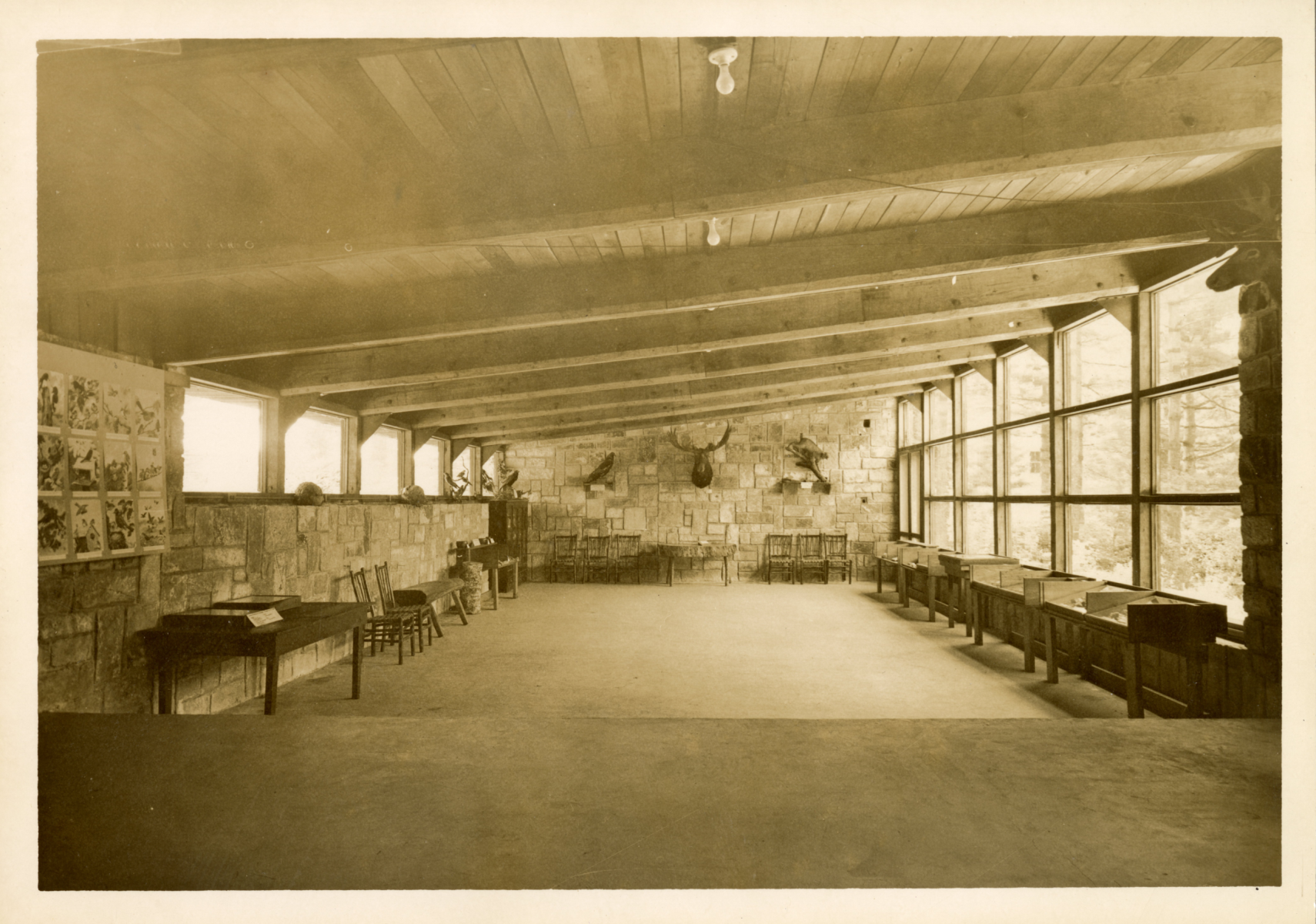
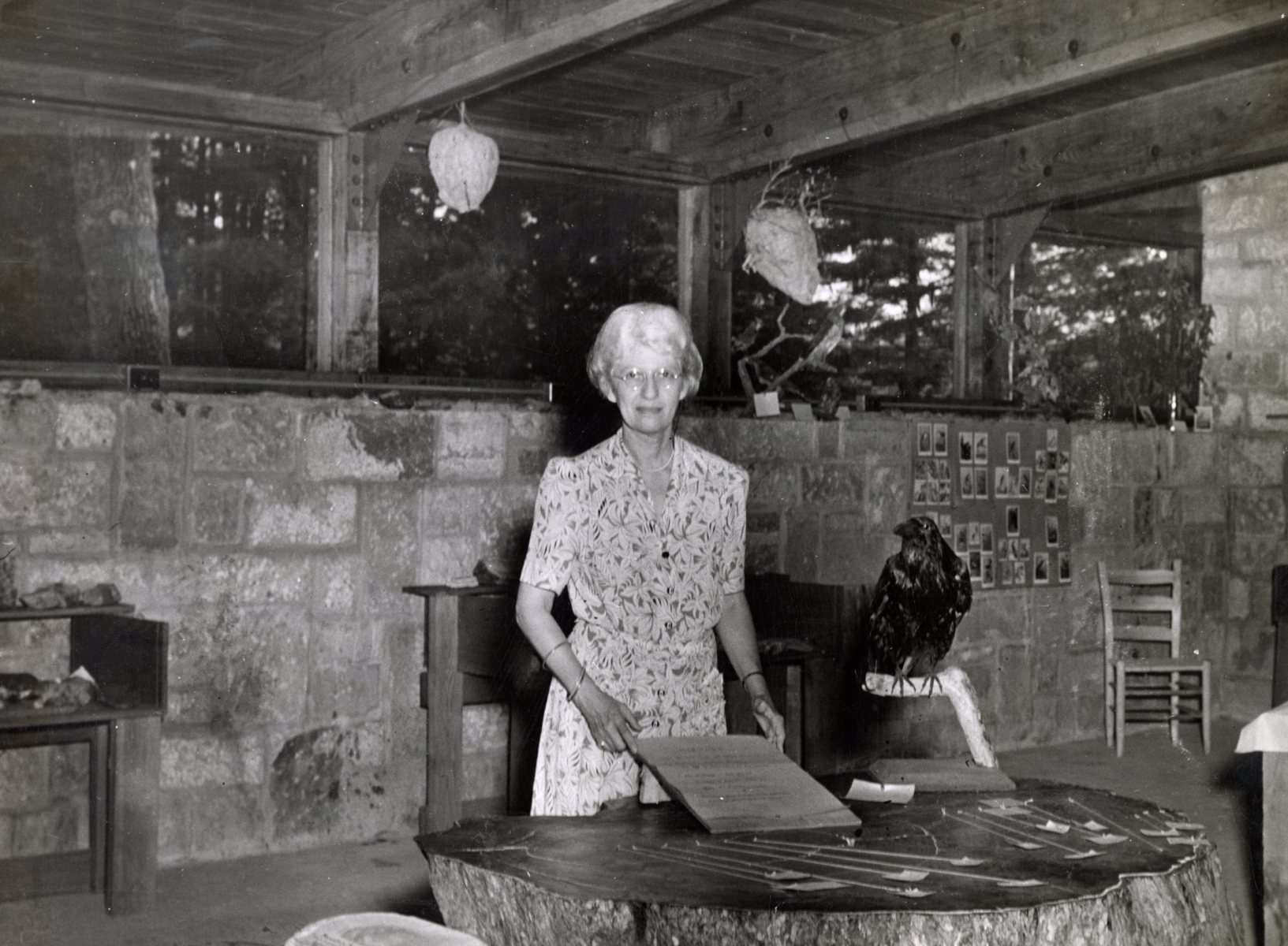
You may remember the photograph below from three different stories: one on Laura M. Bragg, Summer Director; one on the hemlock slice; and one on the ladder-back chair in the background. But another intriguing object in this August 19, 1941 photograph is the mounted raven.
A Raven in the Museum
The Clark Foreman Museum, August 19, 1941. The mounted raven appears in the room among the museum’s early displays.
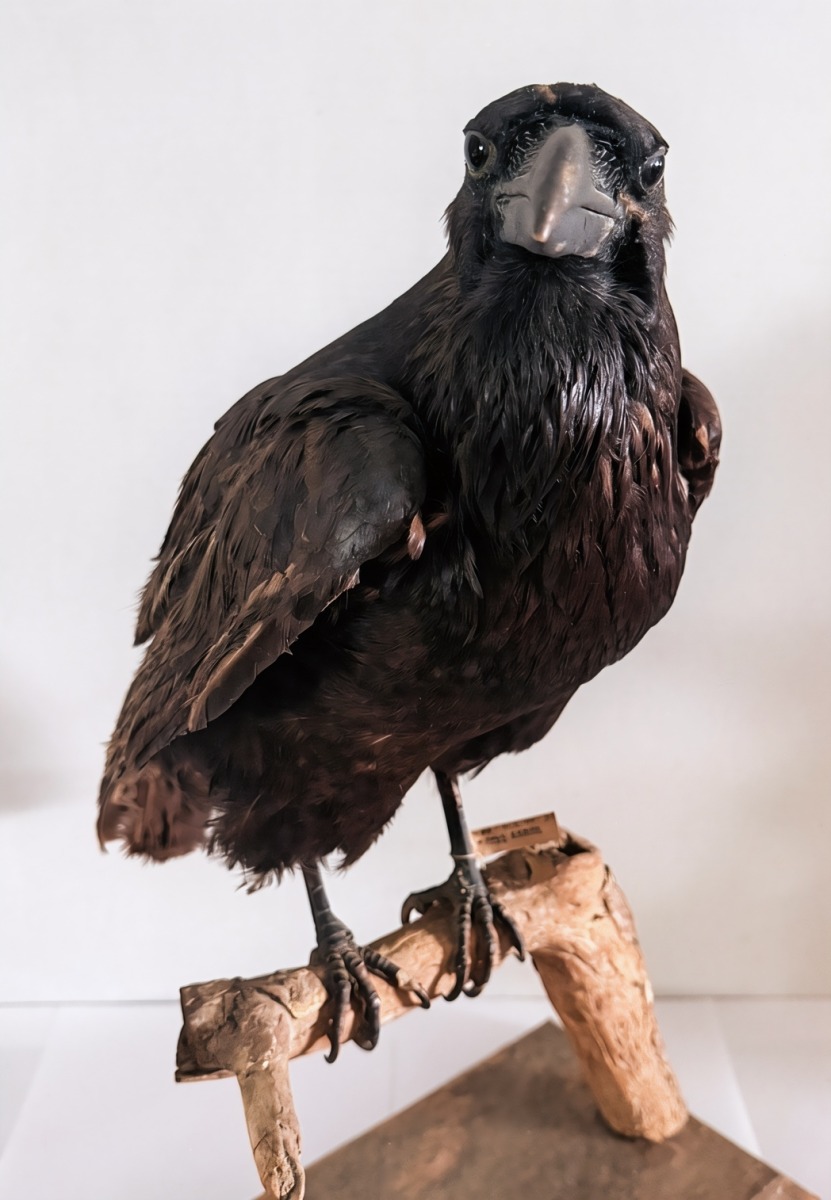
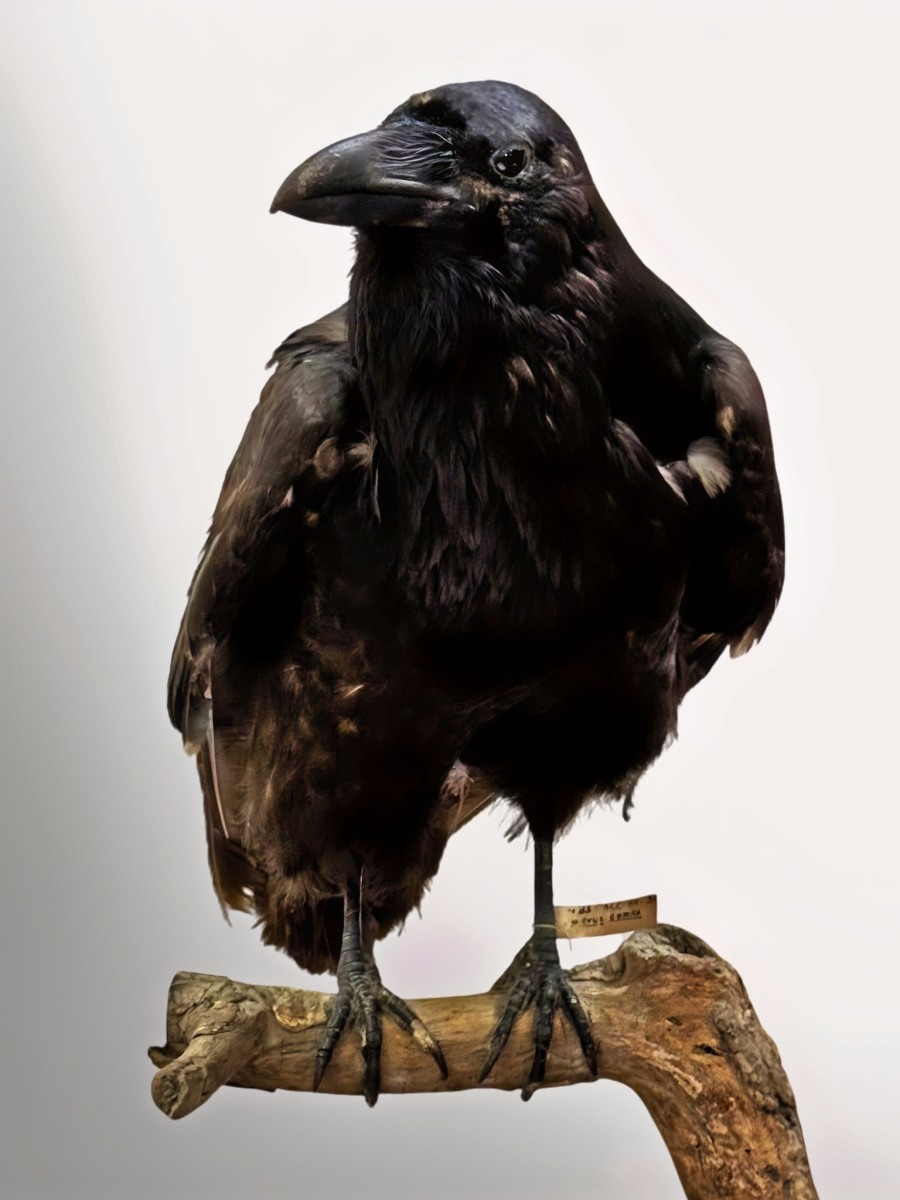
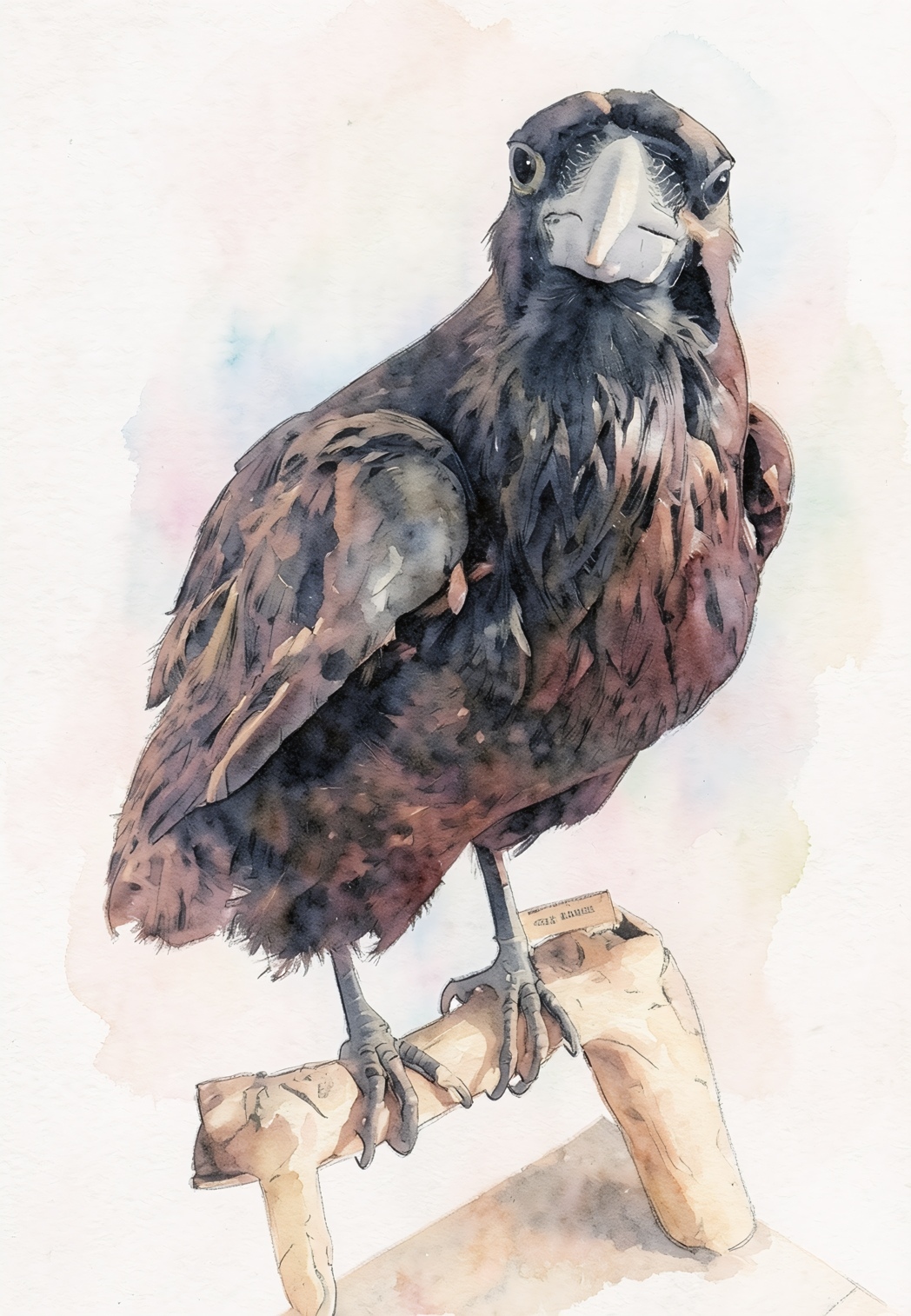
The raven had been on my mind for a while and recently I went into the basement of the Nature Center, where, on a top shelf, he sat. At first, I was not sure he was the same raven as the one in the photograph, but after taking him down and looking more closely, I am now certain that he is.
I remembered a reference to a raven given by Clark Foreman, but a search through Trustee minutes, correspondence, keyword lists, and early accession records came to no avail. Then, after about two weeks of more brainstorming and looking, I finally thought to check the original newspaper files — and bingo, there he was.
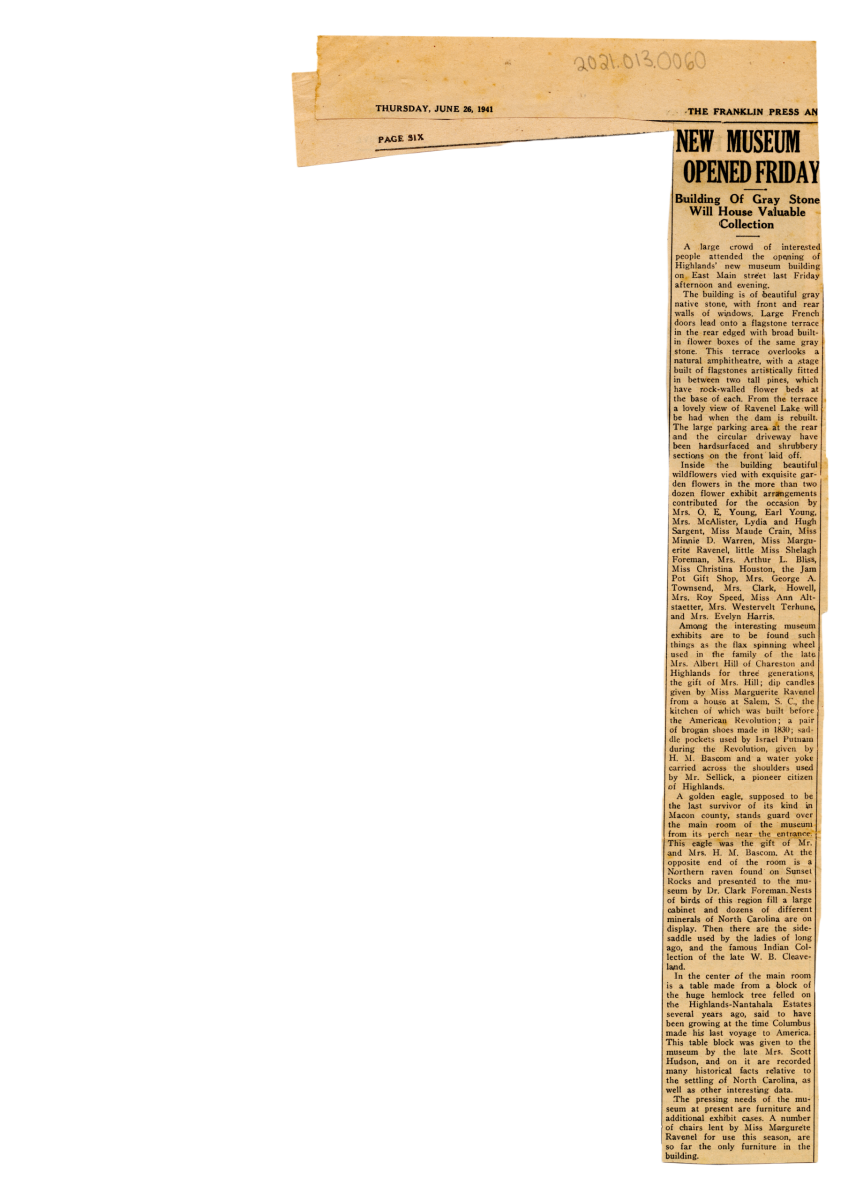
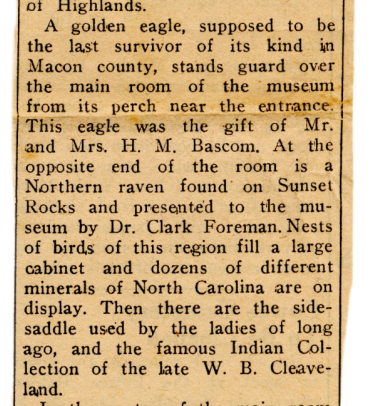
In the Franklin Press and the Highlands Maconian on June 26, 1941, the story “New Museum Opened Friday,” an elaborate description of the museum building and its holdings, includes the quote below.
There it was: verification of my memory about the raven.
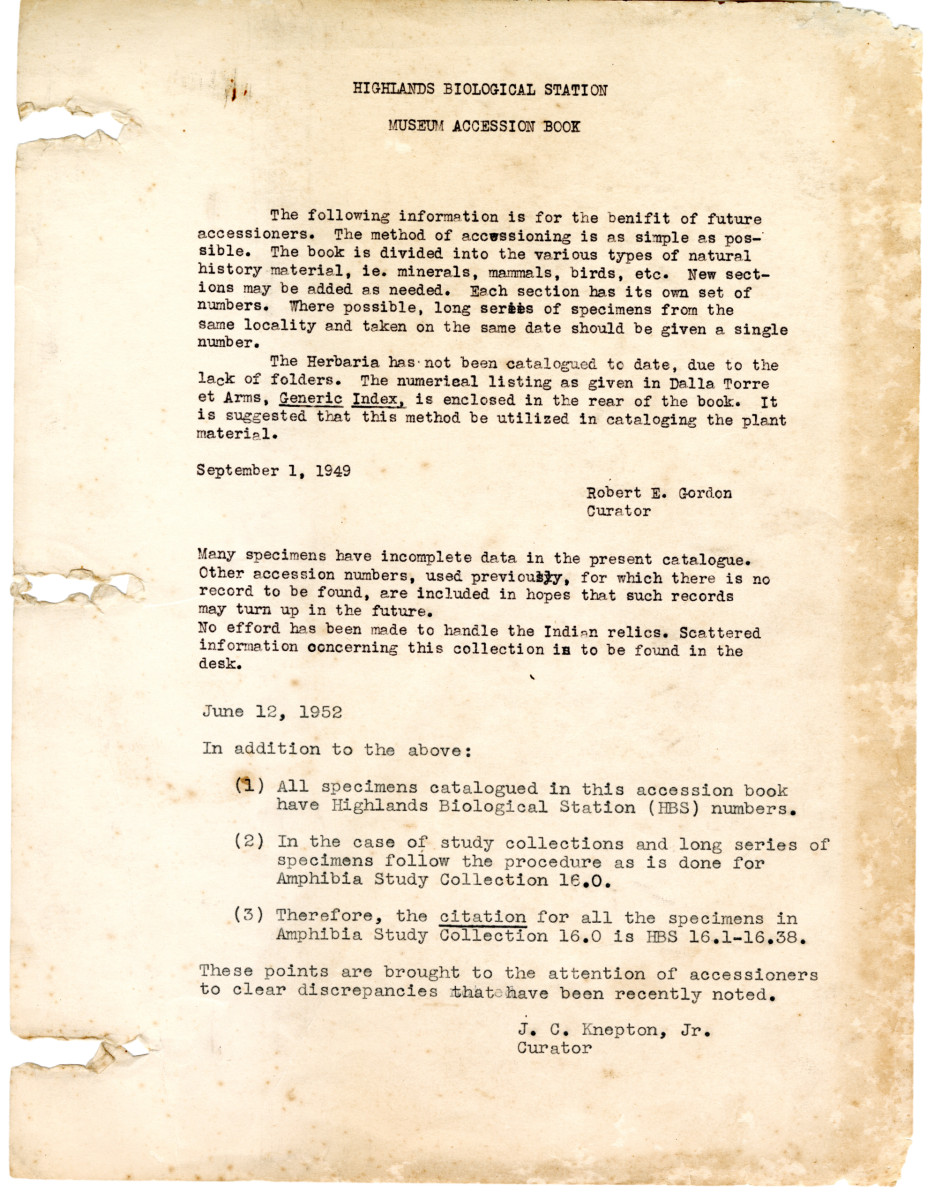
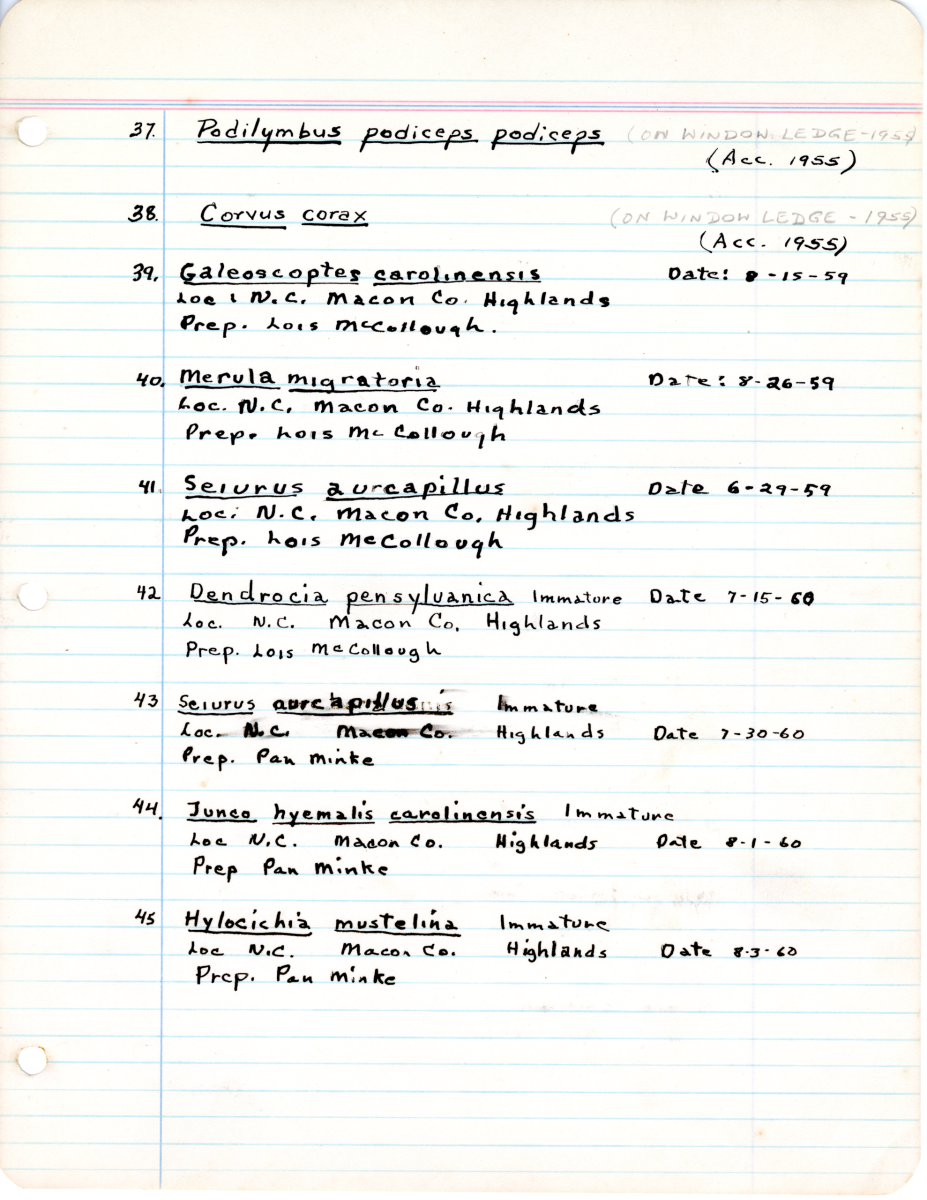
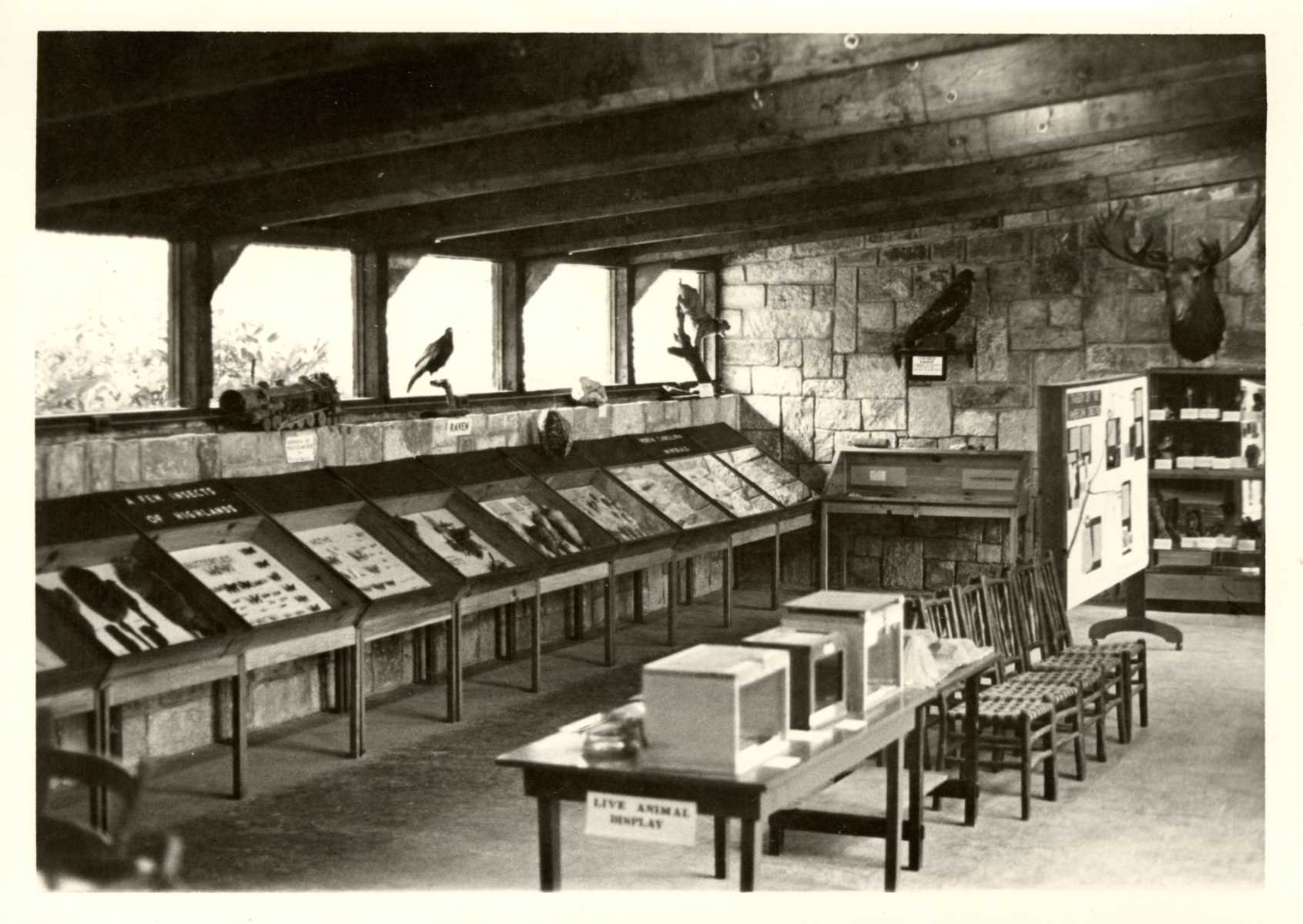
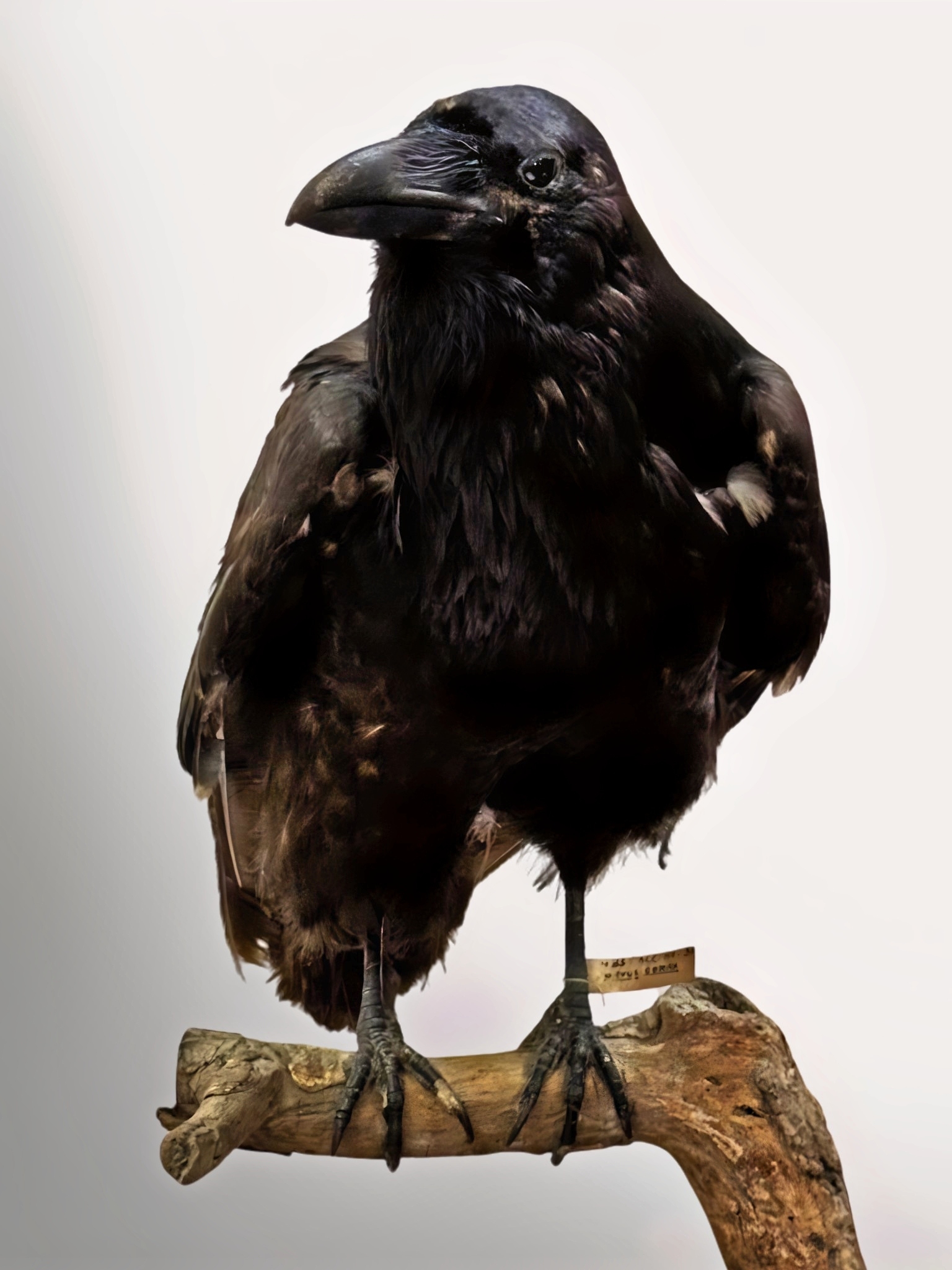
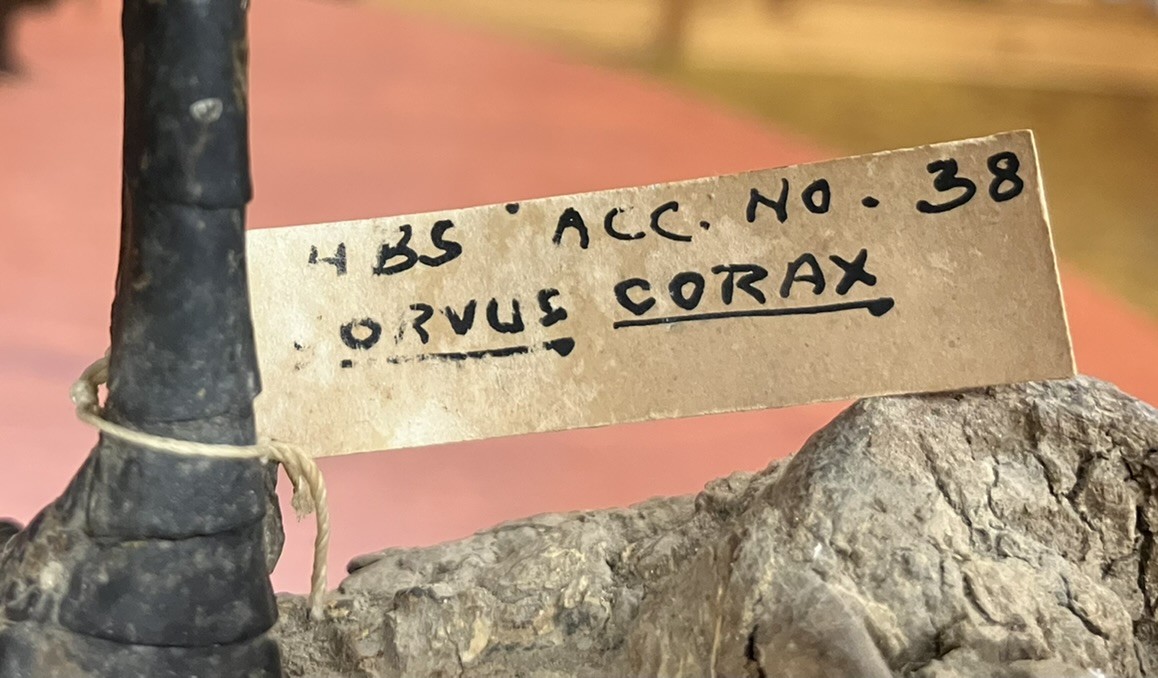
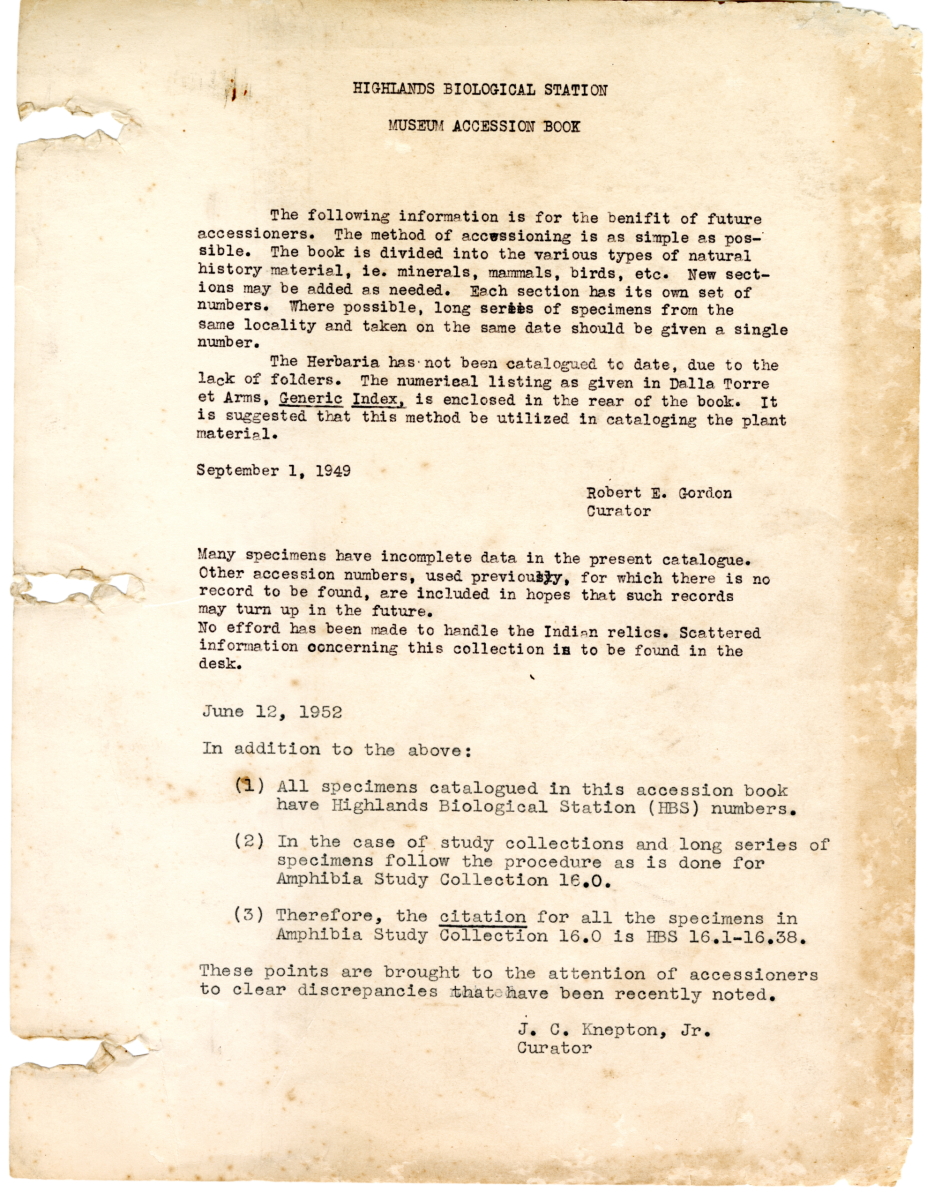
Also around his left leg is the original accession card noting, “HBS ACC. No. 38 Corvus corax.” This accession notation appears in the existing Highlands Biological Station Museum Accession Book from 1949 by Curator Robert E. Gordon, later updated in pencil in 1955 with the note “On window ledge,” as depicted below.

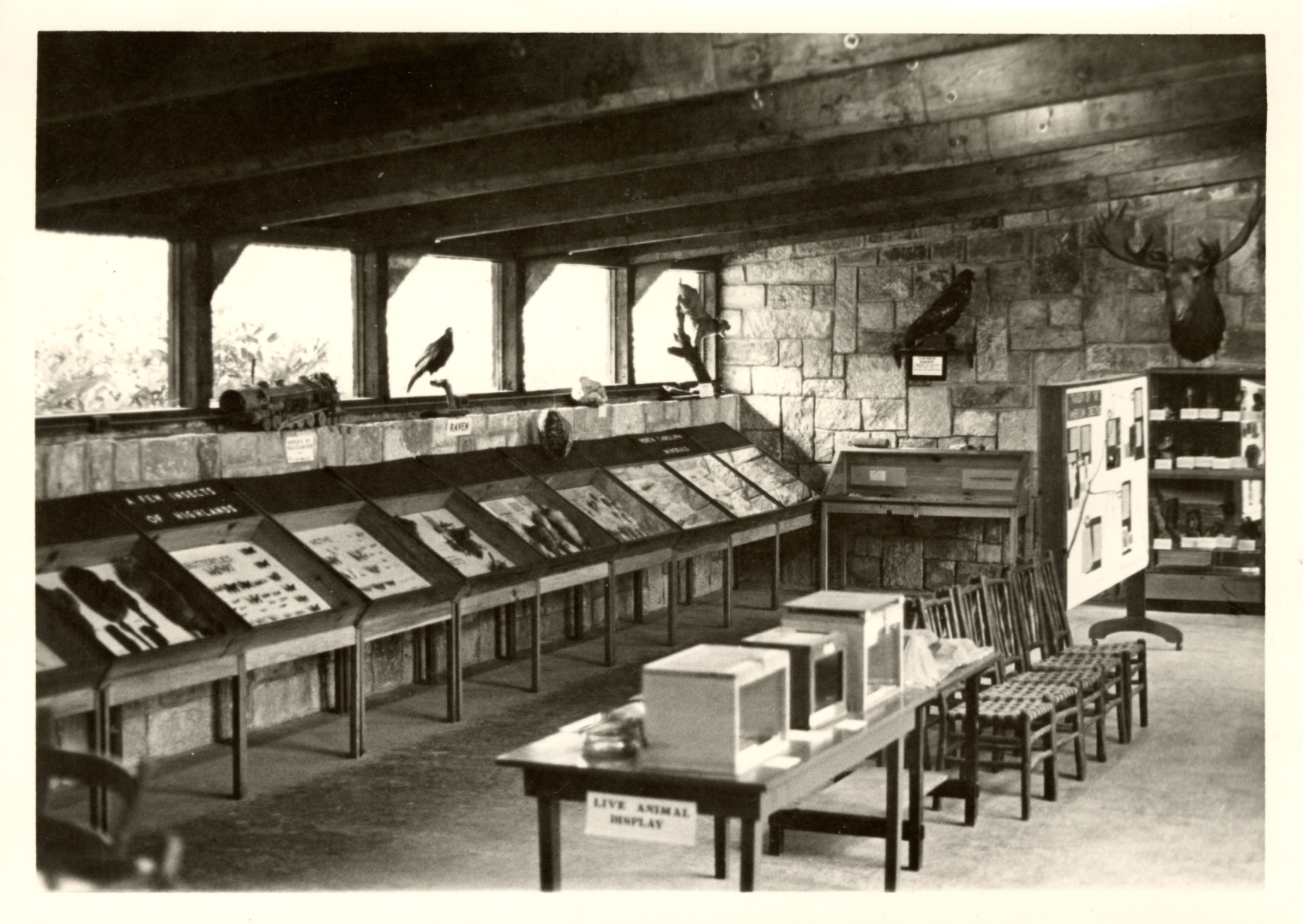
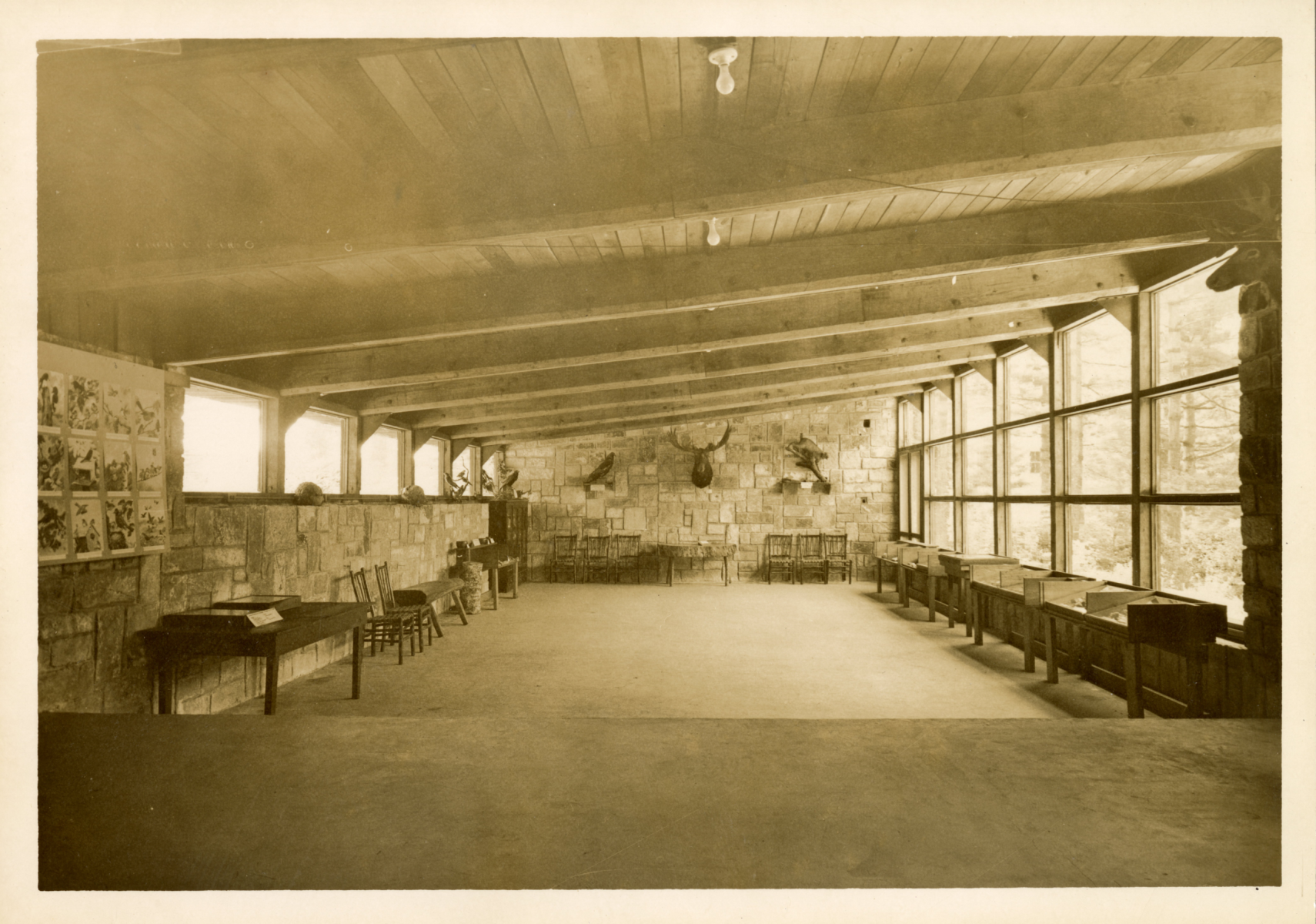
A golden eagle, supposed to be the last survivor of its kind in Macon County, stands guard over the main room of the museum from its perch near the entrance. This eagle was a gift of Mr. and Mrs. H. M. Bascom. (Lost unfortunately.) At the opposite end of the room is a Northern raven found on Sunset Rocks and presented to the museum by Clark Foreman.

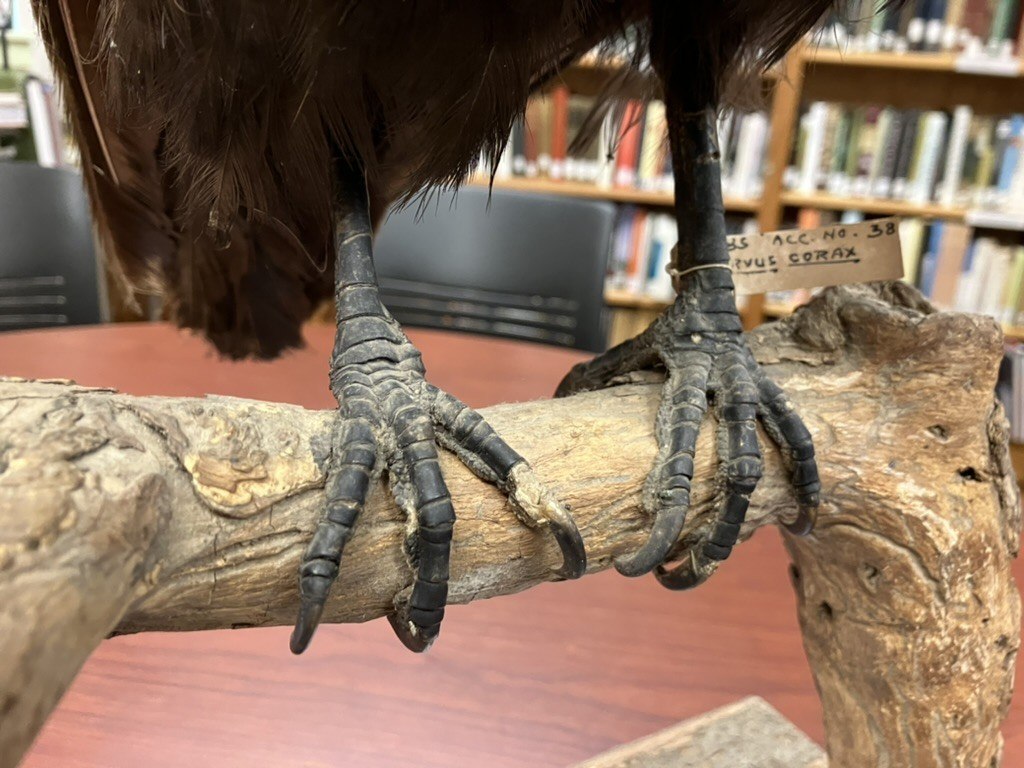
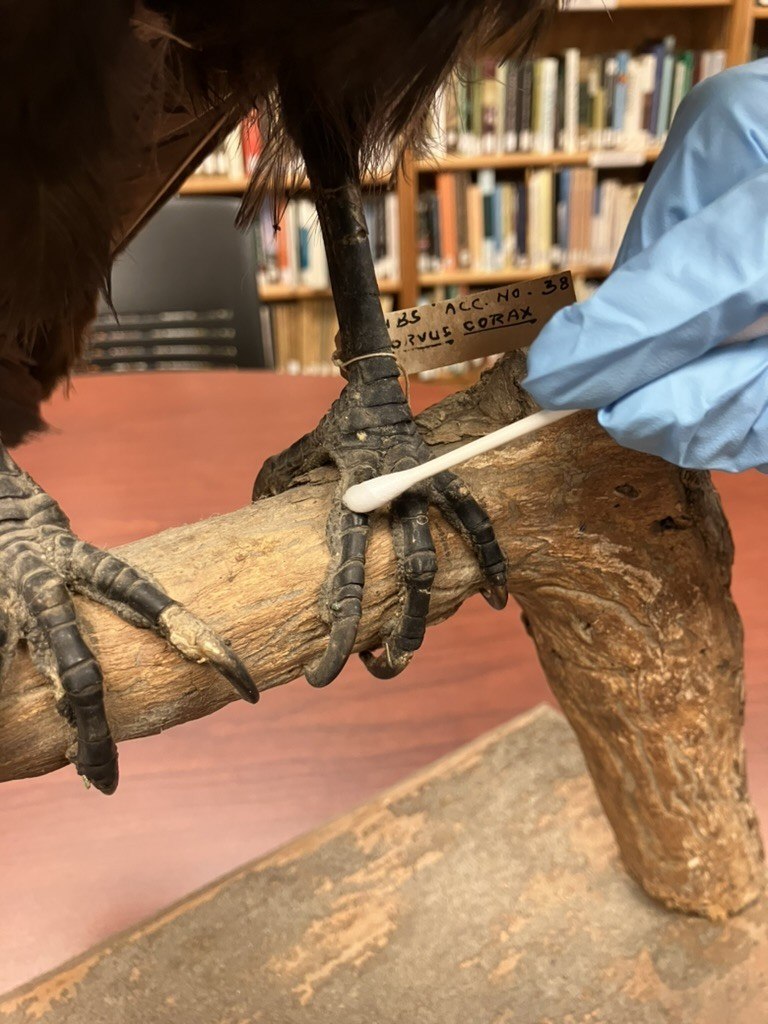
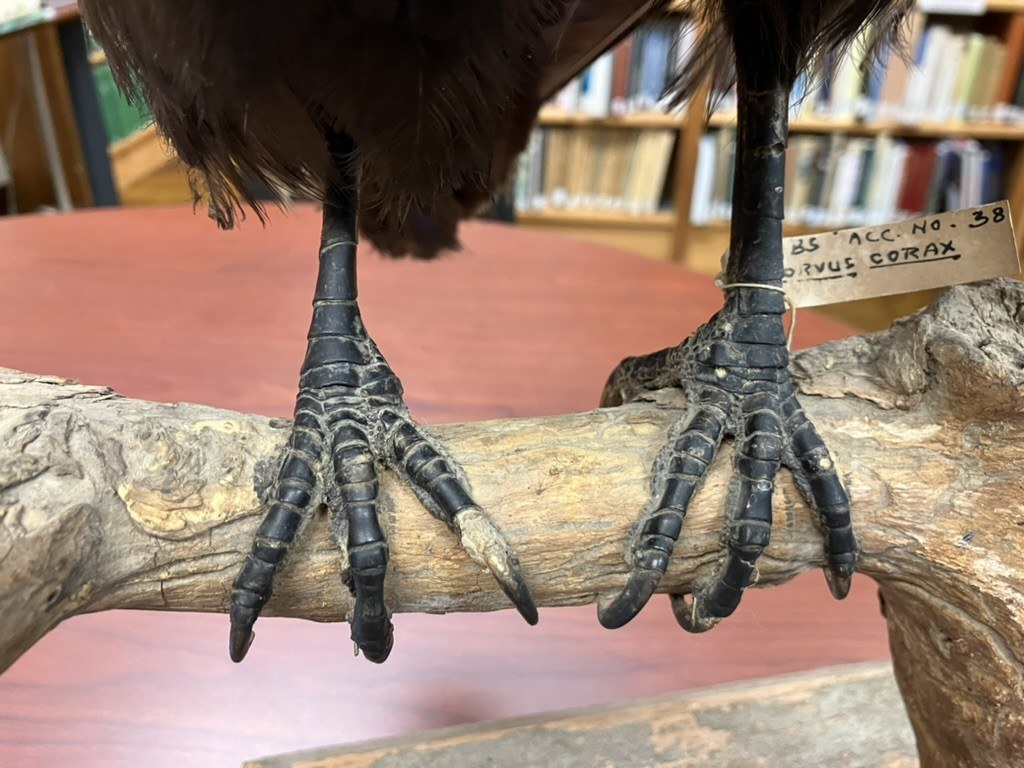
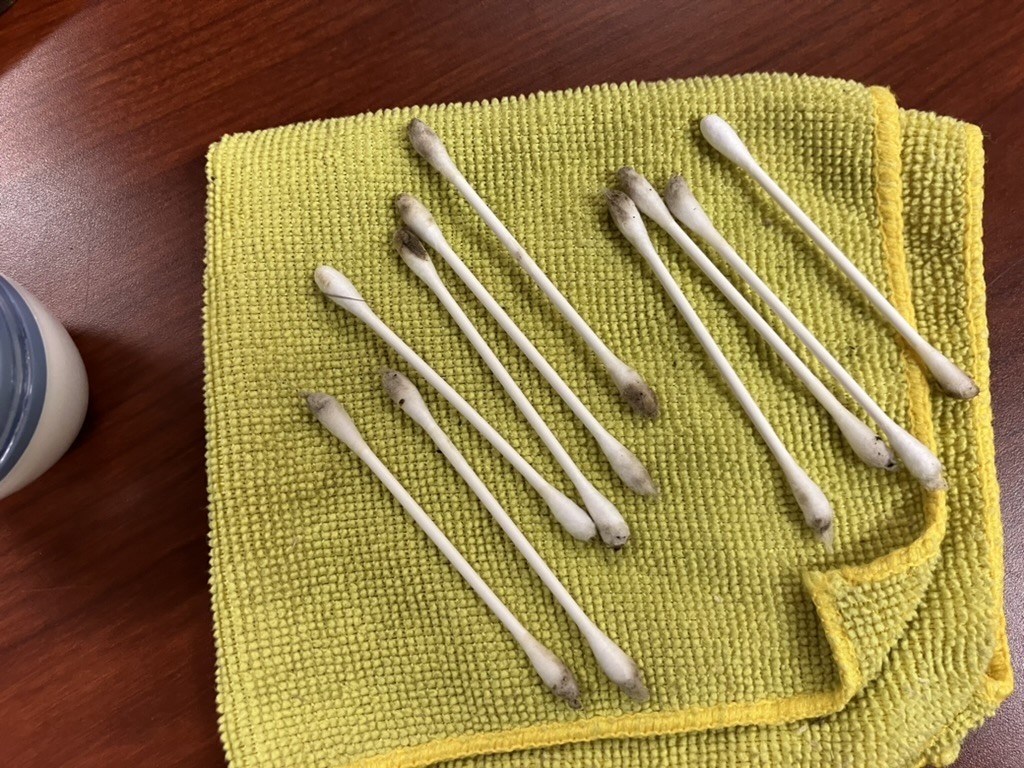
The raven currently lives in the archives, where he recently received a careful cleaning. Using slightly damp Q-tips and distilled water, we cleaned his eyes, which are glass, and his feet. We watched a cleaning tutorial on mounted specimens and adhered carefully to the procedure. We did not use a low-pressure screened vacuum, as we decided his feathers were too delicate.
We are now on the lookout for a conservator with experience working with mounted birds.
Local Ravens
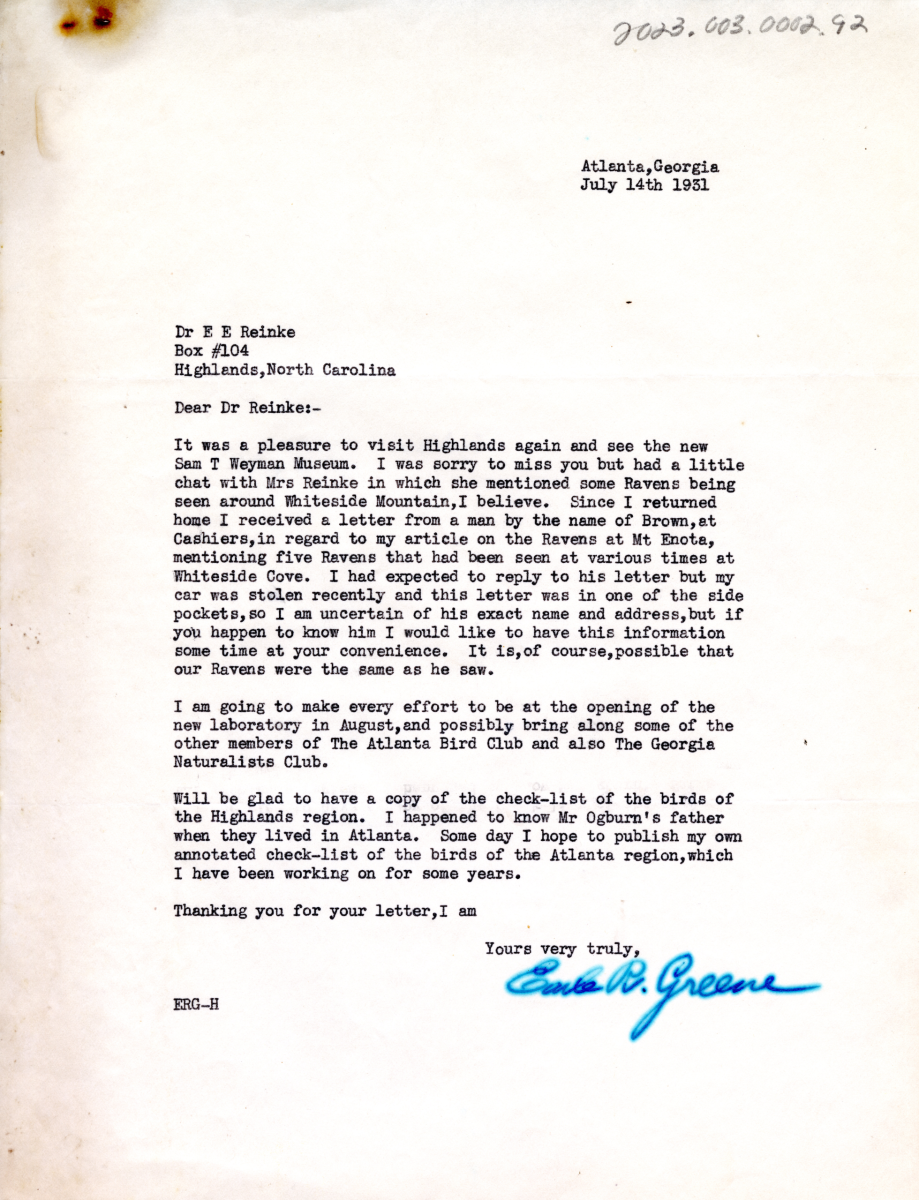
One other piece of historical correspondence, dated July 14, 1931, from Earle R. Greene to Dr. E. E. Reinke, discusses ravens in the area:
Mrs. Reinke mentioned some Ravens being seen around Whiteside Mountain.
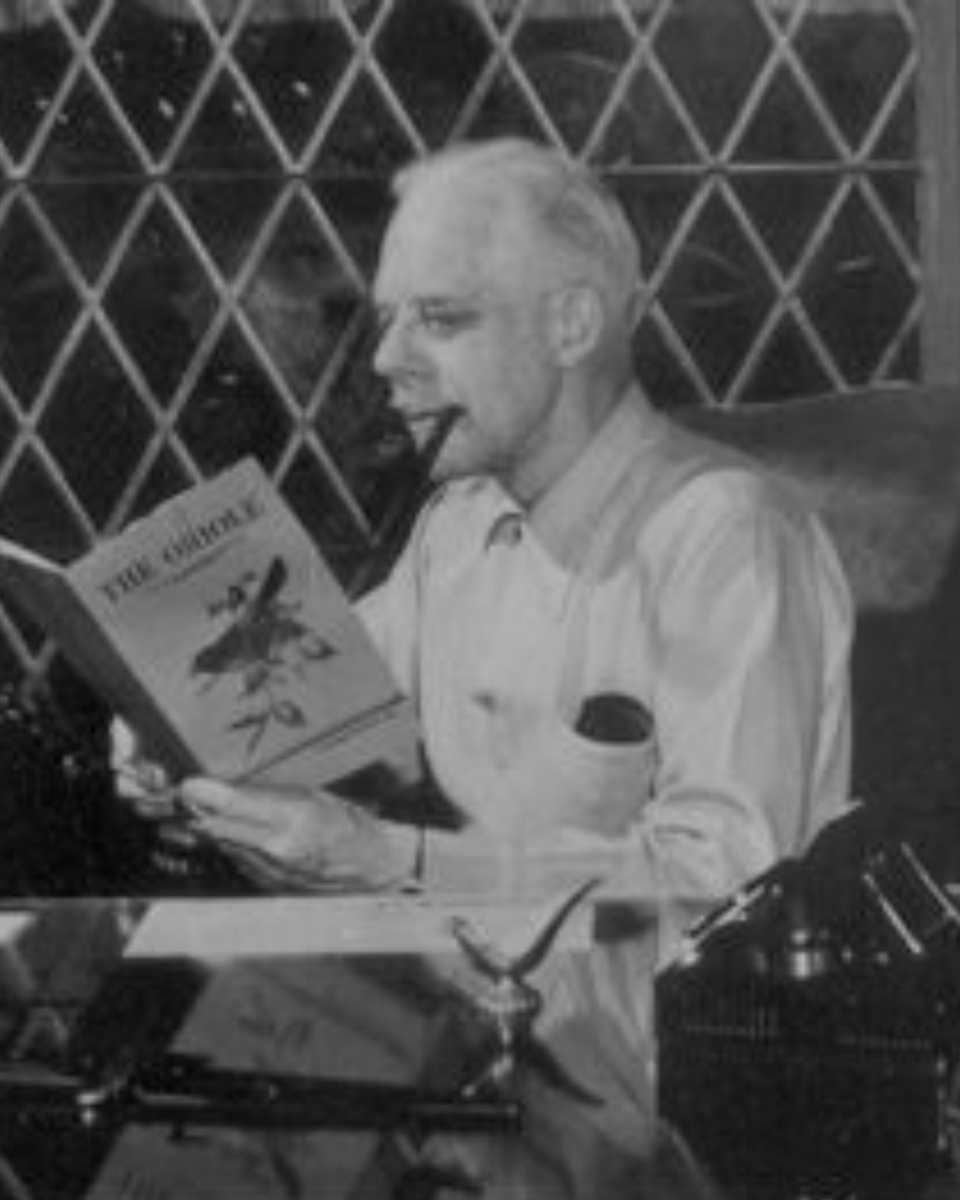
Earle R. Greene (1887–1975) served as President of the Atlanta Bird Club, was a member of the Georgia Naturalists Club, and belonged to the Six Hundred Club, a distinction reserved for birders who had observed more than 600 species. By profession, he worked in real estate, but ornithology was his passion, leading him to work for the U.S. Fish and Wildlife Service in Okefenokee and other refuges protecting birds.
Greene was also a founder of The Georgia Ornithological Society and, after his death, was honored through the Earle R. Greene Memorial Award, given each year since 1975 for major contributors to Georgia ornithology.
Click on images to expand
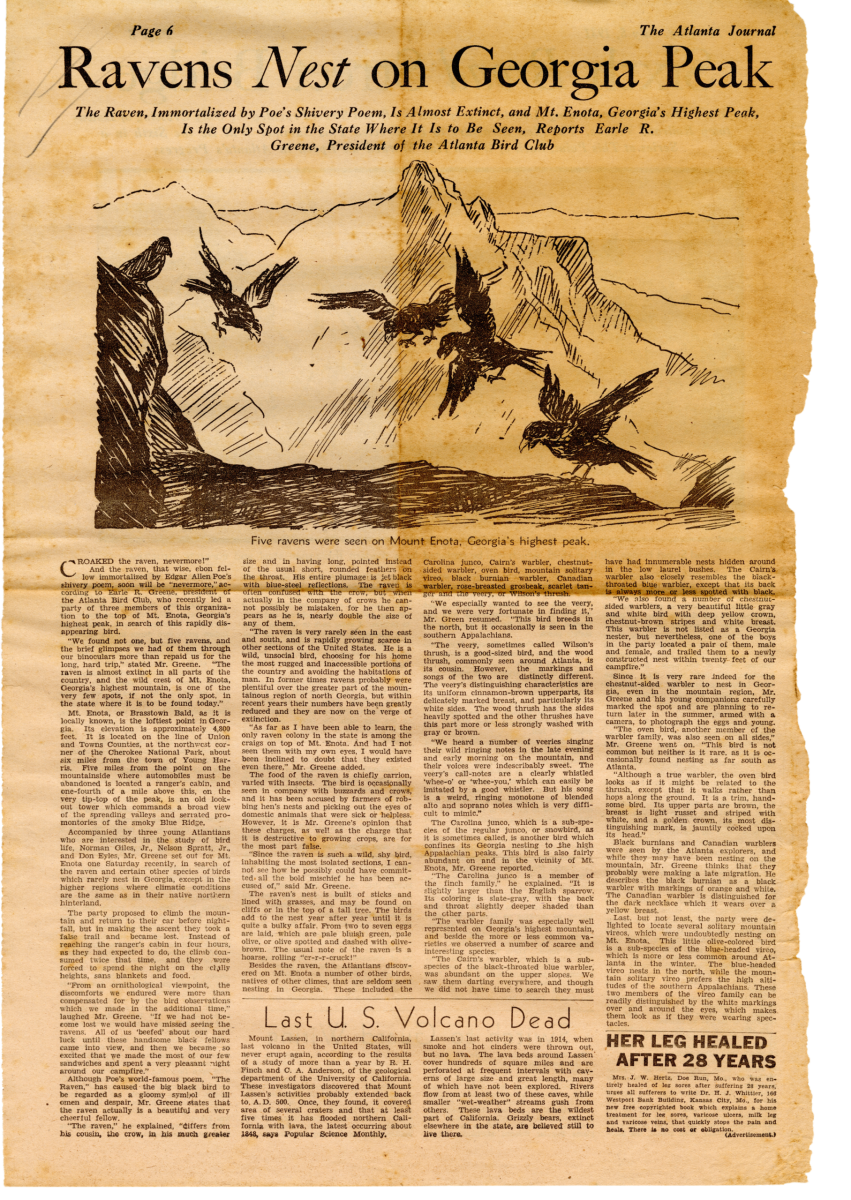
Ravens on Georgia’s Highest Peak
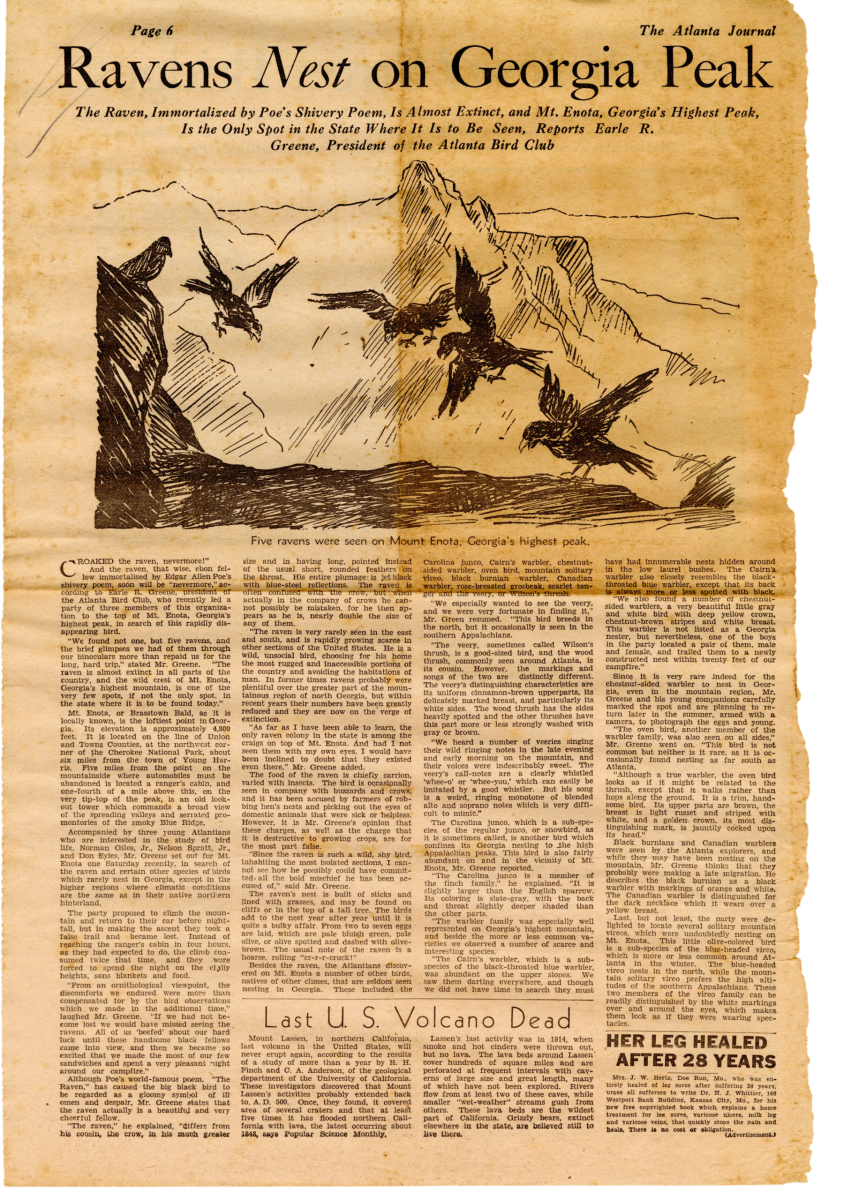
Greene also wrote a story for The Atlanta Journal, published July 5, 1931, titled “Ravens Nest on Georgia Peak,” about seeing five ravens on the summit of Mt. Enota (Brasstown Bald), Georgia’s highest peak at 4,800 feet. His story recounts a trip from Atlanta with fellow Bird Club members Norman Giles, Jr., Nelson Spratt, Jr., and Don Eyles. They became lost and spent the night outside, which unexpectedly turned into a benefit, as it allowed them to see the ravens.
He also described the many other birds they observed, species then thought to occur only at higher elevations.
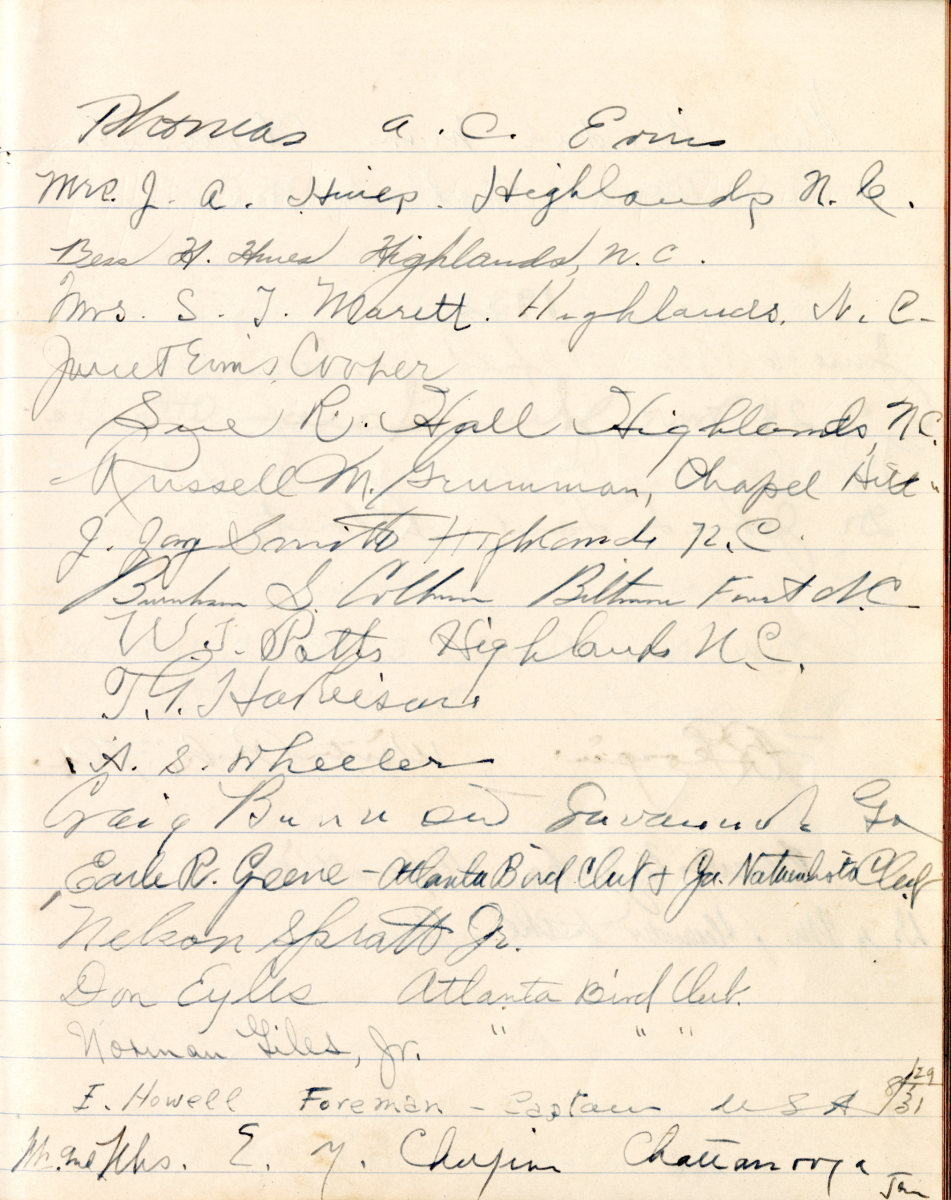
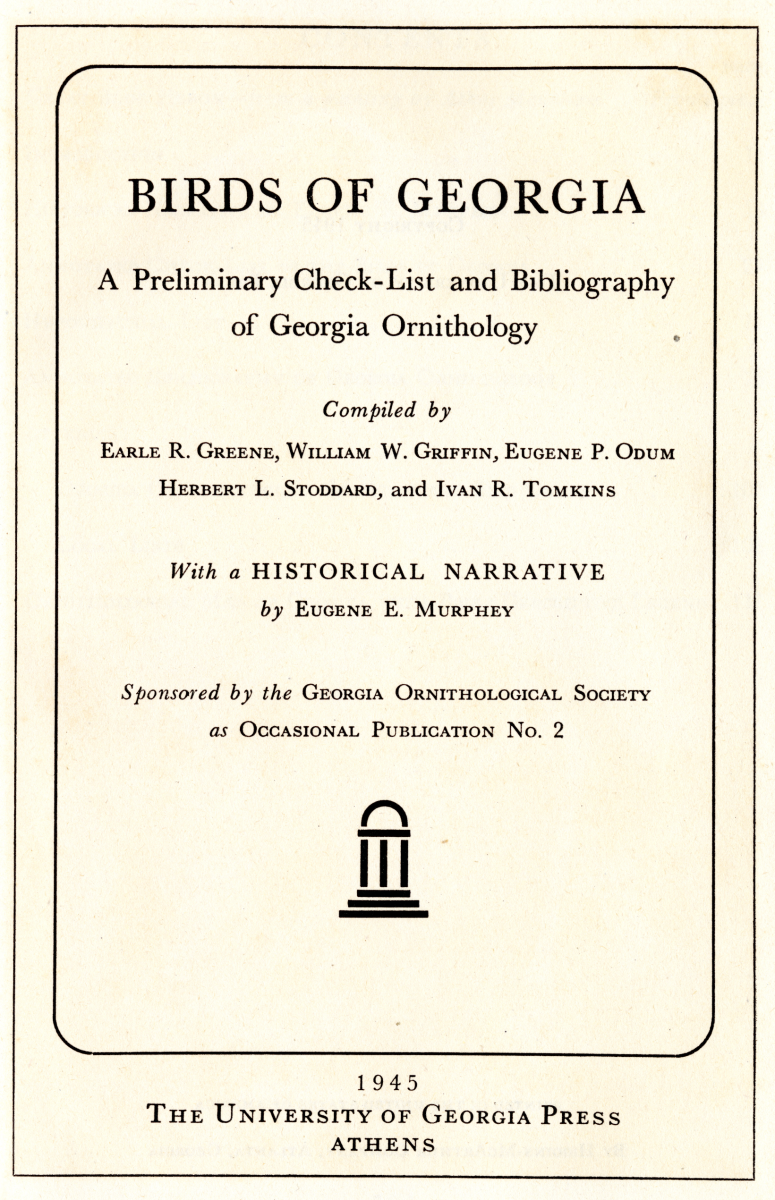
In his letter, Mr. Greene went on to say that he hoped to attend the opening of the Weyman Building, which he did. The guest book dated August 29, 1931, for the Weyman dedication includes his signature. Greene also requested a copy of the checklist of birds on the Plateau to be published by HBS, noting that he hoped to publish his own checklist of the birds of Atlanta. Indeed, Greene did help with a checklist of Georgia birds as evidenced by the 1945 book, Birds of Georgia, which list him as one of five authors.
Click on images to expand
Biota Cards and Bird Records
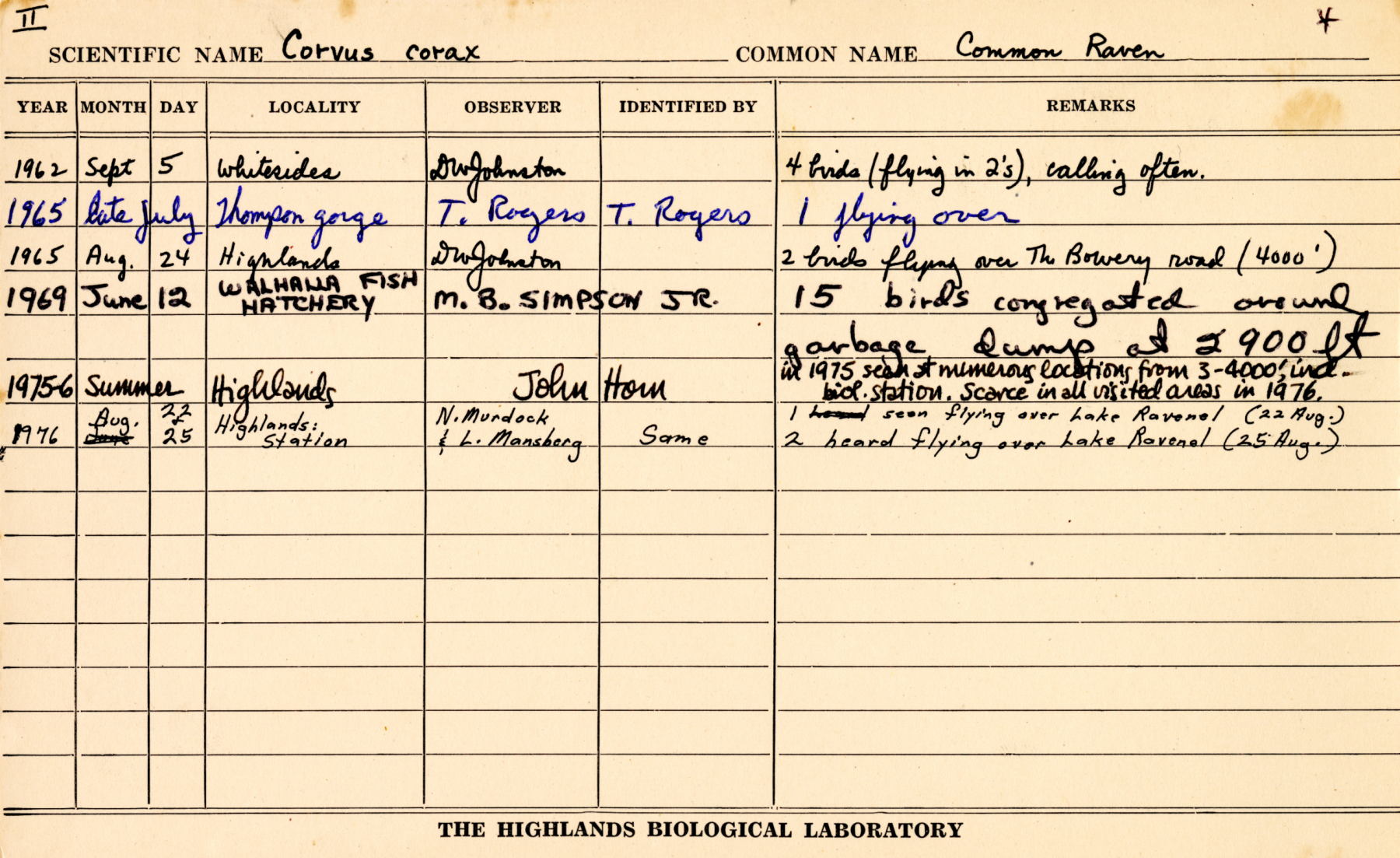
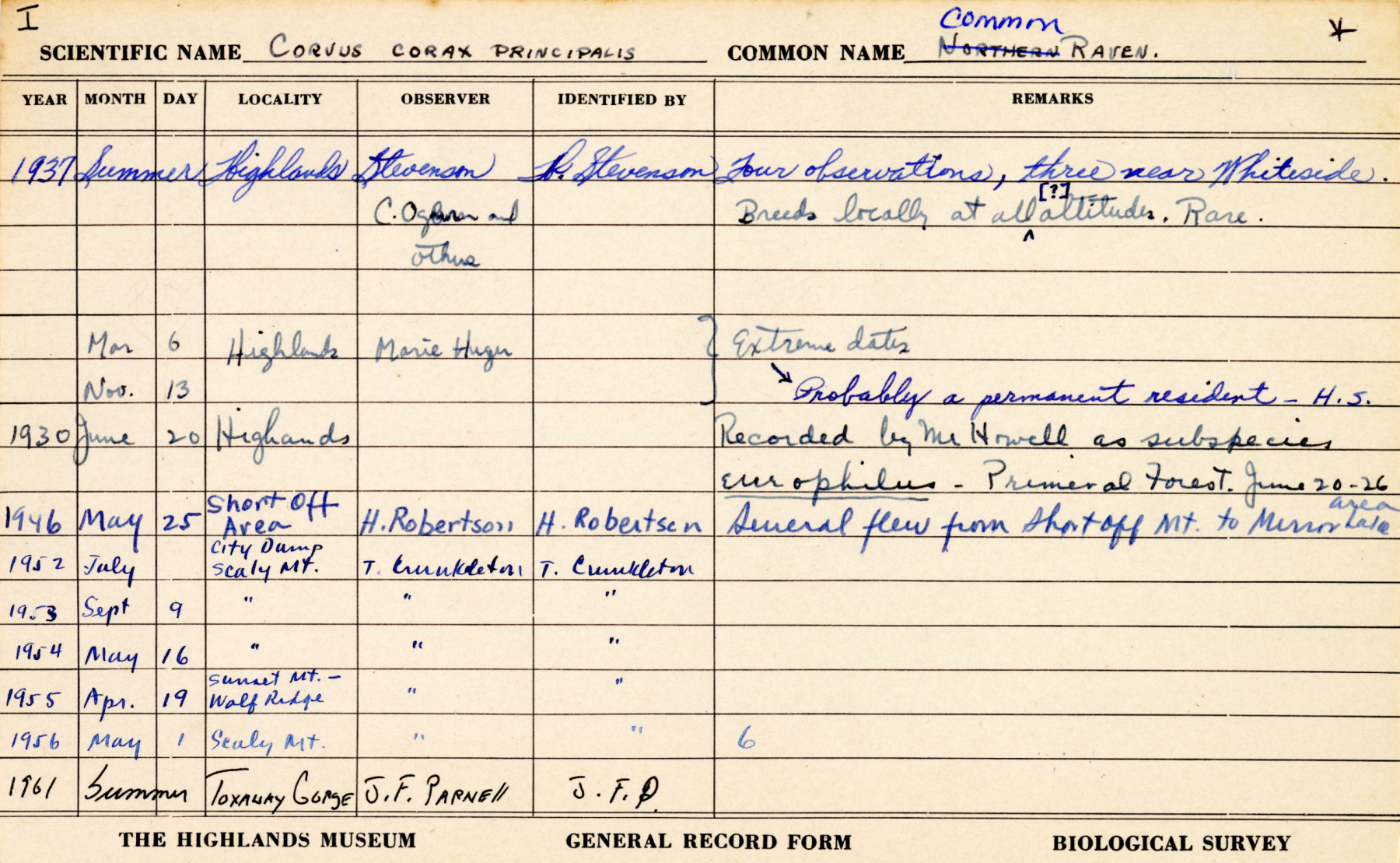
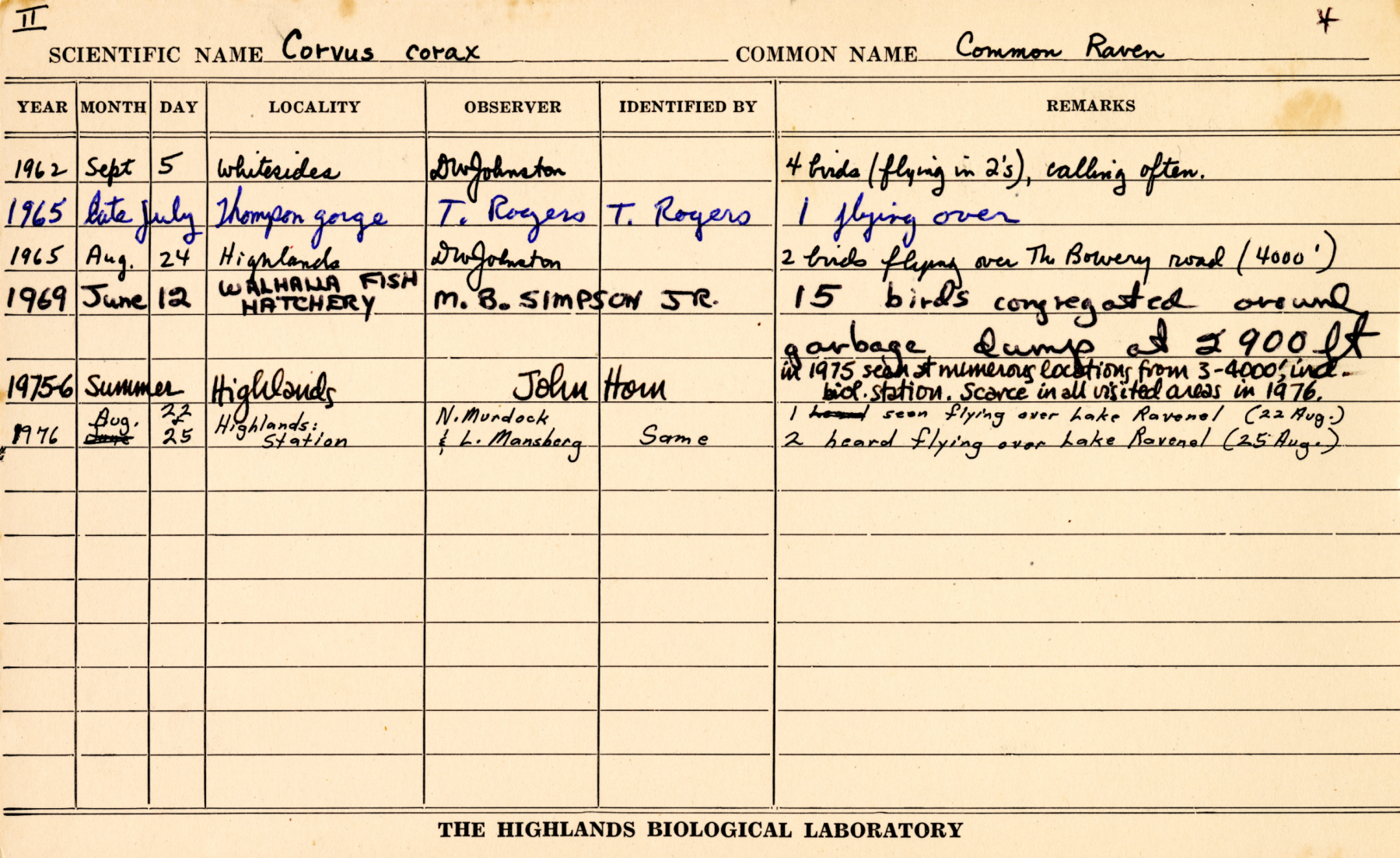
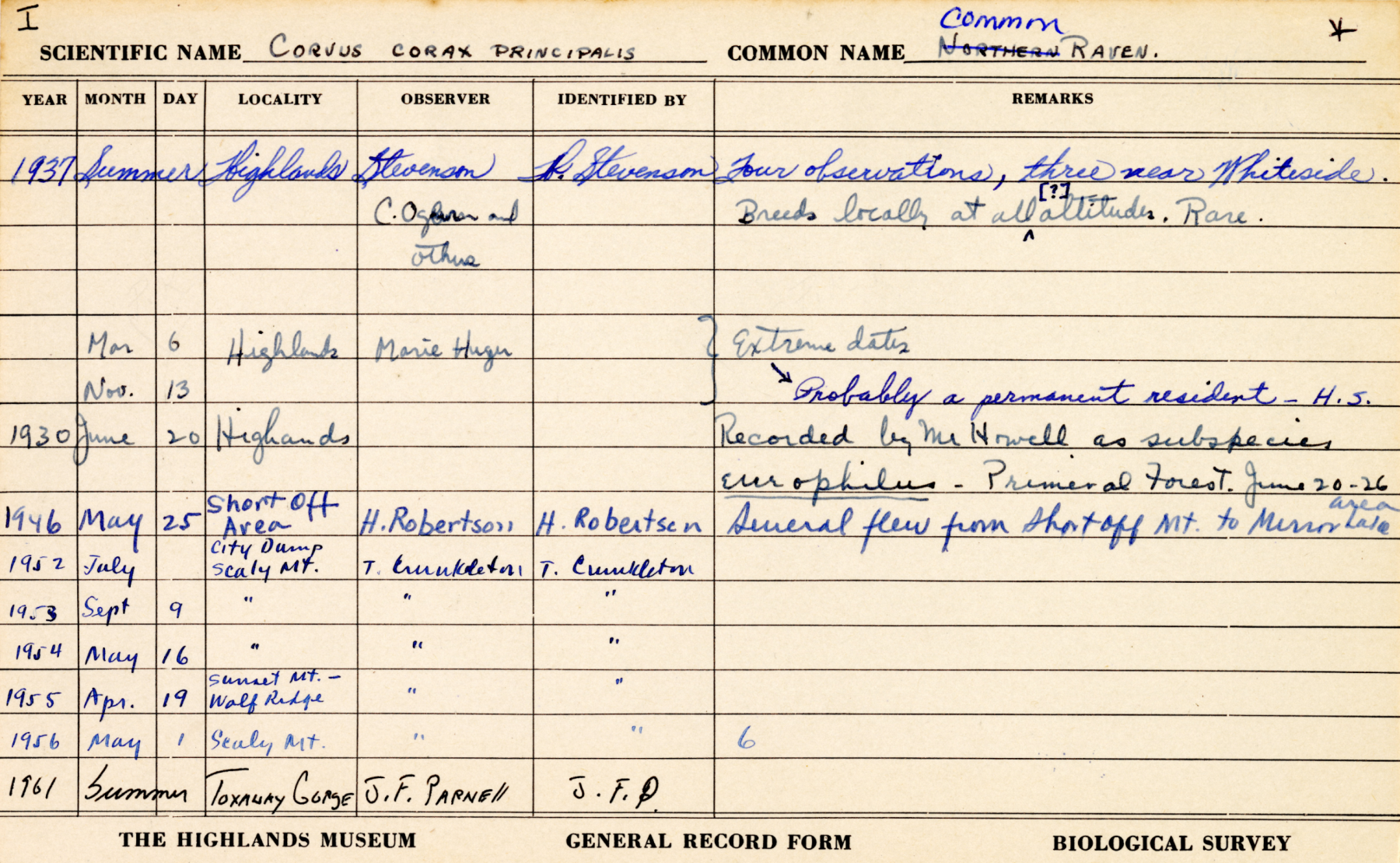
Of additional interest are observation, or biota, cards on ravens also held in the HBS Archives. When the Highlands Museum was founded, it was common for scientists and amateur biologists to record sightings of flora and fauna. Between June 1930 and August 1976, there are fourteen records of people seeing ravens in the Highlands area.
Of particular note is an observation by John Horn in the summer of 1975:
“seen at numerous locations from 3–4000 feet incl. biol. station. Scarce in all visited areas in 1976.”
Click on images to expand
It is astonishing to me that this raven still exists for us to admire today. Although we do not know whether the bird was male or female, I have named him Edgar, and I thank him for helping us learn a little more about ravens and the history of Highlands Biological Station.
-Bryding Adams, Volunteer Archivist, May 2026
Explore the Gallery