
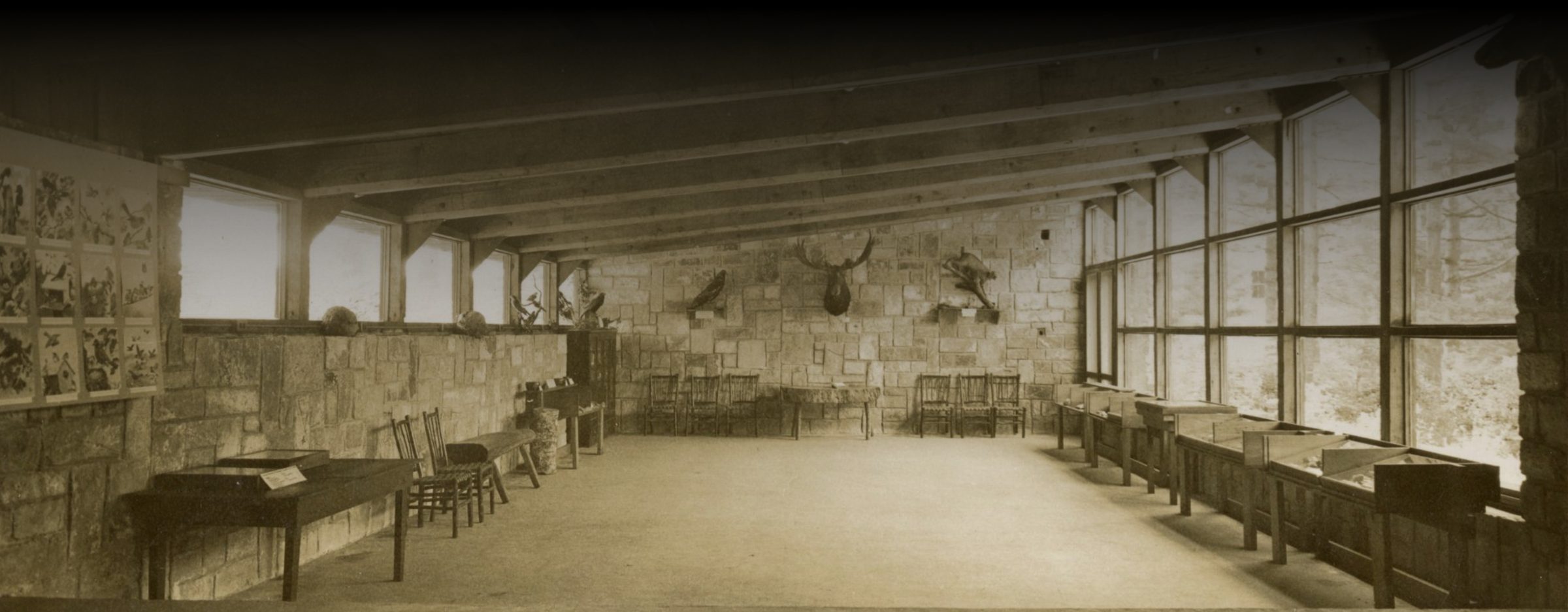
Notes from the Archives · Highlands Nature Center · February 2025
Laura M. Braggand the Highlands Museum
Begin reading“The principle of museum work is progressive installation. A finished museum is a dead museum.”
Laura Mary Bragg
Laura Mary Bragg (1881-1978), a Massachusetts descendant of New England patriots, lived most of her adult life in Charleston, S.C. How she came to The Highlands Museum of Natural History is told in the biography below.
At about age six, Bragg contracted scarlet fever leaving her with progressive hearing loss, so she learned to lip read and developed an exceptional memory. She was educated at home by her professor father, Rev. Lyman Bragg until high school. Thereafter she earned a library science degree from Simmons College in 1906, the college’s first graduating class. She later studied biology in a museum practicum at the Boston Society of Natural History.
Arriving in Charleston in September of 1909, Bragg ushered in a brave new era of the suffragettes. She was hired to be the librarian at the Charleston Free Library, now the Charleston County Library, and in 1920 Bragg made national news by becoming the first female museum director to lead a publicly funded natural history and art museum in the country at the new Charleston Museum, a development of the Charleston library.
The Bragg Boxes
Bragg was devoted to the idea of public education with imaginative and engaging exhibits as well as innovative programming. She transformed The Charleston Museum from a repository for the academic elite into a public institution. The most famous aspect of Bragg’s educational program was traveling exhibits, known as “Bragg Boxes,” which were crated and sent to both black and white schools in South Carolina. The wooden boxes with hinged panels were like miniature stage sets on history and nature. Over time she created over five dozen boxes which were later copied by other natural history museums. With these boxes, Bragg changed the nation’s approach to museum education.
Open the box
Imagine one arriving at a schoolhouse in a crate. Open the panels to see the little stage set inside.
An illustration of the idea, not a copy of one of her boxes.
60+Over five dozen boxes, later copied by other natural history museums
Bragg was not in Charleston for most summers, but visiting family and museums in New England. And for several summers, Bragg roamed the coastal region of South Carolina noting flora and fauna and publishing a “Preliminary List of the Ferns of the Coast Region of South Carolina North of Charleston” in 1914. She adapted her science curriculum to local plants exploring the diversity of the region.
Preliminary List of the Ferns of the Coast Region of South Carolina North of Charleston
Laura M. Bragg
Beyond Charleston
In 1931 Bragg left Charleston to become the director of the Berkshire Museum in Pittsfield, Massachusetts, the art collection of the Zenas Marshall Crane family. She developed the museum into an educational institution with a sculpture gallery and theater. Ground-breaking exhibitions on modern art included one of the first on Alexander Calder’s sculpture shows, and Shaker furniture, both little known to the public. Bragg retired from the Berkshire Museum in 1939 returning to Charleston continuing her work as an educator.
Other duties outside of Charleston included advising on the reorganization of the Valentine Museum in Richmond, Virginia from 1924 to 1928. Most importantly she played an active role in the American Association of Museums (AAM) and helped organize the Southern Museums Conference providing better training to museum employees and particularly women. The Southern Conference of the AAM met in Charleston in 1923 and Bragg became a board member in 1924. There were subsequent meetings as well, one in April of 1931.
A life in five institutions
- 1909Charleston Free LibraryCharleston, S.C.Librarian
- 1920 – 1931The Charleston MuseumCharleston, S.C.Director
- 1924 – 1928Valentine MuseumRichmond, VirginiaAdvised on its reorganization
- 1931 – 1939Berkshire MuseumPittsfield, MassachusettsDirector
- 1928 · 1941Highlands MuseumHighlands, N.C.Advisory Committee, then summer director
One document in the E. E. Reinke Archives at the Highlands Biological Station is an interesting request, possibly to the AAM for funds for Bragg to visit other museums in the South, most likely as a consultant but probably not funded.
By establishing a professional network, Bragg hoped larger museums would write more didactic labels, initiate docent programs and lectures, and work with children in connection with their exhibits. Bragg’s self-trained skills in museum work, science, and modern art prepared her for the final phase of her life – educating the elite of Charleston.
One specimen, two labels
A catalog label tells a specialist what the object is. A didactic label teaches everyone else. Switch between them for the raven that stood beside Miss Bragg in 1941.
Example labels written for this page.
The largest member of the crow family. In the Southern Appalachians, ravens nest on high cliffs and rock faces. Listen for a deep, hollow croak, very different from the caw of the American crow.
Help for Highlands
It was undoubtedly because of her work with AAM, that Clark Foreman, a founder of the Highlands Museum and a member of AAM, located Bragg and requested her help with establishing the Highlands Museum. Early histories of the Highlands Museum note that:
“in order to get the best possible advice and direction, we asked Miss Laura Bragg to send us her trained (sic) assistants for summer directors. . . . our Museum was launched according to the most approved methods.
. . . A Biological Survey of the region with card indexes was started. A policy of changing exhibits was adopted and … classes on botany and natural science were given for children. . . . Miss Bragg showed a very real and generous interest in the Highlands project.”
Correspondence between Bragg and Clark Foreman began as early as 1928 with Miss Bragg being appointed to the Highlands Museum Advisory Committee at the August 12th Trustees meeting. Continuing in 1934 with Foreman asking Bragg for advice on museum procedures, the August 25 Minute Book records: “Under Miss Bragg’s direction made filing cards for recording acquisitions.” At that time the Museum was in a one room addition to the Highlands Public Library.
The first summer directors at the Highlands Museum were Edward McCrady, Jr. and Helen McCormack both sent by Bragg from the Charleston Museum working one month each for free. From 1929 to 1935, E. E. Reinke was summer director, then H. E. (Harry Edgar) Wheeler was hired remaining in that position through 1939. There was no director in 1940 (the salary funds were used for the new building) and Clark Foreman, a founder of the Highlands Museum, asked Bragg to take the summer position in 1941 to direct the summer session and open the new museum building – the Clark Foreman Museum. A published biography and Wikipedia citation on Bragg does not list this relationship or correspondence with Foreman nor her engagement with the Highlands Museum, this historically significant information is first time published here.
- First summersEdward McCrady, Jr. & Helen McCormackSent by Bragg, one month each
- 1929 – 1935E. E. ReinkeSummer director
- to 1939H. E. WheelerSummer director
- 1940No directorSalary went to the new building
- 1941Laura M. BraggOpens the new museum
A Research Station
As an Advisory Board member to the Highlands Museum, Bragg along with Edward Burnham Chamberlain (1895-1986), curator at The Charleston Museum, attended the June 20 – 22, 1930 important meeting in Highlands establishing a biological research station as a part of the museum. Bragg even wrote a letter of support for the museum’s first publication, Report on the Necessity of a Mountain Biological Research Station in the South, by E. E. Reinke. Bragg’s letter of Jan. 2, 1930 to Clark Foreman is on page 12 of the original published report along with 5 other letters from prominent scientists throughout the east. “A Highlands research laboratory would . . . inaugurate a new era in scientific study in the south. I earnestly hope your plan may be realized.”
“A Highlands research laboratory would . . . inaugurate a new era in scientific study in the south. I earnestly hope your plan may be realized.”
Laura M. BraggTen Suggestions
Then on November 23, 1937, Foreman writes to Bragg concerning the Highlands Museum need to vacate the room at the growing library and build its own building. Foreman asks Bragg to comment on ideas by Director Wheeler, the architects, and Foreman, himself, sending her preliminary drawings. Clearly her duties at The Berkshire Museum (1931–1939) were keeping her exceedingly busy delaying her response until May 12, 1938. Her extensive letter with ten major suggestions were then circulated to the architects and at her suggestion, sent to Robert Whitelaw, Director of the Gibbes Art Gallery in Charleston.
170days between the letters
Bragg’s ten suggestions included:
design – “general design is charming and well suited to Highlands.”
theft – a discussion of exit and entrances.
a covered entrance, children’s entrance and stage problems.
problems with proposed cases and their arrangement – “Architects case plans and arrangements . . . are pretty awful.”
a need for a place where 1 staff member can see everywhere – economy of staff.
a need for a kitchenette on the main floor.
a need for a cleaning closet with running water.
“the executive office is good but not enough record storage.”
a need for a carpenter shop/receiving room.
“the exterior topographical garden plan is delightful but large.”
Bragg’s extensive comments reflect even today’s museum needs, further revealing her prowess and understanding of museums. A final note in Bragg’s letter mentions Foreman’s wife, Mairi, indicating a close connection with Foreman and his family.
Summer 1941
For the summer of 1941 with the June 20th opening of The Clark Foreman Museum, Bragg spent July and August in Highlands as director. She was paid $100 per month and $10 for moving. The Minutes of the Board of 1941 include her accounting for the Petty Cash, Receipts for Memberships and the Donation Box and Disbursements. Unfortunately her report for her two months work is not included per usual in the minutes as reflected that she did not attend the Board Meeting.
| July | $100.00 |
|---|---|
| August | $100.00 |
| Moving | $10.00 |
| Total | $210.00 |
- Petty Cash
- Receipts for Memberships
- Donation Box
- Disbursements
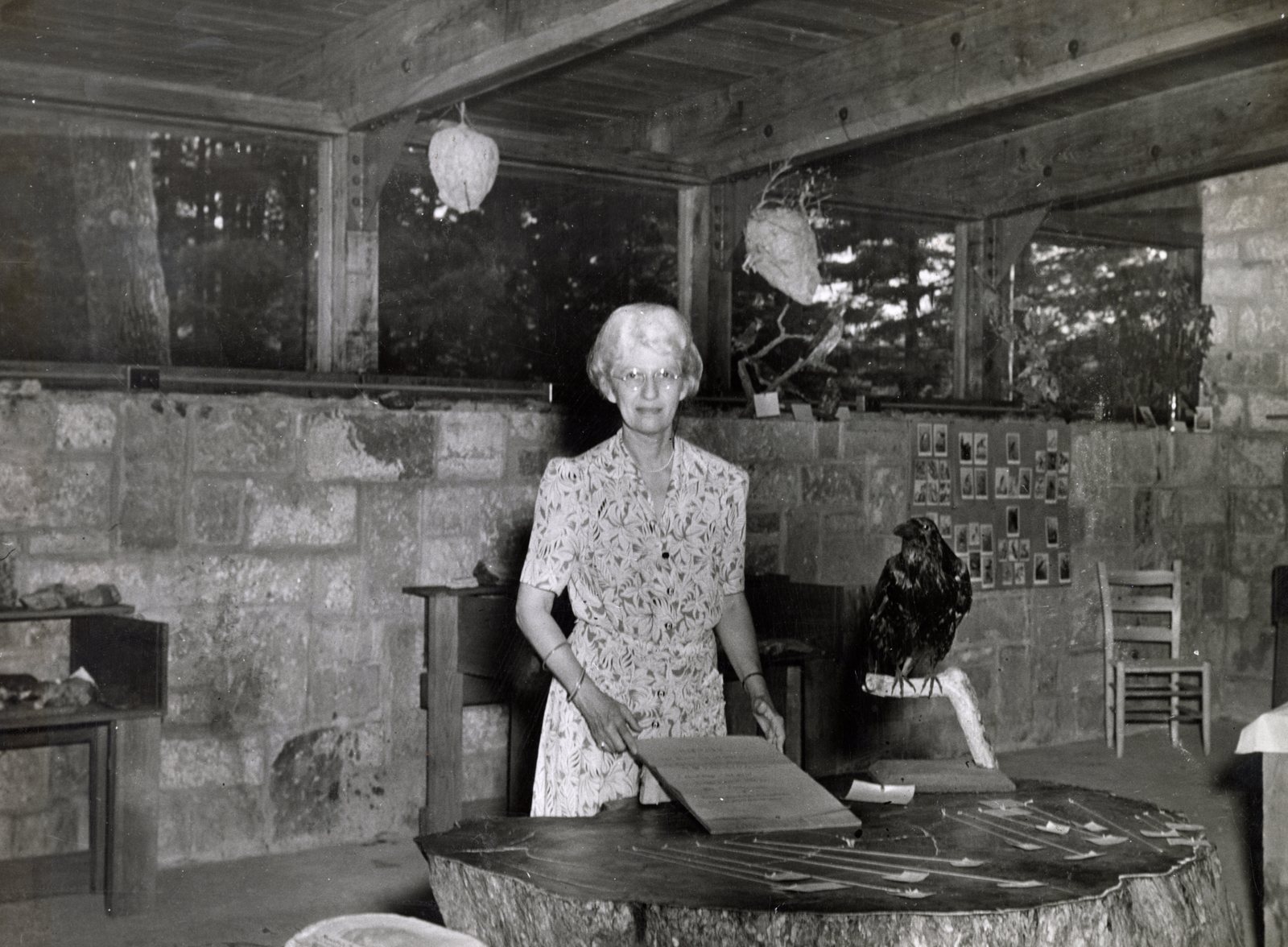
An August 19, 1941 photograph of Bragg in the Highlands Museum held in the Reinke Library Archives at HBS has a credit line of “Interior of WPA-built Highlands Museum. Miss Laura M. Bragg, Director of the museum, is shown behind a section of the 425 year old Hemlock tree and a specimen of the northern Raven (a gift of Clark Foreman)”.
August 19, 1941
Drag to move around. Pinch, double-click or use the + button to zoom. On a computer, hold Ctrl (⌘ on a Mac) and scroll.
Choose a detail above, or explore on your own.
Use the arrow keys to move around, plus and minus to zoom, and 0 to see the whole photograph.
NCWPA
Date Taken – 8-19-41
Credit Line – WPA
Subject: WPA-built native stone museum at Highlands, Macon County.
Interior view of WPA-built Highlands Museum. Miss Laura M. Bragg, Director of the museum, is shown behind a section of the 425 year old Hemlock tree and a specimen of the northern Raven.
The story of the hemlock sliceThe Asheville Citizen-Times reported on June 15, 1941,
The Asheville Citizen-Times · June 15, 1941“Miss Bragg is organizing a camera club . . . and for the opening day Miss Bragg will have a large exhibit of flowers common and rare. . . . She was a member of the original advisory committee for organizing the Highlands museum. Her home for the summer will be at the Foreman residence.”
The Charleston Renaissance
After her museum career, Bragg, having developed friendships with Charleston elites such as DuBose Heyward, Hervey Allen, Alice Huger Smith, Josephine Pinckney and John Bennett, helped to found the Poetry Society of South Carolina. This then launched the Charleston Renaissance, paving the way for the city to become the art and tourist mecca it is today. She supported herself by teaching classes to women and holding “Sunday salons” for men. She was a cultural prima donna from whom students were eager to learn.
Bragg DuBose Heyward Hervey Allen Alice Huger Smith Josephine Pinckney John Bennett
Despite all of these life-long accomplishments, Bragg was only recently credited with changing the cultural face of Charleston and the nation’s approach to museum education. Bragg remained virtually unrecognized by historians until 2001 when Louise Anderson Allen published the book, A Bluestocking in Charleston: The Life and Career of Laura Bragg which initiated subsequent articles on her museum contributions and life. Then in 2022 The Charleston Museum held an exhibit on Bragg and also named the Board Room in her honor.
- 1978Laura Bragg dies
- 2001A Bluestocking in Charleston, by Louise Anderson Allen
- 2022An exhibit at The Charleston Museum, and the Board Room named in her honor
Her papers are largely archived at the South Carolina Historical Society and The Citadel Archives and Museum in Charleston.
A life in museums
- 1881Laura Mary Bragg is born.
- 1906She earns a library science degree from Simmons College, in its first graduating class.
- 1909SeptemberShe arrives in Charleston as librarian of the Charleston Free Library.
- 1914She publishes her “Preliminary List of the Ferns of the Coast Region of South Carolina North of Charleston.”
- 1920She becomes director of The Charleston Museum, and makes national news.
- 1924She begins advising the Valentine Museum in Richmond, through 1928.
- 1928August 12She is appointed to the Highlands Museum Advisory Committee.
- 1930January 2 · June 20 – 22Her letter supports the case for a research station, and she attends the meeting in Highlands that establishes one.
- 1931She becomes director of the Berkshire Museum in Pittsfield, Massachusetts.
- 1938May 12She answers Foreman with ten suggestions for the new museum building.
- 1939She retires from the Berkshire Museum and returns to Charleston.
- 1941July – AugustShe directs the Highlands Museum in its new building.
- 1978Laura Bragg dies.
- 2001Louise Anderson Allen publishes A Bluestocking in Charleston.
- 2022The Charleston Museum holds an exhibit on Bragg and names its Board Room in her honor.
“A finished museum is a dead museum.”
Documents for this story are housed in the E. E. Reinke Archives of the Highlands Biological Station Library.
Bryding Adams, Volunteer Archivist, February 2025