
Notes from the Archives · Highlands Nature Center · January 2025
Clark Howell Foremanand the building of the Highlands Museum
Begin reading“…remembering his father’s often quoted remark of Ben Franklin to the effect that you could accomplish a lot more if you didn’t worry about the credit…”
The Clark Foreman Museum
As you walk into the front door of the Highlands Biological Station’s (HBS) Nature Center, on the right you will see a plaque stating the “Clark Foreman Museum”.
Today, few know who Clark Foreman was or his tremendous contribution in establishing “the museum” or the Highlands Biological Station.
Museum
Who Was Clark Foreman?
Clark Howell Foreman was born in 1902 and died in 1977. He was the son of Robert Langdon (R. L.) Foreman (1867-1940) and Effie Park Howell (1870-1943). The Howells were a prominent Atlanta family who had a lengthy involvement with the HBS. Clark’s namesake, his great uncle, was Clark Howell Sr. (1863-1936), owner and editorial executive of the Atlanta Constitution for 53 years.
- Robert Langdon Foreman1867 – 1940 · his father
- Effie Park Howell1870 – 1943 · his mother
- Clark Howell Sr.1863 – 1936 · his namesakeMarried Margaret Cannon Howell, whose story is told here →
- Linton H. YoungAtlanta architect · his cousinWorked on the new museum →
A Museum in a Library Room
On July 4, 1927, the Highlands Museum opened in a one room addition to the Highlands Library. “The Highlands Museum was started for the purpose of preserving and increasing some of the private collections made by first citizens in the region.” Open daily during July and August, the collections included the Cleaveland Cherokee artifacts, the Wheeler Herbarium and the J. Jay and Mary Chapin Smith Collection of minerals from North Carolina as well as a limited series of birds, insects, native woods and pioneer implements and crafts of North Carolina. The Museum was supposed to be housed in the Library for 5 years, at which time the room would be given to the Library. But it was not until 1938 that a new building for the museum was proposed on East Main Street where it is located today.
What visitors saw in 1927
Open a case to see what it held. The museum was open daily during July and August.
Case 1Cleaveland Cherokee artifacts
The Cleaveland collection of Cherokee artifacts, one of the private collections “made by first citizens in the region” that the museum was started to preserve.
Case 2The Wheeler Herbarium
A herbarium: a collection of pressed and preserved plant specimens.
Case 3Minerals of North Carolina
The J. Jay and Mary Chapin Smith Collection of minerals from North Carolina.
Case 4Birds, insects and native woods
A limited series of birds, insects and native woods.
Case 5Pioneer implements and crafts
Pioneer implements and crafts of North Carolina.
Founders and First Letters
The Highlands Museum of Natural History was incorporated on July 21, 1930. Twenty-five founders include names we still hear today: Ravenel, Harbison, Foreman, and Kelsey to mention a few. Clark Foreman was President.
Twenty-five founders, incorporated July 21, 1930. The four named above are highlighted.
Clark Foreman’s correspondence concerning the museum goes back to at least July of 1928 when he was visiting museums in North Carolina and the American Association of Museums in Washington, D. C. which he joined “in order to get help in forming the Highlands Museum.” He also was seeing the Curator of Biology at the Smithsonian, then the National Museum.
The Hemlock Slice
Still in the Nature Center today, Mr. Foreman writes about the Hemlock slice.
“Mr. Holmes in Raleigh told me the best way to get a tree to dry out without cracking was to cover both cut sides with wax and thus force the tree to dry through the bark. This takes a long time but he says it is worth doing. Tell this to Mr. W. M. Cleaveland so that he can do it for us when he cuts down the hemlock stump.”
The Hemlock stump/slice has between 425 and 439 rings, was from a tree on the Highlands Estate, now the Highlands Country Club given by Scott Hudson and was officially accepted at a Museum Board Meeting on July 8, 1929. Many years later Robert (Bob) Zahner counted the rings again and marked the historical events on the slice we see today.
Four centuries in one slice
Slide inward from the bark toward the heart of the tree. Each ring is roughly one year of growth.
Years are approximate, counted back from 1929, when the Museum Board accepted the slice. With 425 to 439 rings, the tree began growing around 1490 to 1505. The years Bob Zahner marked can be seen on the slice itself at the Nature Center.
Building the Museum
In order to build the museum, the land on which the proposed new museum would stand was deeded to the Town of Highlands. The architects were Arthur Kelsey and Alfred Kastner of Kastner and Bella in Washington, D. C. They worked with Atlanta architect, Linton H. Young, a cousin of Clark Foreman. The Town applied to the Works Progress Administration (WPA) for a grant to help with the construction of the new museum which funded – $13,509 for labor and equipment of the $20,940 building. The Museum was constructed from chestnut trees from the National Forest and stone from the town quarry across from Wilson Gas today.
Mr. Cleaveland of Highlands built the Museum which was completed in 1941 and also built the Samuel T. Weyman Laboratory Building completed in August of 1931.
A site plan for the new museum
Drag to move around. Pinch, double-click or use the + button to zoom. On a computer, hold Ctrl (⌘ on a Mac) and scroll.
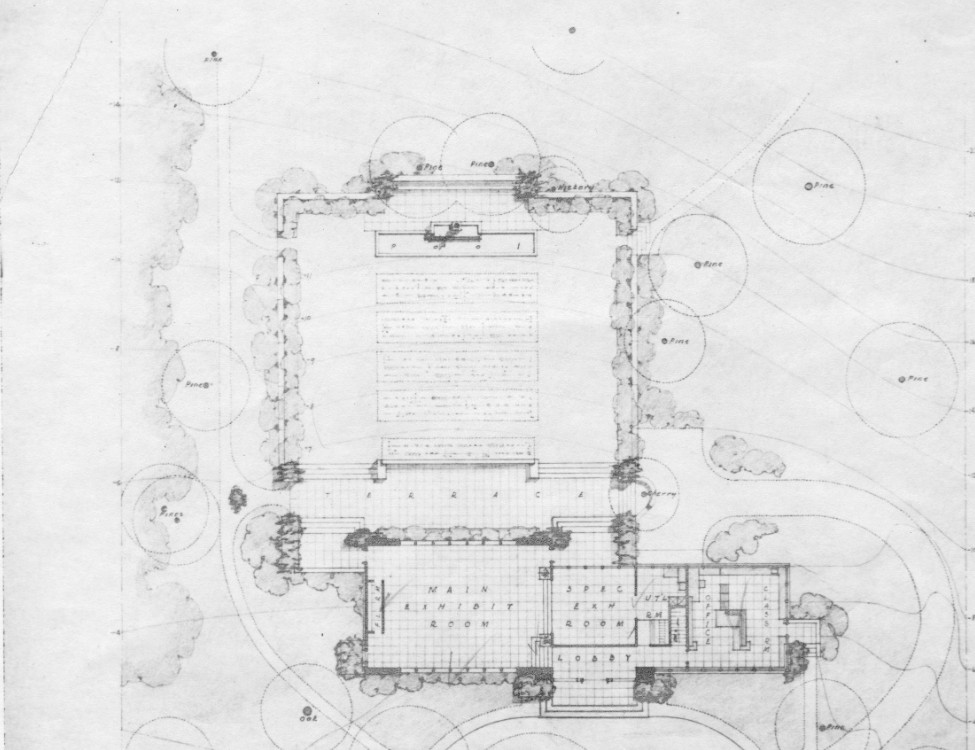
Use the arrow keys to move around, plus and minus to zoom, and 0 to see the whole plan.
Site plan for the Highlands Museum, showing the main exhibit room, special exhibit room, lobby, office and classroom, with a terrace and walled garden. E. E. Reinke Archives, Highlands Biological Station Library.
The saga of building the Museum is revealed in Clark Foreman’s 182 letters between 1934 and 1941, revealing Foreman’s frustration with the WPA. Another story to be told.
182letters, 1934 – 1941
Yet through Mr. Foreman’s perseverance, the Highlands Museum opened June 20, 1941. The Visitor’s Register for that day still resides in HBS Library Archives.
From one room to a museum
- 1902Clark Howell Foreman is born.
- 1927July 4The Highlands Museum opens in a one room addition to the Highlands Library.
- 1928JulyForeman visits museums in North Carolina and joins the American Association of Museums “in order to get help in forming the Highlands Museum.”
- 1929July 8The Museum Board officially accepts the hemlock slice.
- 1930July 21The Highlands Museum of Natural History is incorporated, with twenty-five founders. Clark Foreman is President.
- 1931AugustThe Samuel T. Weyman Laboratory Building, built by Mr. Cleaveland, is completed.
- 1934Foreman’s 182 letters about building the Museum begin, running to 1941.
- 1938A new building for the museum is proposed on East Main Street.
- 1941June 20The Highlands Museum opens. The Visitor’s Register for that day is still in the archives.
- 1977Clark Howell Foreman dies.
In His Own Words
Clark Foreman’s autobiography, “My Autobiography,” is written in the third person. Turn the pages below, or jump to the passages that touch this story.
Clark Howell Foreman, My Autobiography
Read the text of this page
Machine-read from the typescript. It may contain small errors; the page image is the original.Remembering Clark Foreman
With many thanks to Clark Foreman, we remember the building of the Highlands Museum.
Documents for this story are housed in the E. E. Reinke Archives of the Highlands Biological Station Library.
Bryding Adams, Volunteer Archivist, January 2025