
Grant-in-Aid Spotlight · Highlands Biological Station
After Dark, Following Salamanders Up the Mountain
As night settles over Nantahala National Forest, two researchers from Highlands Biological Station climb into the dark to follow a small, secretive mountain salamander — and to learn how a warming climate may reshape the most salamander-rich landscape on Earth.
Nantahala National Forest, North Carolina
By the time the sun slips behind the mountains, David Adams and Evie Bradley are getting ready for work.
Headlamps, checked. Sampling gear, gathered. Then the two researchers drive into Nantahala National Forest, where three study plots — one low on the slope, one in the middle, one high on the mountain — are waiting in the dark.
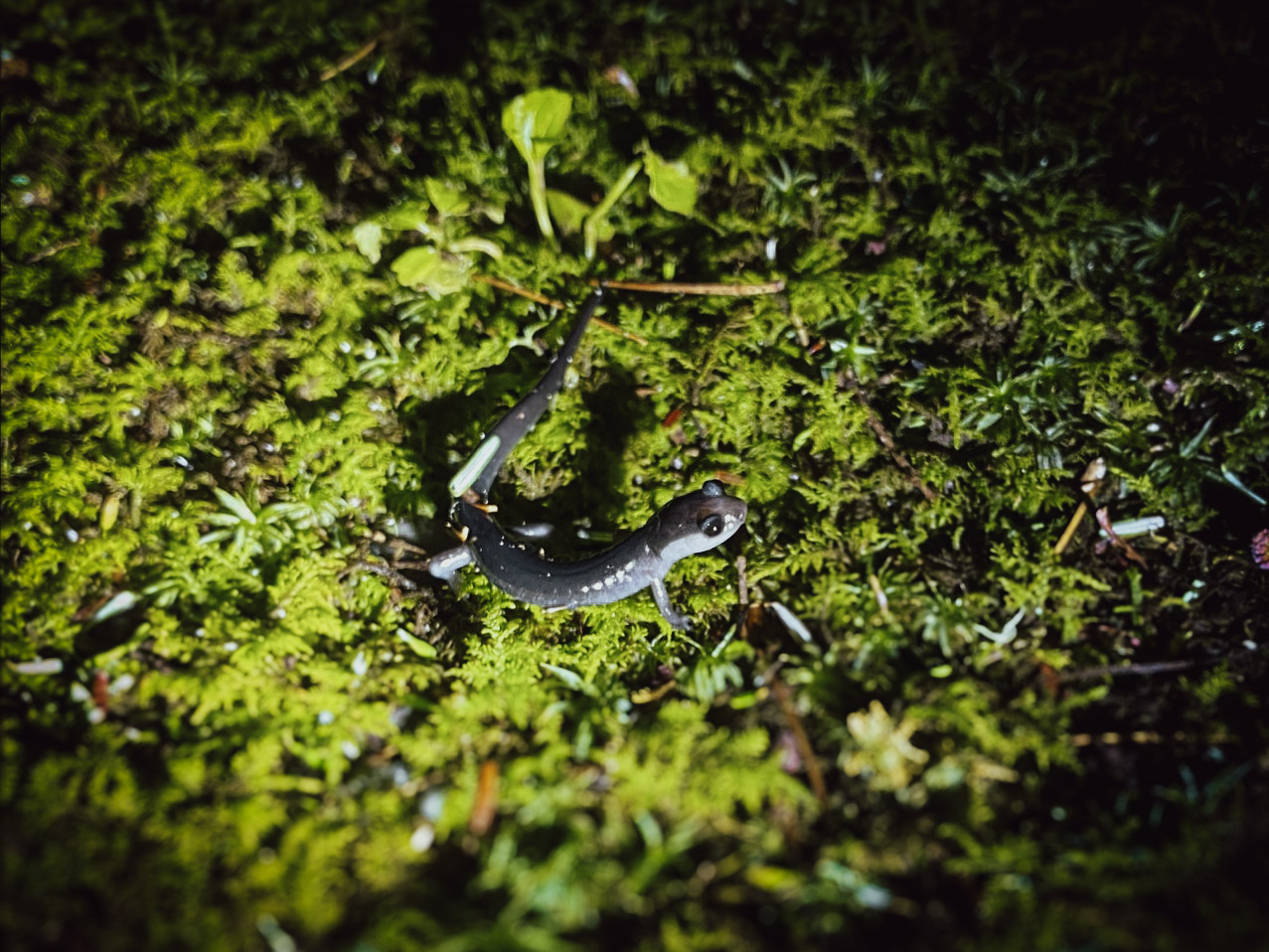
Their quarry, the Southern Gray-Cheeked Salamander, comes out after sunset. Moving slowly through the plots, side by side, Adams and Bradley sweep their headlamps across the forest floor, over moss-furred rock, and into the narrow crevices where the small, secretive animals slip out into the damp night air.
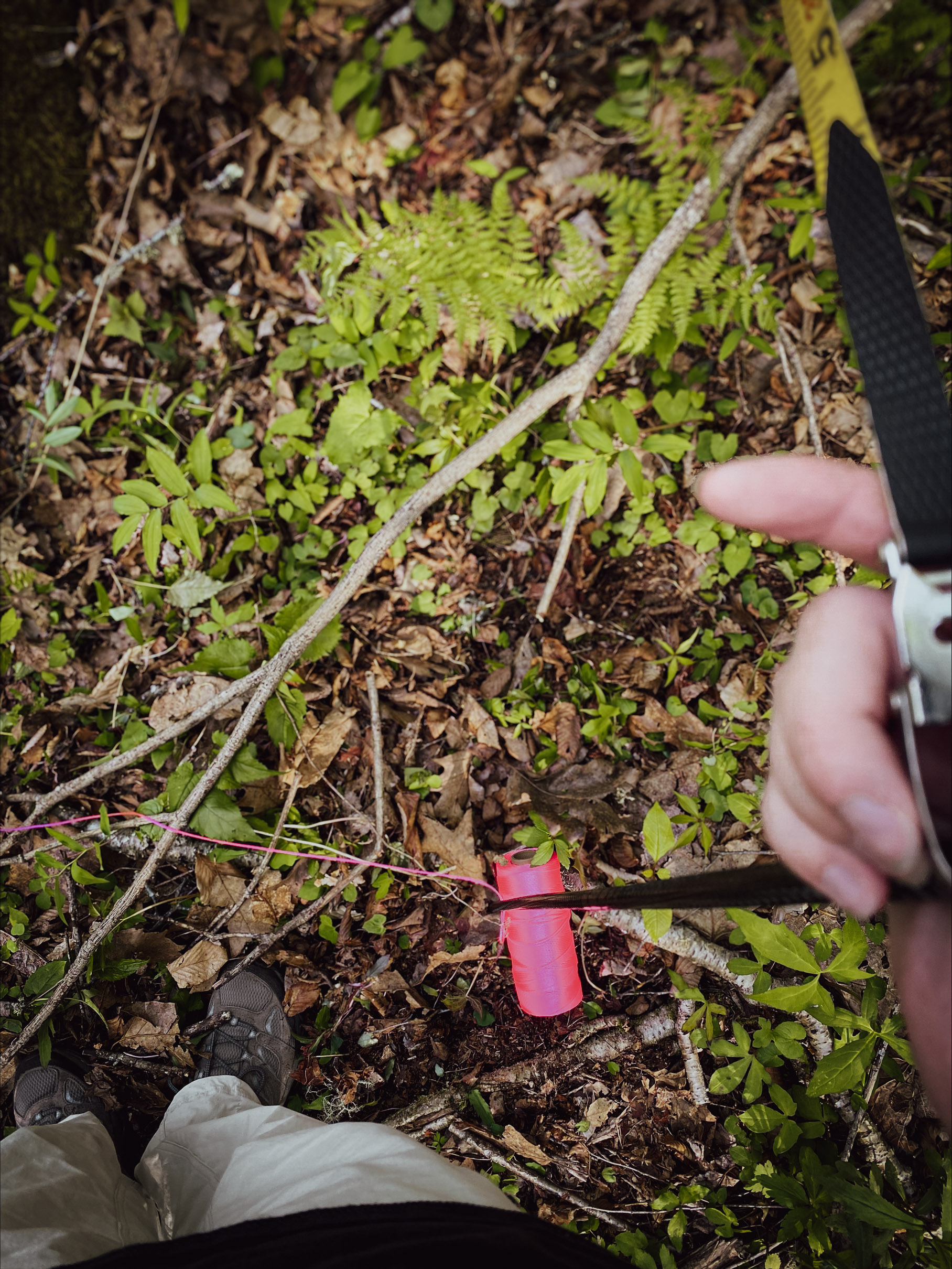
Each salamander they find on the surface is caught, and the spot is marked. Back in the lab at Highlands Biological Station, every animal is given a unique identifier and then carried to the exact place it was found. By recording where each one turns up — and noting which ones reappear in later surveys — the researchers can begin to follow the lives of creatures that would otherwise stay almost completely hidden.
It is the beginning of a mark-recapture study built around one pressing question: how a warming climate is changing the way these salamanders live.
This is how the nights tend to begin for Adams and Bradley — after sunset, deep in the forest, watching for movement at the edge of a headlamp's beam.
Some nights, the work starts with clearing the trail — long before the first headlamp.
One evening, the route to a plot was blocked by a fallen tree, and before the night's real work could begin, David had to clear the way through. It is the kind of task that never appears in a research plan, and a fair emblem of the whole enterprise: a single night of sampling can generate hours of preparation, animal care, measurement, and record-keeping — and now and then it begins with reopening the trail itself.
For Bradley, the downed tree ranked among the summer's more unexpected chores — right alongside the remarkable amount of bear scat the team met along the trail.
The team
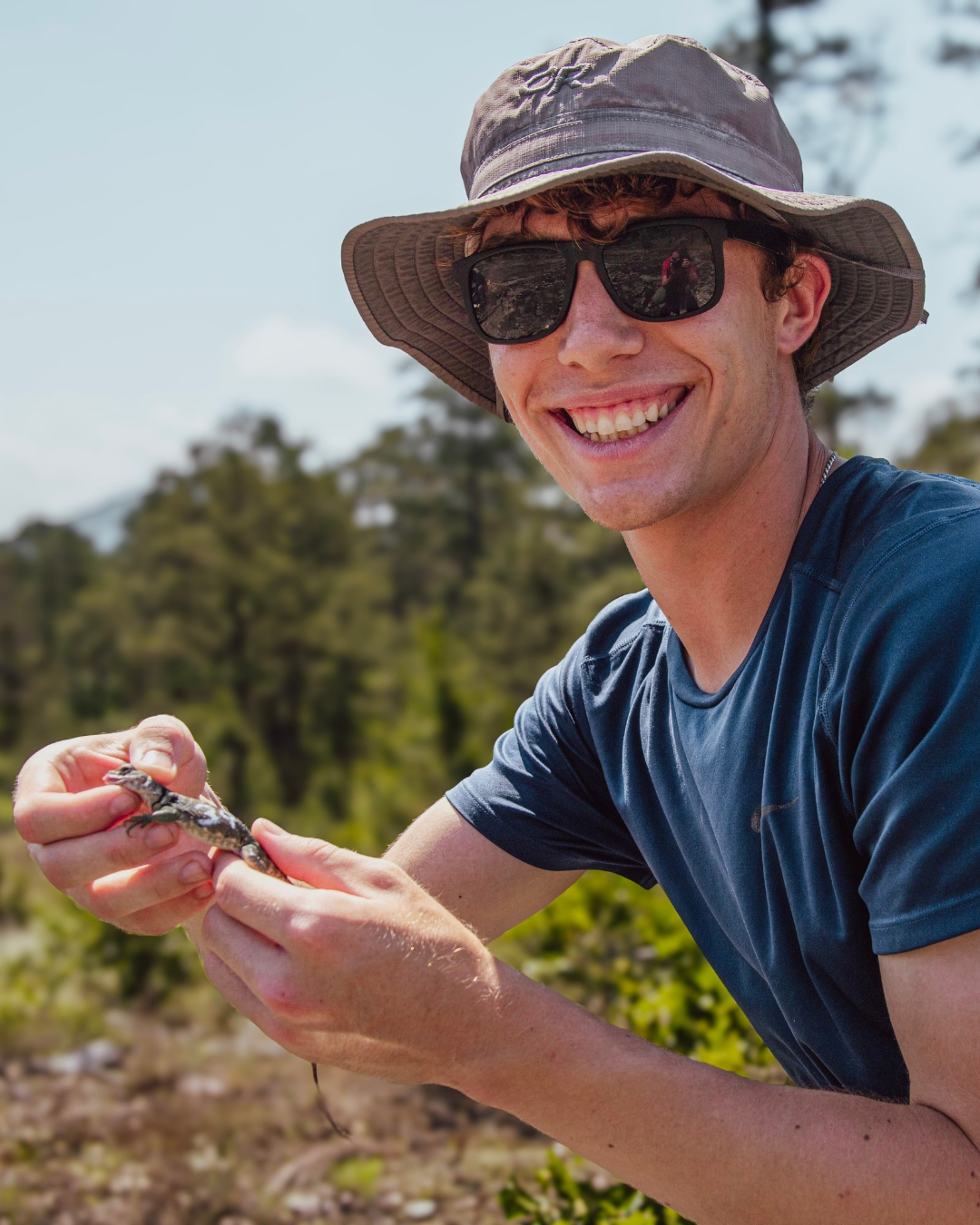
The study is new, and so, in a way, is the partnership behind it. David Adams is a doctoral student at the University of North Carolina at Chapel Hill, where he works in Dr. Eric Riddell's Ecophysiology Lab. He came to UNC after an undergraduate degree at the University of Central Arkansas, studying the ecophysiology of lizards with Dr. Matthew Gifford — but his path into the field started long before that.
Both of his parents are fish ecologists, and he grew up in and around streams, absorbing not just the life of moving water but the idea that careful research can serve conservation. “Since then, I have always wanted to conduct my own research,” Adams said. Over high school and college, a broad curiosity narrowed into a specific fascination with herpetology and ecophysiology — the study of how an animal's inner workings are shaped by the conditions around it.
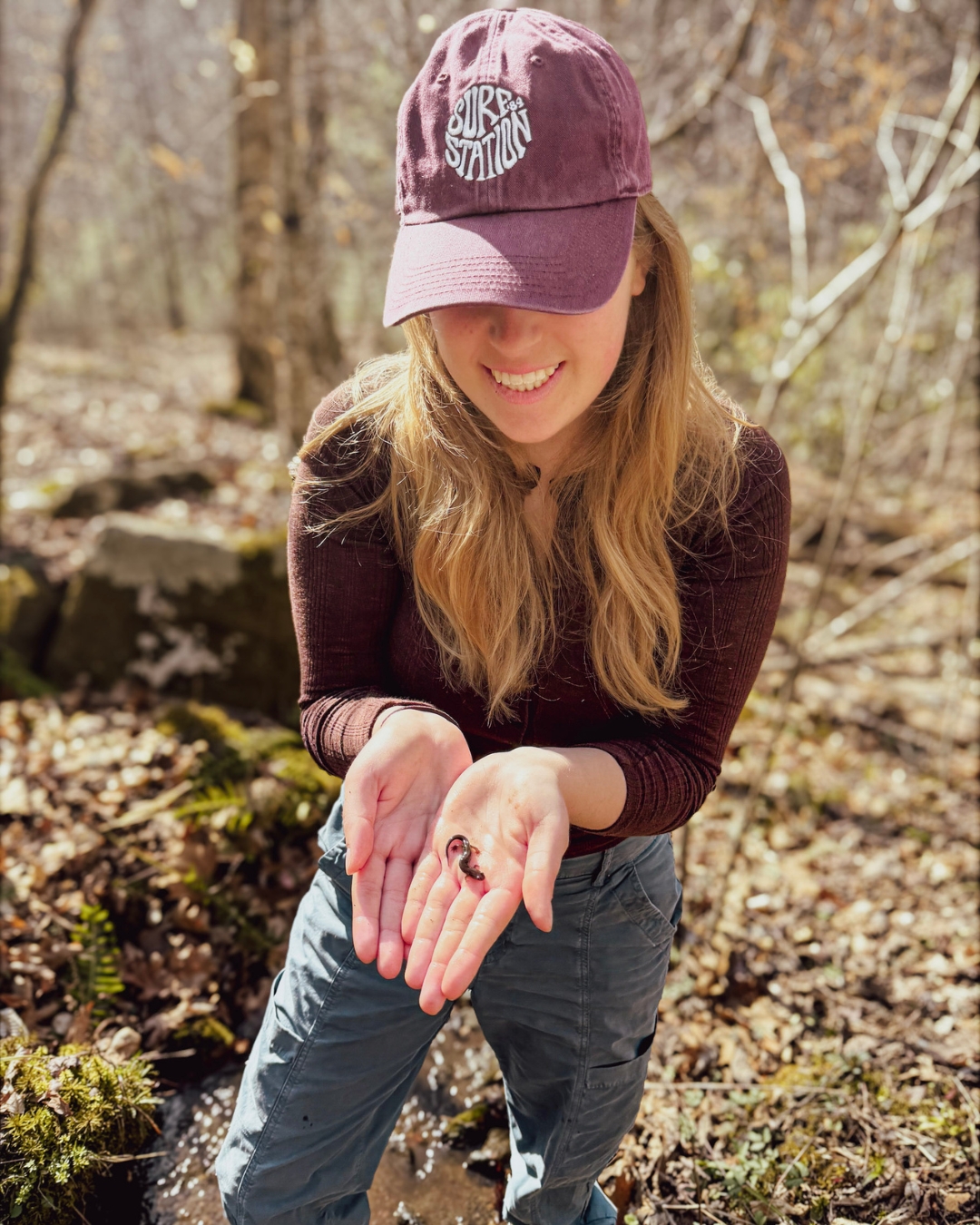
Evie Bradley arrived by a different road. A rising sophomore at UNC-Chapel Hill majoring in biology, she started as an undergraduate research assistant last September, learning image analysis, three-dimensional modeling, and animal care. But she wanted to see what happened before any of it reached the lab bench. “I wanted to learn more about collecting data in the field and get exposure to different species,” she said.
Already working with another doctoral student in Riddell's lab, she heard that Adams needed help with a summer mark-recapture project and reached out. She had handled aquatic salamanders before, but the terrestrial species of the Southern Appalachians were new to her. “I've always enjoyed catching salamanders,” she said. “Getting to see and work with terrestrial salamanders has been really exciting.”
That enthusiasm comes in handy on nights when the forest seems to move with them. During the team's first sampling period the woods were unusually dry, and few salamanders appeared. Rain arrived later in the week, and Bradley expected the next survey to be better. She was not ready for how much better. “There were moments where I would see three salamanders at a time and have to keep an eye on them while catching others,” she said.
For Adams, every one of those encounters is a small piece of a much larger question: how a salamander's physiology and behavior shape its odds of surviving, and what that means for whole populations as the climate warms.
The mountains around Highlands give him an unusually clean way to study it. As the team climbs from the lowest plot to the highest, temperature and humidity shift with the elevation — so by comparing salamanders living low, middle, and high on the slope, Adams can watch populations meet very different conditions without ever leaving the species' home range.
For a subset of the animals, the team measures behavior — traits like boldness and activity — alongside physiology, including how much energy a salamander spends and how much water it loses. Moisture matters enormously to a woodland salamander. With no fur, feathers, or scales to seal it in, a salamander trades water and gases directly through its skin, which means a shift in temperature or humidity can change when it dares to come out, how hard its body has to work, and whether the habitat around it still holds what it needs.
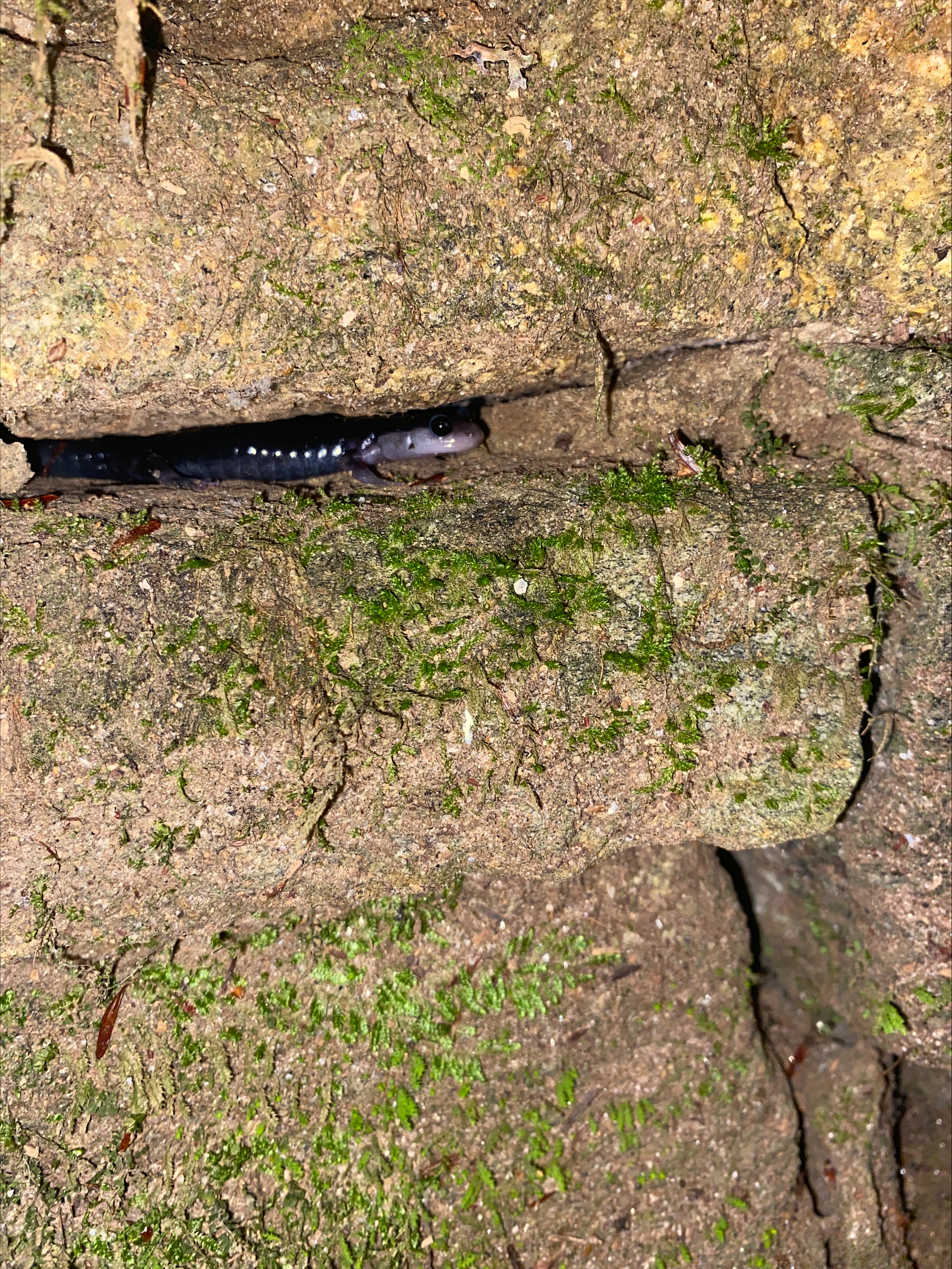
Why it matters
These mountains hold more kinds of salamander than anywhere else on Earth — which is exactly what makes a warming climate so urgent a problem here.
Understanding the resilience of salamander populations to climate change can help biodiversity managers prioritize species and populations that may be most at risk.David Adams · Riddell Ecophysiology Lab, UNC-Chapel Hill
That last fact is what gives the project its edge. The Southern Appalachians are the global center of salamander diversity, and the same skin that lets these animals breathe also leaves them exposed to the very things a changing climate is shifting: heat, drought, and the daily margins of moisture they depend on.
By following marked individuals up and down the gradient — watching which ones reappear, which ones move, which ones endure — Adams hopes to sharpen our ability to predict how populations will respond, and to help the people who manage these forests decide where to focus first.
The work doesn't end when the salamanders go back under the leaf litter. In the afternoon, Bradley readies Petri dishes and the incubator for the night's behavioral trials and checks on each salamander housed briefly at the Station, making sure every enclosure stays clean and damp. Adams takes the physiological measurements early in the morning; Bradley runs the behavioral observations after dark. Their hours overlap in the field, then hand off — one picking up where the other sets down. “Working together allows us to collect data that neither of us could collect alone,” Adams said.
None of it would be possible without the Station itself. Highlands Biological Station gives the researchers lab and office space, incubators, environmental chambers, and equipment they'd otherwise go without, down to an ultra-low-temperature freezer; its staff have tracked down supplies, untangled logistics, and, now and then, lent an extra pair of hands in the field. “Everyone has been very supportive and helpful whenever we need extra equipment,” Adams said, with particular thanks to Angie.
Now the team is waiting — to see how many of the marked salamanders turn up again. That moment of recapture is what turns an encounter into a history: an animal found a second time may show that it survived, grew, moved, or bred. Gathered across elevations and over the seasons, those small histories begin to reveal how an entire population is answering the world around it.
And each evening, the work begins again — gear packed, headlamps switched on, two scientists stepping into the forest just as the rest of the mountain settles into the dark.
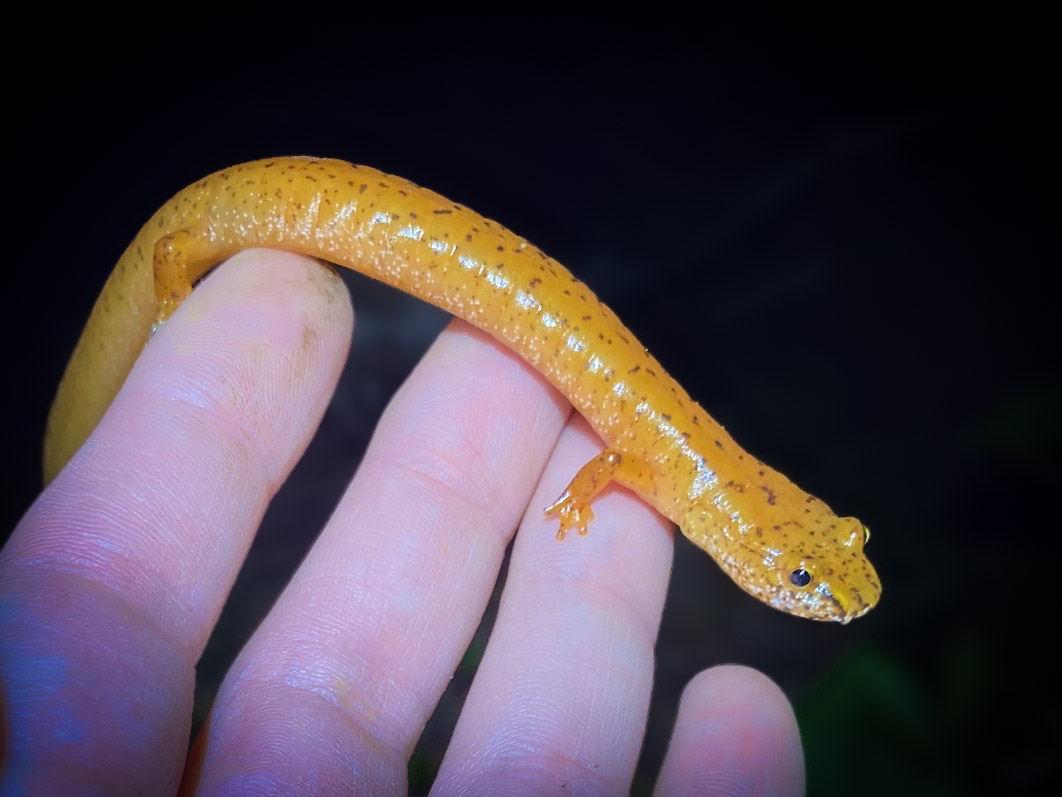
Grants-in-Aid of Research
Field science like this starts with a grant.
David Adams's salamander study is supported by the Station's Grant-in-Aid of Research program, which helps visiting scientists turn a question into a field season. Explore the program — or help support the researchers who come next.
Explore Grants-in-Aid