
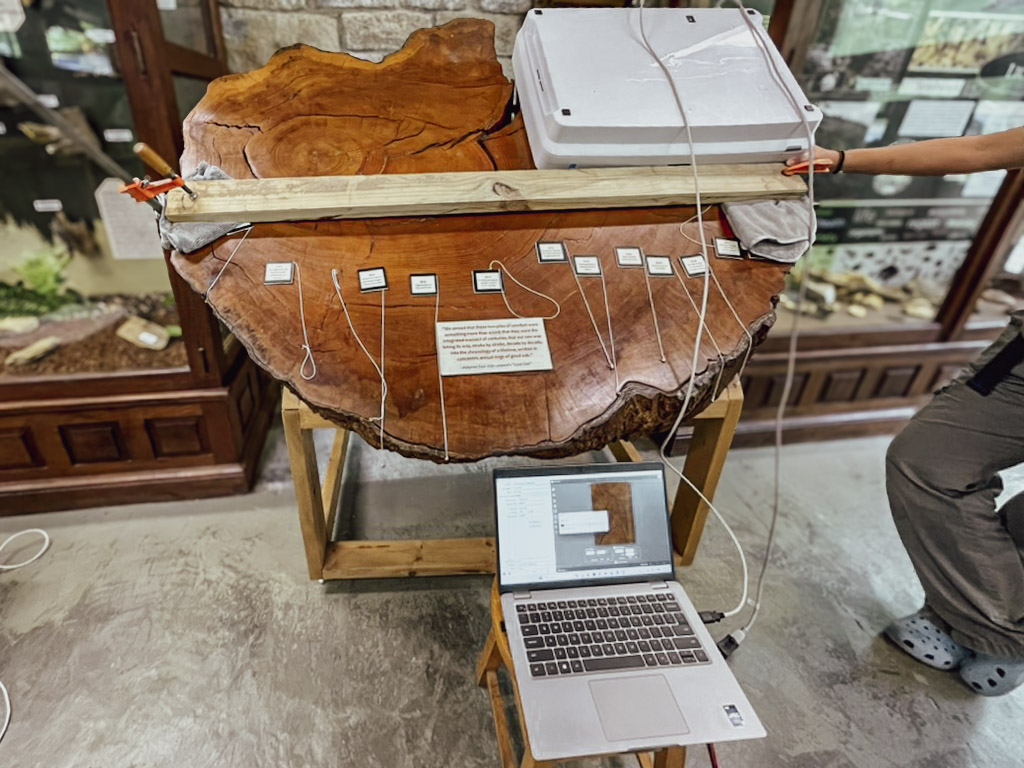
 Highlands Nature Center collection
A Long-Dead Hemlock Still Has Stories to Tell
A historic eastern hemlock cross-section in the Highlands Nature Center collection may help researchers extend the Plateau's tree-ring record back more than 500 years — revealing new insight into climate, forest growth, and ecological change over time.
Subject Eastern hemlock cross-section — began growing c. 1500 CEMost of us have noticed the light and dark bands inside a freshly cut tree stump. These bands, known as annual rings, mark each year of a tree's growth. The lighter wood forms during spring and early summer, while the darker latewood forms near the end of summer before growth slows in the fall. But each ring tells a more detailed story than age alone. The pattern of wide and narrow rings forms a kind of natural fingerprint — a record of drought, wet springs, early frosts, insect outbreaks, and other events that shaped a tree's growth year by year. This is the focus of dendrochronology, the study of tree rings, which researchers use to understand long-term climate variation, forest ecology, and environmental change across centuries.
In the collectionA Historic Hemlock in the Nature Center Collection
Since 1928, a cross-section of an eastern hemlock trunk has been part of the collection at the Highlands Nature Center. Originally donated as a museum piece and natural history curiosity, the specimen has long helped visitors imagine the age, scale, and story of an ancient tree. HBS Archivist Bryding Adams recently explored the hemlock's early history and place within the collection in her discovery article, “A First Gift to the Highlands Museum.”
Now, nearly a century after entering the collection, this hemlock may still have something new to contribute to science. Based on its rings, the tree began growing around 1500 CE — making it older than any known hemlock tree-ring record from the Highlands Plateau. That makes the specimen especially valuable for researchers seeking to understand long-term patterns in forest growth and local environmental change.
The workReading a 500-Year Record
If the hemlock's rings can be measured and matched with other records, they may help extend the known timeline of hemlock growth in the Highlands area. Liam Stiefel is using high-resolution scans of the cross-section to create a dataset of the tree's growth. The goal is to compare this record with tree rings from living old-growth hemlocks at Highlands Biological Station. If successful, the work could provide a 520-plus-year record of eastern hemlock growth — available to researchers at HBS and beyond — offering insight into multi-century patterns of climate, disturbance, and forest ecology on the Plateau.
Behind the scenesScanning the Hemlock
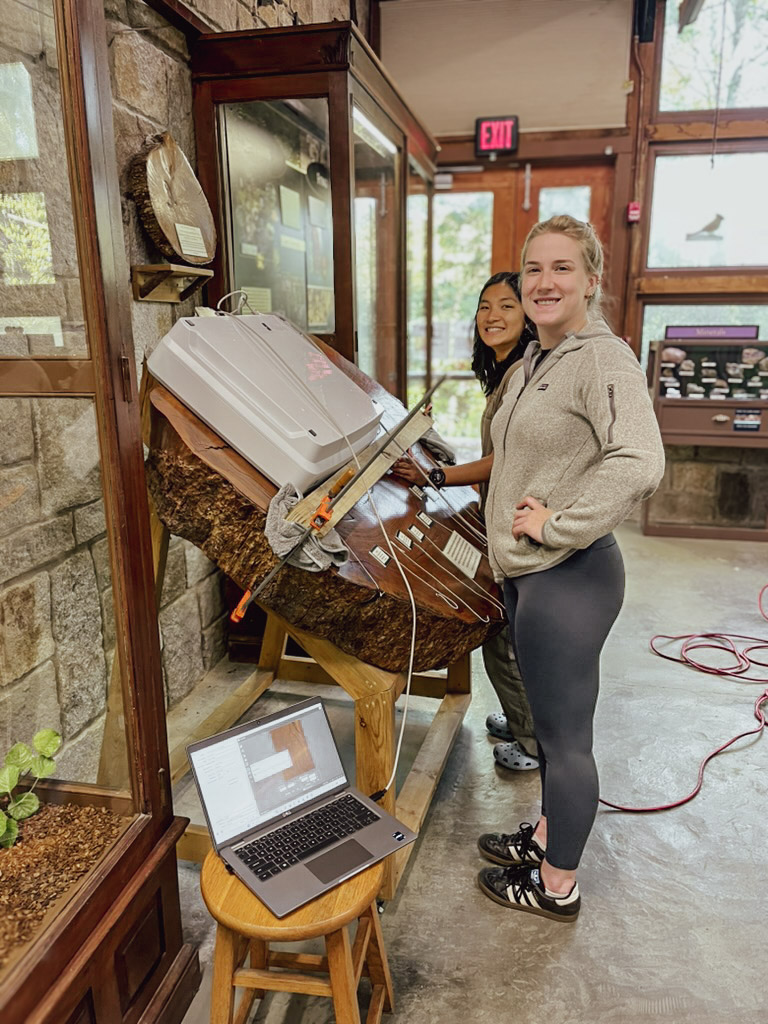
Creating this record began with a careful and slightly unconventional scanning process. HBS staff members Angelina Guerrero, Hannah Shepherd, and Liam Stiefel spent a morning capturing high-resolution images of the tree's rings. The cross-section's slanted surface made the task especially tricky: the team had to hold an upside-down scanner steady while capturing a series of images that could later be stitched together. The process was painstaking, but each scan brings the hidden story of the hemlock into sharper focus.
Why it mattersWhy Tree Rings Matter
Tree rings are more than marks of age. They are biological records of the conditions a tree lived through. A narrow ring might suggest a difficult growing year — shaped by drought, cold, competition, or insect damage — while a wider ring may reflect more favorable conditions. When researchers compare ring patterns across many trees, they can identify shared signals and build longer records of environmental change. For a place like the Highlands Plateau, where forests are central to both the landscape and the work of Highlands Biological Station, these records can deepen our understanding of how local ecosystems have changed over time.
New lifeA Museum Object with New Scientific Life
The eastern hemlock cross-section began as a museum specimen — a preserved piece of natural history meant to inspire curiosity and learning. Today, it is doing that and more. By combining historic collections with modern imaging and analysis, researchers can ask new questions of old specimens. In this case, a long-dead hemlock may help extend the scientific record of the Highlands Plateau back more than five centuries. It is a reminder that collections are never static. Even objects quietly preserved for decades may still hold data, stories, and discoveries waiting to be uncovered.
What's nextStay Tuned
Liam plans to continue analyzing the scanned images and matching the hemlock's growth patterns with tree-ring records from living old-growth hemlocks at Highlands Biological Station. If all goes well, HBS will share an update later this summer on what this remarkable tree can tell us about the forests, climate, and ecological history of the Plateau.
Collections are never static.
Liam Stiefel & the HBS team
Highlands Biological Station · collections & dendrochronologyLiam Stiefel is leading the effort to read the hemlock's rings, with scanning support from HBS staff members Angelina Guerrero and Hannah Shepherd. The specimen's early history was documented by HBS Archivist Bryding Adams in her discovery article, “A First Gift to the Highlands Museum.”
Keep exploring
More from the field
This story is part of Notes from the Field — researcher spotlights, current research, and discoveries from Highlands Biological Station.