
Notes from the Archives · November 2024
E. E. ReinkeEdwin Eustace Reinke, Founder and First Director
The scientist who helped make the case for a biological station in the southern mountains, and whose own books became the Station’s library.
Begin readingThe E. E. Reinke Library
Between the Thelma Howell Administrative Building and the Coker Laboratory at the Highlands Biological Station is the E. E. (Edwin Eustace) Reinke Library established by Dr. Reinke, a Founder and the First Director of the Highlands Museum and Biological Laboratory. Little known to visitors of the Nature Center or Botanical Gardens, the many college and graduate students and researchers from around the world use this library for their studies.
How the Library Began
First suggested in 1941 by Botany Professor Kaufman visiting from the University of Alabama, he and other researchers told Reinke and the Trustees that they needed a library to aid in their study of the plateau flora and fauna. To that end, Reinke established the library in 1945 and then others began to donate books and published research reprint papers to the Station for library use. Upon Reinke’s death in 1945, his widow, Emily, gave all of his books and a collection of his personal papers to the Station which comprised the initial library. Other major donors to the library include: Lindsay Olive, C. K. Wall family, Sargent Family, and the family of Byron Ingram among others.
Who filled the shelves
Select a volume to see who gave it.
Dr. Reinke
Dr. Reinke was a Princeton graduate awarded a Ph.D. in Biology in 1914. He was primarily affiliated with the Biology Department of Vanderbilt University in Nashville, holding various positions in that department including Chairman. Reinke spent his summers in Highlands with his family for many years, even commissioning a log cabin by local famed builder, Joe Webb, which still stands today as the location of the Highlands Hiker.
- Name
- Edwin Eustace Reinke
- Ph.D.
- Biology, Princeton, 1914
- University
- Vanderbilt University, Biology Department, including Chairman
- Highlands
- Founder and First Director, Highlands Museum and Biological Laboratory
- Summers
- A log cabin by Joe Webb, now the Highlands Hiker
A Station in the Mountains
In 1928-1929 Clark Foreman of Atlanta and a summer resident of Highlands, approached Reinke about a biological station in Highlands. The Station Trustees asked Reinke to study the Highlands region with a view of establishing a southern biological research station in the mountains. His findings were published in the Highlands Museum of Natural History Publication No. 1, entitled “Report on the Necessity of a Mountain Biological Research Station in the South.”
Hormones and Salamanders
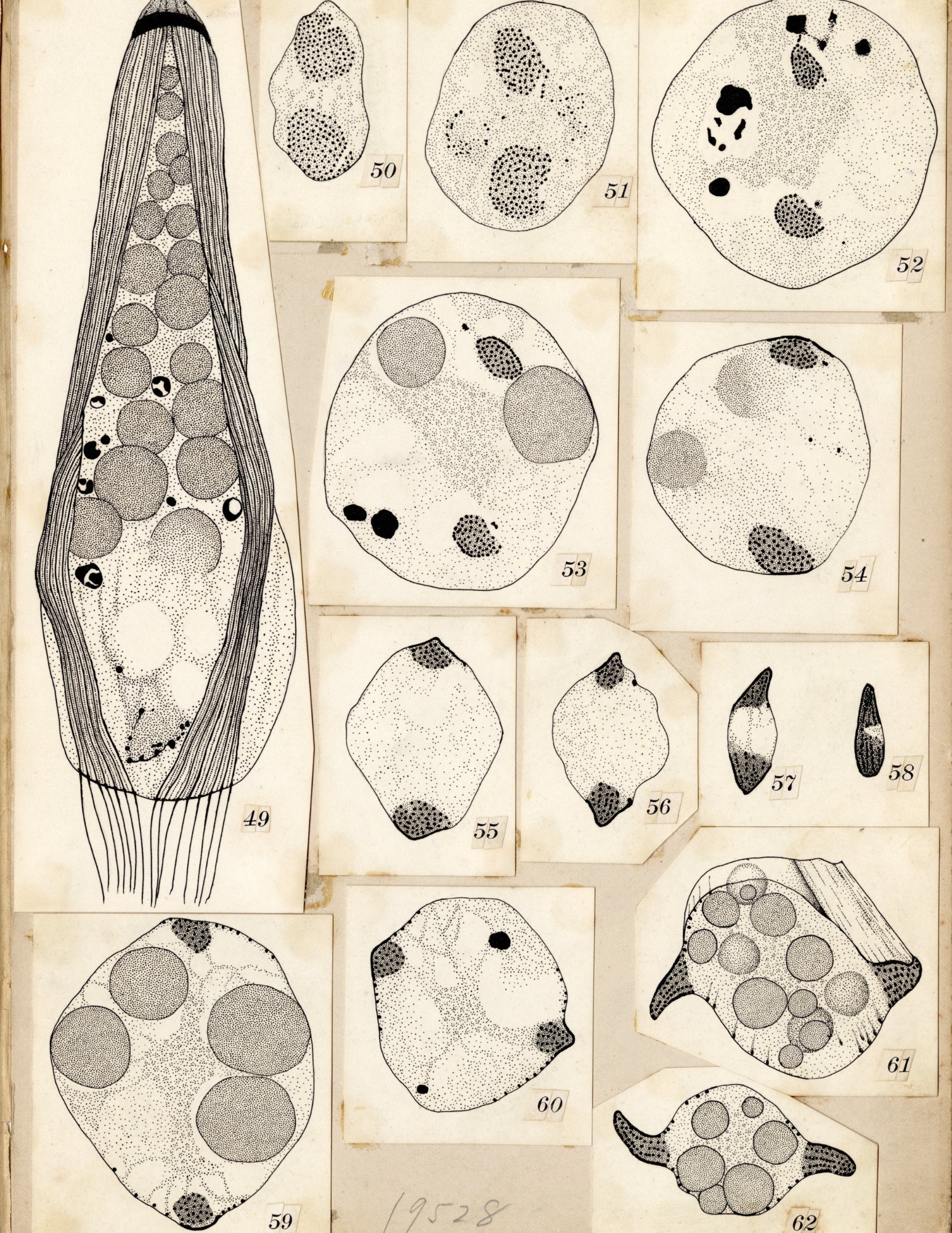
Reinke’s primary research included experimental work in the field of hormones and the pituitary gland in the life pattern of vertebrates, namely salamanders, which he carried out at the Highlands Laboratory. Some of his original drawings were included in his correspondence files, an illustration of which is shown here.
Figures 49 to 62, from Dr. Reinke’s correspondence files
Drag to move around. Pinch, double-click or use the + button to zoom. On a computer, hold Ctrl (⌘ on a Mac) and scroll.
Use the arrow keys to move around, plus and minus to zoom, and 0 to see the whole board.
Original drawings, numbered as figures 49 to 62 and mounted together on a board. Reinke Library Archives.
The library’s long story
- 1914Reinke receives his Ph.D. in Biology from Princeton.
- 19281928 – 1929Clark Foreman approaches Reinke about a biological station in Highlands. The Trustees ask Reinke to study the region, and his findings are published as Highlands Museum of Natural History Publication No. 1.
- 1941Botany Professor Kaufman of the University of Alabama first suggests a library for studying the plateau flora and fauna.
- 1945Reinke establishes the library. After his death that year, his widow, Emily, gives his books and personal papers to the Station.
- LaterLindsay Olive, the C. K. Wall family, the Sargent family, the family of Byron Ingram and others add to the collection.
- TodayResearchers from around the world use the library, and its holdings are available online through Hunter Library at Western Carolina University.
Visiting the Library
The Reinke Library is a non-lending library, except for registered students and research faculty, but is open to visitors by reservation. Its holdings are available online through the Hunter Library at Western Carolina University.
Bryding Adams, November 2024