
- Visiting Researcher
- Amphibians
- Hall Creek
Under a Flat Rock in Hall Creek
Twenty-five eggs, a few remarkably golden salamanders, and the small discoveries that remind us how much there is left to learn about these mountains.
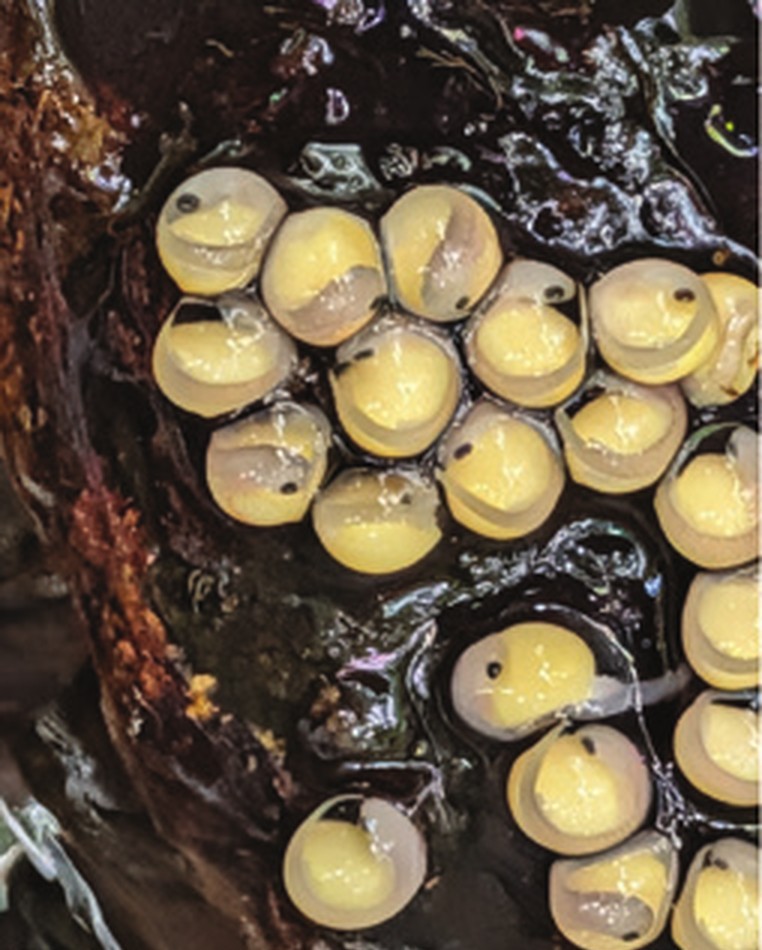
There are whole worlds moving quietly beneath the stones of our mountain streams. Most of us pass right over them, following the water downstream, never knowing what we’ve missed.
Last September, researcher Sandy Kawano lifted a flat rock in Hall Creek and found twenty-five pale yellow salamander eggs tucked against its underside. It was a small discovery, easy enough to overlook, but one worth writing down.
And the eggs weren’t the only surprise this particular creek had to offer. Among the dark, beautifully camouflaged salamanders living there, a few appear in shades of brilliant yellow.
Sandy, who has spent time with us here at Highlands Biological Station, recently published these observations with R. Alexander Pyron in Herpetological Review. Their short note includes photographs taken right here at the Station, and I thought the story was too lovely not to share.
What the creek was keeping
The Northern Shovel-nosed Salamander (Desmognathus marmoratus) is wonderfully suited to the cold, fast-moving streams of the southern Appalachians. It spends much of its life in the water, largely hidden from view, and despite generations of scientific study, there are still things about its life that we understand only in fragments.
How it nests, for instance. Or why some individuals are almost entirely black while others are the color of autumn leaves.
On September 6, 2025, Sandy was conducting fieldwork along Hall Creek in Burke County, North Carolina, when she discovered a nest beneath a flat stone. She and fellow researcher R. Alexander Pyron documented the find in the Natural History Notes section of Herpetological Review.
Hall Creek is an interesting place for another reason. Its shovel-nosed salamanders are geographically isolated in the South Mountains, within the Upper Catawba and Santee River drainage. Only two species of Desmognathus are known from the area: D. marmoratus and D. lycos.
It’s a reminder that even within a familiar species, a population tucked away in one particular creek may have its own story to tell.
Take your time exploring. The photographs, figures, and observations below offer a closer look at what the researchers found.
A few numbers from the creek
A nursery beneath the current
Imagine the cold water of a mountain creek slipping over a flat stone. Beneath it, hidden from anything passing above, twenty-five tiny eggs cling together in a single cluster.
That’s where Sandy found them: attached to the underside of a rock, directly in the flowing water.
The female was nowhere to be seen. The researchers suspect she slipped away when the stone was disturbed, disappearing into the current before anyone noticed.
But the eggs held a remarkable amount of information.
Inside their translucent capsules, the embryos were already well along in their development. Tiny pupils had appeared. Gill buds and all four limbs were beginning to take shape. Each embryo still carried a generous yolk sac, supplying what it needed for the days ahead.
There’s something extraordinary about being able to see so much of a life taking shape before it has even begun.
And yet, for all we know about salamanders, very few nests of this particular species have ever been documented.
Twenty-five eggs beneath one ordinary rock might not sound like much. But carefully observed and recorded, they become another small piece of a much larger picture.
Look a little closer
Explore the highlighted details in the photograph to see the developing embryos, or switch to the view of the nest as it appeared in the creek.
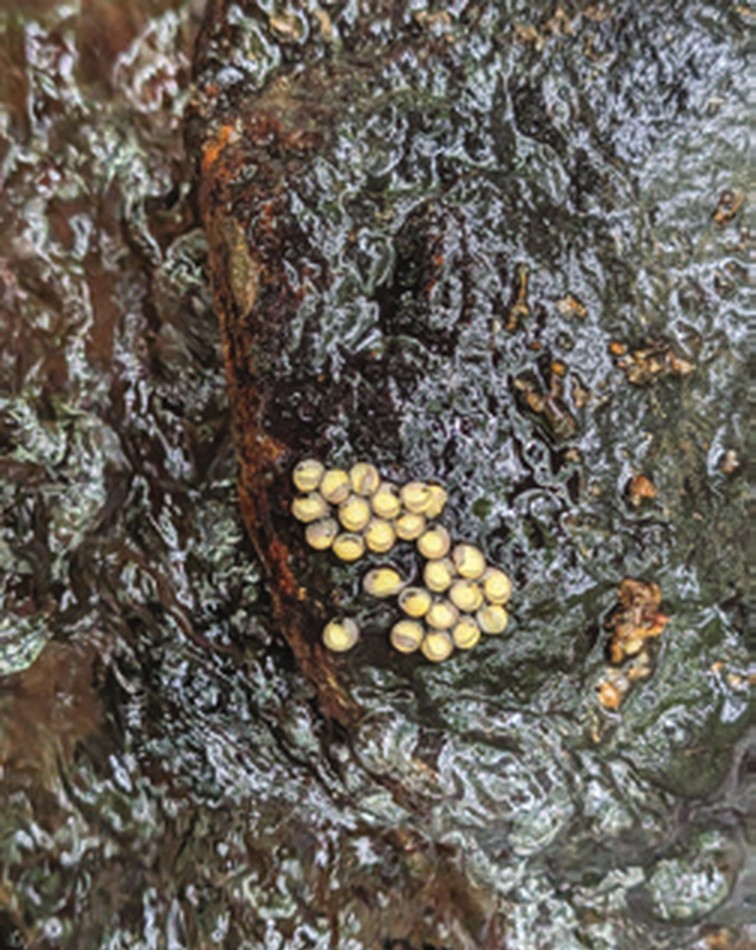
Close-up · Fig. 1A. The pale eggs rest together against the dark stone, their translucent capsules revealing the earliest details of developing salamanders.
Twenty-five small lives, suspended beneath the current.
Is twenty-five a lot?
Twenty-five eggs seemed like a remarkable number to me, although it’s difficult to know what counts as remarkable when so few nests have been observed.
The researchers placed their discovery alongside the handful of earlier records for this species, some dating back more than a century, as well as observations of a closely related salamander.
A nest of twenty-eight eggs was documented in 1924. Another early account described females carrying twenty-six and thirty-four eggs. In the related Southern Shovel-nosed Salamander, researchers have recorded clutches ranging from twenty-seven to fifty-four.
It’s a relatively small collection of observations for animals that have lived in these mountains far longer than we’ve been keeping records.
“Very few nests from this species have been reported in the literature.”FROM THE RESEARCH NOTE, P. 394
A century of egg counts
Explore the chart to compare the Hall Creek discovery with earlier observations.
The records don’t all describe the same thing. Some count eggs laid in nests, while others count eggs still developing inside females. Together, they offer a glimpse of what earlier researchers were able to observe.
Four salamanders, a remarkable range of color
One of my favorite parts of this research isn’t the nest at all.
It’s the salamanders themselves.
At Hall Creek, Northern Shovel-nosed Salamanders range from the deep brown and black we might expect of an animal living among wet stones to an almost startling shade of yellow.
Some are dark all over. Others carry scattered patches of gold across their backs and sides. A few are so brightly colored that they hardly seem like the same species.
In July 2024, four individuals from this population were photographed here at Highlands Biological Station. Placed side by side, they make a beautiful illustration of just how much variation can exist within a single species.
From dark to gold
Move through the photographs to see the range of color, from nearly black to golden yellow.
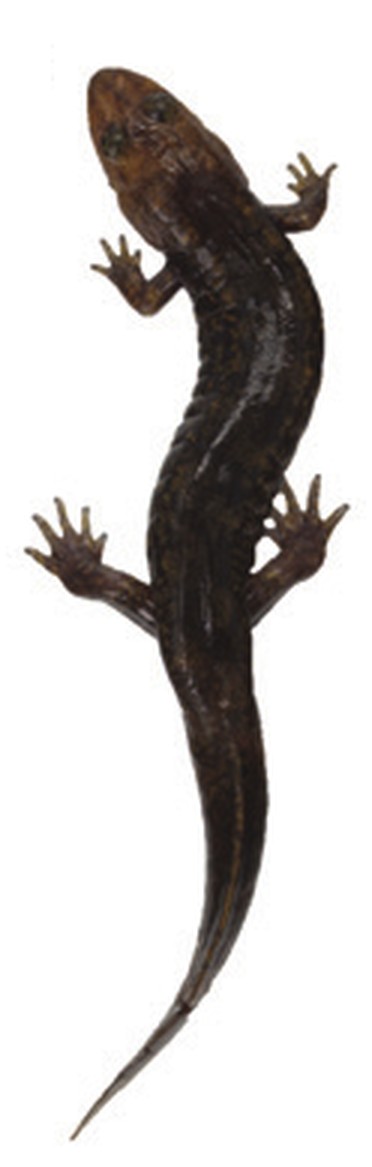
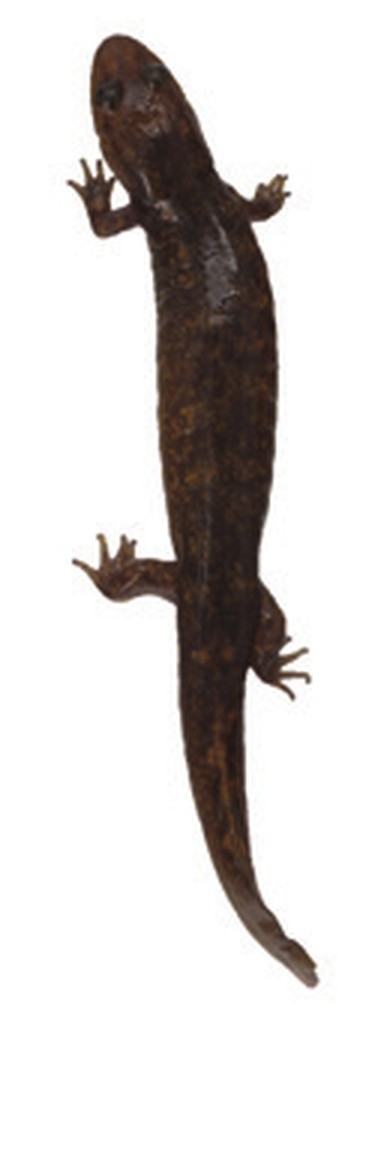
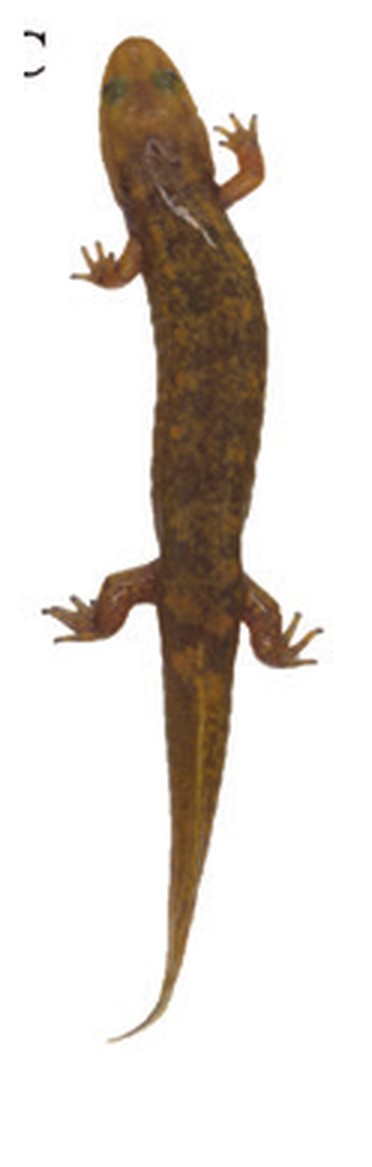
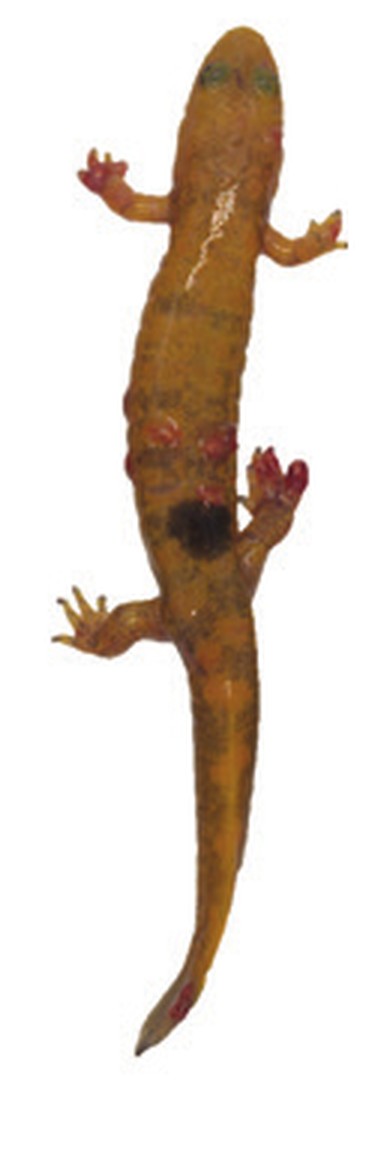
Snout-to-vent length, or SVL, is how biologists measure a salamander’s body without including its tail. The scale in the photographs represents 1 cm. Individuals A and B show ordinary pigmentation, while C and D represent the xanthic form. Measurements are from Fig. 2 of the research note.
Why are some of them golden?
I have a particular fondness for questions that begin with something as simple as noticing a difference.
Why is that one yellow?
It turns out researchers have been asking versions of that question for decades.
Since beginning regular visits to Hall Creek in 2019, the authors have encountered roughly one hundred Northern Shovel-nosed Salamanders. About ten have displayed the unusual yellow coloration, sometimes covering most of the body and sometimes appearing in patches.
Three of those yellow individuals are described in the note: one adult and two subadults.
Yellow shovel-nosed salamanders have been reported in other places, including observations shared through iNaturalist. But Hall Creek remains the only known location where the coloration has appeared consistently.
That makes this little population especially interesting.
How often does the yellow appear?
Explore the observations below to compare the frequency of yellow coloration at Hall Creek with earlier reports from a related species.
The figures are approximate. The 1954 observation was described only as “rare,” without a numerical estimate.
There may be an explanation for the unusual color, although it’s not yet a settled one.
Decades ago, researchers studying the closely related Southern Shovel-nosed Salamander (D. aureatus) described a similar yellow form as “partial albinism.” They suggested that reduced activity of an enzyme called tyrosinase might interfere with the production of melanin, the pigment responsible for much of an animal’s darker coloring.
It’s an intriguing possibility, but whether the same process explains the Hall Creek salamanders remains an open question.
And then there’s the question I find even more interesting: does being yellow make any difference to the salamander?
Does it affect where it lives, what it eats, or how easily it can hide? Does the proportion of yellow animals change from one generation to the next?
We don’t know.
What we do know is that this unusual coloration has appeared in at least two related species, including populations that are geographically distant and genetically distinct.
Sometimes a good discovery gives us an answer. Just as often, it gives us a better question.
A century of looking closely
One of the things I love about natural-history research is the way it connects people who may never meet.
A scientist working along a creek in 2025 can find herself returning to an observation made in 1924. A question raised decades ago becomes relevant again because someone notices something unusual beneath a rock.
This particular note reaches back more than a century, drawing on the work of earlier naturalists who were paying attention to the same animals, the same questions, and sometimes the same unexpected colors.
Highlands Biological Station appears at both ends of that long history, which feels especially meaningful as we approach our centennial.
Explore the timeline
Move through a century of observations, from early egg counts to the Hall Creek discoveries.
More than a century separates the earliest observations from the latest. Each adds a little to what we know.
The questions beneath the surface
One of the nicest things about this kind of research is that it doesn’t pretend every question has been answered.
Sometimes the unanswered questions are the most interesting part.
“Whether this mutation or its variable frequency over time carries any adaptive or ecological significance is unknown.”FROM THE RESEARCH NOTE, P. 395
Where was the mother?
She wasn’t observed with the nest. The researchers suspect she escaped unnoticed when the rock was disturbed. Whether she had been guarding the eggs is not established by this observation.
Is twenty-five a typical clutch?
It’s hard to say. So few nests have been documented that even a single new count helps fill a gap in what we know about the species’ reproduction.
Why are some individuals yellow?
Changes in pigment production offer one possible explanation, but the exact mechanism behind the coloration in these salamanders has not been determined.
Does the proportion of yellow salamanders change over time?
That’s another question still waiting for an answer. Repeated observations at Hall Creek may eventually help researchers understand whether the frequency of the yellow form remains stable or shifts from one generation to another.
Meet the researchers
Behind every natural-history note are people willing to spend time looking closely at things the rest of us might never notice.
Sandy M. Kawano
Sandy studies how vertebrates move, with particular interest in the evolutionary transition between water and land. Salamanders are among the animals that help her explore those questions.
She conducted the Hall Creek fieldwork described in this note, adding another observation to the growing picture of how these remarkable amphibians live.
Her research is supported by a National Science Foundation CAREER grant and start-up funding from the University of Virginia.
Affiliation as listed in the publication.
R. Alexander Pyron
Dr. Pyron is a researcher in the Department of Biological Sciences at George Washington University. His earlier work on Desmognathus salamanders in the South Mountains provides important context for understanding the geographically isolated population at Hall Creek.
Affiliation as listed in the publication.
A connection to Highlands
One of the pleasures of reading a scientific paper is occasionally finding a familiar name tucked into the acknowledgments.
This note includes three.
“We thank Dr. James Costa, Jason Love, and Mike McMahan for their assistance at Highlands Biological Station.” FROM THE ACKNOWLEDGMENTS, P. 395