
The Father of Modern Ecology
Dr. Eugene Pleasants Odum (1913–2002)
Before his textbook reframed ecology around the ecosystem, Eugene Odum spent his summers on the Highlands Plateau: trapping small mammals, counting birds, and serving the Station for sixteen years.
by Lily Haney · Reinke Archives Intern
Begin reading- 35small-mammal species Odum documented on the plateau, up from the 14 on the Station’s biota cards
- 17trapping sites, from the top of Satulah Mountain down to Horse Cove Bog
- 16years on the Station’s Executive Board, 1947 to 1963
When biologists study ecology today, they look at the broader ecosystem, interactions between species and their environments, and how nature works together to make one big, cohesive whole. Prior to the 1950s, this was not the case.
Early in the history of ecology, the focus was on individual species and their unique structures and functions in what has since been deemed “bottom-up” or “reductionist” ecology. In 1953, however, the first edition of Dr. Eugene Pleasants Odum’s Fundamentals of Ecology textbook was published, reframing ecology under new principles based around the ecosystem concept and the main idea that “the ecosystem is greater than the sum of its parts.” Odum’s textbook, along with his vast writings, research, and influence shifted ecology from “bottom-up” to “top-down,” establishing the field as an essential discipline of biology.
Before he was “the father of modern ecology,” Dr. Odum was a researcher, summer teacher, and Executive Board member of the Highlands Biological Station. He spent his summers there teaching, completing research, and leading graduate biology students in field work until the field stations he established for the University of Georgia and his textbook writing took up more of his time. Though he was already a budding ecosystem ecologist when he first arrived at the Station in 1945, his work there with field research, ecology summer courses, and the growing graduate field work programs until 1981 was an important part of his work and his service on the Executive Board benefited many programs and researchers at Highlands.
Study the parts, or study the whole?
Bottom-up: each species studied on its own, its structures and functions catalogued one at a time.
A sketch of the idea using plants and animals named in this story. It is not a food web drawn from Odum’s data.
Beginning Biology with Birds
Eugene Pleasants Odum was born on September 17, 1913, to sociologist Dr. Howard W. Odum and Anna Louise Kranz Odum. During his childhood, his father worked first at the University of Georgia, then for only 1919 at Emory University, and finally after 1920 at the University of North Carolina in Chapel Hill. His father taught him to work hard, avoid anger, and “think in terms of the larger system,” always encouraging him to grow his education. When he was young, Eugene Odum thought he would become a plumber and would always study the plumbing of a house when his parents brought him to visit anyone. In high school, however, he grew obsessed with birds, starting a magazine called “The Briarbridge Bird News” with just a typewriter and a mimeograph machine and completing all of the work himself. When his father proudly shared the magazine with Louis Graves, the editor of the Chapel Hill Weekly, the editor included a story about the magazine with excerpts in the August 2nd, 1929, edition of the newspaper.
Sharing this article in the Chapel Hill Weekly brought Odum attention and friendship from Coit Coker, son of Robert E. Coker and nephew of William C. Coker of Highlands fame. Robert Coker was a zoologist, and William C. Coker was a botanist, both at UNC Chapel Hill. Coit asked Odum if he could join in writing the magazine, and the two became close friends. Their bird articles continued as a column entitled “Bird Life in Chapel Hill” in the Chapel Hill Weekly once Odum began his undergraduate degree at UNC Chapel Hill.
Odum received his bachelor’s degree in zoology from UNC Chapel Hill in 1934. Ironically, he made a C in his first biology class with Robert Coker, but it made a great impact on him. He later said, “It required so much dissection of dead frogs, and my hands got so wrinkled up with formaldehyde, that I decided I was more interested in the living world.”1 Later on, when Coker was on leave during his junior year, Odum took a zoology course with Coker’s temporary replacement and got an A, leading him to apply for and get an assistantship with the course. This astonished Coker when he returned.
Odum’s overall undergraduate GPA led one of his father’s colleagues to assert that he just was “not college caliber.”2 But Odum went on to complete a master’s degree at UNC Chapel Hill in 1936, writing his thesis on the history of germ cells in toadfish. He applied for the University of Michigan and Western Reserve University in Ohio, and though denied at Michigan, was offered a teaching position and summer employment at the Baldwin Bird Research Laboratory in addition to acceptance into the graduate program at Western Reserve. He worked and studied there for one year, reinforcing his belief that he wanted to work with the living environment, not preserved museum specimens. After the summer of 1937, Odum transferred to the University of Illinois to finish his PhD where he continued the research he began at Baldwin on the heart rates of small birds. This research would become his dissertation and in 1939, he graduated from the University of Illinois with a PhD in ecology.
On November 18, 1939, he married Martha Anne Huff, whom he had met through his sister while they were both attending the University of Illinois. Martha Anne was a painter, and wherever Odum took them, she would paint the landscapes, putting on many one-woman art shows over the years with her popular watercolors.
Becoming an Ecologist
After receiving his PhD, Odum began working as a resident naturalist at Edmund Niles Huyck Preserve in Rensselaerville, NY. Here, he began to study the ecosystem as a whole. He examined plant and animal relations, continued his long-time research on Northern Black-capped Chickadees, and inventoried all of the plants on the preserve to create a habitat map to use in future studies of succession at the site. This began his transition from studying the parts to studying the whole, a trajectory that would define the remainder of his career.
In the fall of 1940, he was appointed a professor of biology at the University of Georgia by Dr. George Boyd. He did not expect to stay long, even telling Martha not to unpack, but did like the area, as his father had given him some farmland he was using to graze Jersey cattle in Athens when Eugene graduated high school. Despite his expectations, the University of Georgia was where Odum would spend the remainder of his career and would become known for teaching, researching, writing, and advocating for ecology.
The 1940s were eventful for the Odums. In October 1942 their first son, William Eugene, was born. By age 3, William had decided he wanted to be an ichthyologist because of his experiences fishing with his maternal grandmother and collecting biological specimens with his father. He tagged along on his father’s expeditions, which were often to the Highlands Biological Station during the 1940s. During this time, the University of Georgia did not allow air conditioning in any labs except the ones that had live animals. Odum’s solution to this was to move Martha and William with him to Highlands for the summers where the weather was cooler.
Odum’s years at a glance
- 1913Born September 17 to Howard W. and Anna Louise Kranz Odum
- 1929The Briarbridge Bird News is written up in the Chapel Hill Weekly
- 1934Bachelor’s degree at UNC Chapel Hill: a zoology major with a minor in botany
- 1936Master’s degree, UNC Chapel Hill: germ cells in toadfish
- Instructor in biology, Western Reserve University (1936–37)
- 1939PhD in ecology, University of Illinois; marries Martha Anne Huff
- Resident naturalist, Edmund Niles Huyck Preserve, Rensselaerville, New York (1939–40)
- 1940Joins the University of Georgia’s zoology department as an instructor
- 1942
- Assistant professor of zoology, University of Georgia
- 1945First mention in the Station’s records, in a letter from Dr. Thelma HowellAt Highlands
- Associate professor of zoology, University of Georgia
- Fellow, American Ornithologists’ Union
- 1946A summer fellowship at the Station: birds and small mammalsAt Highlands
- 1947Wall Scholarship; UGA becomes an Institutional Member and Odum joins the Executive BoardAt Highlands
- 1948“Synaptomys on the Highlands, North Carolina Plateau”At Highlands
- 1949“Small Mammals on the Highlands (North Carolina) Plateau”At Highlands
- 1950“Bird Populations of the Highlands (North Carolina) Plateau” in EcologyAt Highlands
- Fellow, American Association for the Advancement of Science
- 1951Helps establish the Savannah River Ecology Laboratory
- 1953Fundamentals of Ecology; the Sapelo Island station
- 1954
- Full professor of zoology, University of Georgia
- 1956Two months lecturing in Japan
- Mercer Award, shared with Howard T. Odum, for “Trophic Structure and Productivity of a Windward Coral Reef Community on Eniwetok Atoll”
- 1957
- Alumni Foundation Distinguished Professor of Zoology, University of Georgia
- National Science Foundation Senior Fellowship
- Instructor in charge of the marine ecology course, Marine Biological Laboratory, Woods Hole (1957–61)
- 1961
- Director of the Institute of Ecology, University of Georgia
- 1963Ends sixteen years on the Station’s Executive BoardAt Highlands
- President-elect, Ecological Society of America
- 1964
- President, Ecological Society of America (1964–65)
- 1968
- Georgia Scientist of the Year for 1967, from the Georgia Science and Technology Commission
- 1970
- Elected to the National Academy of Sciences
- Accepts Georgia’s two-millionth telephone on behalf of the Institute of Ecology, in recognition of its work for the state’s environment
- 1971
- Outstanding Educator of America
- An award from Georgia’s architects for preserving the environment
- 1973
- Callaway Professor of Ecology, University of Georgia
- Advisory committee, Technological Assessment Commission established by Congress
- President, Ecology Section, American Society of Zoologists (1973–74)
- 1974
- Eminent Ecologist Award, Ecological Society of America
- Honorary member, British Ecological Society
- 1975
- Prix de l’Institut de la Vie, shared with Howard T. Odum
- Fellow, American Academy of Arts and Sciences
- 1976
- A Georgia General Assembly resolution of appreciation for his “many distinguished contributions”
- Conservationist of the Year, Georgia Wildlife Federation
- Gold Seal Award, National Council of State Garden Clubs
- 1977Speaks at the Station’s 50th Anniversary SymposiumAt Highlands
- John and Alice Tyler Ecology Award
- A tribute from Representative Doug Barnard in the Congressional Record, October 12
- Blue Key Award, University of Georgia, as “an outstanding Georgian”
- 1978
- Faculty Service Award, University of Georgia Alumni Society
- Distinguished Alumnus Award, University of North Carolina
- Distinguished Service Award, American Institute of Biological Sciences
- St. Andrews Medal
- Honorary member, Southeastern Estuarine Research Society
- 1979
- Environmental Advisory Committee, U.S. Department of Energy (1979–80)
- 1980
- Honorary Doctor of Letters, Hofstra University
- 1981The end of his decades of field work and courses at HighlandsAt Highlands
- Cynthia Pratt Laughlin Medal, Garden Club of America
- 1982
- Certificate of Appreciation, Ecological Society of America
- Illini Alumni Achievement Award, University of Illinois
- 1983
- Educator of the Year, National Wildlife Federation
- Listed as the “Father of Modern Ecology” among Georgia’s notable innovators at the Museum of Arts and Sciences in Macon, for the state’s 250th anniversary
- 1984Retires from UGA and is named emeritus
- Earle R. Greene Memorial Award, Georgia Ornithological Society
- 1985
- Distinguished Associate Award, U.S. Department of Energy
- The Sierra Club establishes the Eugene Odum Coastal Conservation Award
- The University of Georgia establishes the Odum Lecture Series
- Chairs the Kellogg Task Force on Georgia’s needs and statewide environmental problems
- 1986
- Honorary Doctor of Humanities, Ferrum College, Virginia
- 1987
- Crafoord Prize in Ecology, shared with Howard T. Odum, from the Royal Swedish Academy of Sciences
- 1989
- Chevron Conservation Award
- Silver Trout Award, Trout Unlimited of Georgia
- 1990
- Honorary Doctor of Humane Letters, UNC Asheville
- Honored at the 75th annual meeting of the Ecological Society of America
- 1991
- Abraham Baldwin Award, University of Georgia
- Theodore Roosevelt Distinguished Service Award
- 1992
- Environmental Educator Award, Society of Environmental Toxicology and Chemistry
- 1994
- Distinguished Conservationist Award, Georgia Conservancy
- Citizens for Nuclear Technology Award
- 1996
- Honorary doctorate in ecology, Universidad del Valle de Guatemala
- 1997
- Lifetime Achievement Award, Georgia Environmental Council
- Eugene Odum: An Ecologist’s Life, a film written by Philip Lee Williams and produced by the University of Georgia
- The Estuarine Research Federation’s lifetime achievement award is created in honor of Eugene, Howard T. and William Odum
- 1998
- Distinguished Service Award, International Association of Landscape Ecology
- An award from the Philadelphia Academy of Sciences for “pioneering research” in salt marsh ecology and inspiring a generation of coastal ecologists
- 1999
- Honorary Doctor of Science, Ohio State University
- Alex Little Environmental Award, University of Georgia
- Honorary Doctor of Science, Universidad San Francisco de Quito, Ecuador
- 2002Dies, still a presence at the Institute of Ecology
Years drawn from the story on this page. Appointments and honors from Betty Jean Craige, Eugene Odum: Ecosystem Ecologist & Environmentalist (2001), Appendix Two.
Odum’s Highlands Field Research Days
Highlands was not far from the University of Georgia across the North Carolina-Georgia line and with the Station here where the Cokers of his childhood played prominent roles, it was an obvious choice for field work. Further, Highlands is surrounded by beautiful landscapes for Martha to paint and streams and ponds for William to fish in when he was not tagging along with his dad. It was a perfect summer retreat for the Odum family.
The first record found in the E.E. Reinke Archives of Odum’s research at the Highlands Biological Station is a brief mention in a letter from Dr. Thelma Howell to Dr. William C. Coker. It reads:
No other records of him in 1945 at Highlands have been found in the Reinke Archives, but in 1946 an Asheville Citizen-Times article announced that Odum had been given a fellowship at the Station and would be studying birds for the summer. This article is depicted below.
In 1946, Odum began surveying bird populations in the Highlands region to study their breeding patterns in the region, numbers, and distribution across the varied landscape of the region. He also began preparing small mammal traps that would be used in future studies in the area as long as he was given the opportunity to return for more research. According to a letter from Dr. Howell to Champion Fiber Company, Odum’s research involved studying the effects of logging on animal populations, a study he believed should be carried on for many years to gain practical knowledge of how logged ecosystems recover. Dr. Howell expressed much interest in this project and asked Champion to fund a research fellowship for Odum to continue the work, which would be relevant for them, the Station, and the entire region.
Odum returned that fall and reported to Dr. Howell in September that his weekend research trip was a success, and he was able to catch and document a variety of small mammals and birds, including a list of those he was able to see. Later that fall, he received an invitation from Dr. Howell and Dr. Harold C. Bold to return the following summer as an instructor of a zoology course at the Station. He agreed as long as his research could continue and recommended that he teach a course either on “Field Zoology and Ecology” or “Ornithology.” They agreed that the “Field Zoology and Ecology” course would be best.
E.E. Reinke Archives. Tap a letter to read it.
For his 1947 work, Odum received a $100 Leonce Fremaux Wall Scholarship and brought along an undergraduate student, H. V. Autry, to assist him in his research, who also received a $50 John S. Sewell Scholarship for his work. The summer courses ended up being postponed to 1948 due to high residence costs, but Odum and Autry arrived to begin their research residency on June 9th.
Based on the work Odum completed during these two summers, he was able to publish two papers and a brief commentary on Synaptomys. The commentary was published in 1948 in the Journal of Mammalogy and was titled “Synaptomys on the Highlands, North Carolina Plateau.” The other two were built more cumulatively on all of his findings regarding small mammals and birds in the region. For his mammal research, he published “Small Mammals on the Highlands (North Carolina) Plateau” in 1949 in the Journal of Mammalogy. The paper on his extensive bird research was published the following year in Ecology and was titled “Bird Populations of the Highlands (North Carolina) Plateau in Relation to Plant Succession and Avian Invasion.”
He had presented the “Bird Populations” research at the Ecological Society of America’s annual meeting in 1947 in Chicago, but the paper was not ready for the organization to publish in their most famous journal until 1950. In the interim, Odum did additional research on the bird and mammal populations of Highlands during the summer of 1948 with support from a research stipend and the renewal of the Leonce Fremaux Wall Scholarship. This year he mapped the territories of the birds in his study and completed his three-year mammal study in time for the publication of that paper the following year.
After confirming some of his data on the specimens and maps left for the Station collection, his papers and one by his research students, David Johnston and H.V. Autry, were complete and ready to publish. Both of Odum’s papers acknowledged the Station and the scholarships that enabled Odum and Autry to complete the research, however Johnston and Autry’s brief work in The Chat did not and had to be corrected in the next edition.
“Small Mammals on the Highlands (North Carolina) Plateau”
The research Dr. Odum completed and recorded in “Small Mammals on the Highlands (North Carolina) Plateau” was meant to discover what kinds of small mammals live in the Highlands region. Before this point, he reports that the biota cards at the Station only record fourteen different species in the Highlands area. Knowing that there were more in the region and determined to create a more complete list, Odum set out to trap as many mammals as possible and documents his work and results in this paper.
To cover the full range of habitats and altitudes in the Highlands region, Odum set traps at seventeen different locations ranging from on top of Satulah Mountain between 4500 and 5000 feet in elevation to the Horse Cove Bog at 3000 feet in elevation. Sites in between included the Station grounds, “Franklin Road,” a local patch of virgin hemlock forest, and the recently logged “primeval forest.” He covers bogs, open fields, dense underbrush, immature forest, and old growth forests to ensure as many species as can be captured will be. Yet still, some of the species listed are based on observations by others in the area he has been told about or on specimens taken in the past from the area and were not captured by him during the study from 1946 to 1948.
- Bogs
- Open fields
- Dense underbrush
- Immature forest
- Old-growth forest
The mammals captured by Odum during this study came from 35 different species ranging in size from small white-footed mice to raccoons and opossums. He excluded large mammals, which he categorized as anything larger than a fox. He found that the species composition was almost entirely northern species writing, “Except for the fact that different races are often involved, the list of species could well pass for that of some locality in New England.” There were only four species that were distinctly southern: the golden mouse (Peromyscus nuttalli), opossum (Didelphis), spotted skunk (Spilogale), and cotton rat (Sigmodon). He further found that Highlands was the southernmost point of the range of three more species: the lemming vole or bog lemming (Synaptomys cooperi), Cinereus shrew (Sorex cinereus), and red-backed vole (Clethrionomys gapperi). The finding of a lemming vole during this research was so exciting to Odum that it had prompted him to add a short note on his finding, the brief article mentioned above titled “Synaptomys on the Highlands, North Carolina Plateau.”
In addition to the southern species and northern species for which Highlands was their southernmost range, Odum trapped six species that he knew to only extend their ranges slightly south of Highlands, making them especially important to identify in the area. These included the red squirrel (Tamiasciurus hudsonicus), woodland jumping mouse (Napaeozapus insignis), smoky shrew (Sorex fumeus), New England cottontail (Sylvilagus transitionalis), meadow jumping mouse (Zapus), and meadow vole (Microtus pennsylvanicus). Of these, the New England cottontail was a special find for him and for the Station. It is the only observation of the species listed on the Station’s biota card for this species and has a unique story.
The thirteen species Odum singled out
- Golden mousePeromyscus nuttalliDistinctly southern
- OpossumDidelphisDistinctly southern
- Spotted skunkSpilogaleDistinctly southern
- Cotton ratSigmodonDistinctly southern
- Bog lemmingSynaptomys cooperiSouthern limit
- Cinereus shrewSorex cinereusSouthern limit
- Red-backed voleClethrionomys gapperiSouthern limit
- Red squirrelTamiasciurus hudsonicusJust past Highlands
- Woodland jumping mouseNapaeozapus insignisJust past Highlands
- Smoky shrewSorex fumeusJust past Highlands
- New England cottontailSylvilagus transitionalisJust past Highlands
- Meadow jumping mouseZapusJust past Highlands
- Meadow voleMicrotus pennsylvanicusJust past Highlands
Silhouettes are generic drawings, not to scale.
Based on his new expansion of the mammal species composition of the plateau from the previously observed fourteen to a new total of 35, Odum updated the Station’s biota cards. He started many new observation cards for the mammal collection, giving future observers confirmation that these species have been known to exist in the region and are likely to be found again.
During these beginning stages of research at the Station, it was important to understand what species of plants and animals were here, and the biota cards served this purpose. The Station’s biota cards were a collective record for researchers to record their observations in the region, whether it was a species they were researching or another they found in the process. This allowed the Station to keep a better record of what was present there and being found in research or casual observations so other future researchers could have a starting groundwork of species composition from which to begin their research.
“Bird Populations of the Highlands (North Carolina) Plateau in Relation to Plant Succession and Avian Invasion”
Dr. Odum’s research on the birds of the Highlands area focused on the broad scale of characterizing the bird communities of various forests and ecological succession phases. It studies six locations in and around Highlands with three in different successional stages of hemlock forests and three in different stages of oak-chestnut forests, ranging from shrubland to mature forest. He found that though neither type of forest had much difference in the species composition, the hemlock forests had much greater population densities, meaning there were more birds present in the more wet hemlock forests than the dry oak-chestnut forests.
When studying the different successional phases, Odum noticed that there was little difference between the densities of the intermediate and mature oak-chestnut forests. He deemed that this was because of the chestnut blight, which killed all the chestnut trees in the region. This left even the mature oak-chestnut forests with large open gaps where only saplings of chestnut and oak were growing, creating an effect that makes the bird population composition and density look the same as an intermediate-stage forest.
Where the birds were, and what has changed since
More birds lived in the wetter hemlock forests than in the dry oak-chestnut forests. With the chestnuts killed by blight, the mature oak-chestnut stand looked, to the birds, like the intermediate one.
An illustration of the pattern described in the 1950 paper. Bird marks are not counts.
Since the time of Odum’s research in the region, the woolly adelgid has wiped out most of the hemlock population in the areas he surveyed. A new survey of these same locations may find a similar effect on the hemlock forests as Odum found with the death of the chestnuts in the oak-chestnut forests.
The forests of these areas have definitely changed in ways Odum likely would not have anticipated when completing these studies of succession back in the late 1940s. However, his research characterizing the succession of the region gives a better picture of how a recovering forest would look and what species might be found there, giving us a better idea of how to help the forests return to a more stable, diverse state.
Read the 1950 paper, page by page
Odum, E. P. 1950. Bird populations of the Highlands (North Carolina) Plateau in relation to plant succession and avian invasion. Ecology.
Updating the Biota Cards
Based on their findings during both his studies of mammals and of birds, Odum and his team helped the Station to update its biota cards. In a letter dated July 15th, 1948, Odum tells Dr. Howell that the mammal biota cards are up to date with his records and results, but the birds are not. This is reflected in what we still have in the E.E. Reinke Archives today.
On the bird biota cards, Odum has listed observations of only a ring-necked duck, American woodcock, least flycatcher, and Swainson’s warbler. However, his paper in Ecology listed over 35 different species of birds. A few more including a sharp-shinned hawk, northern barred owl, crow, hooded warbler, red crossbill, and the very first sighting at the Station of a Great Horned Owl are listed as observations by David Johnston during the years he was helping Odum with the bird survey. These still do not encompass all of the species recorded in his paper, so Odum may not have ever finished updating the bird biota cards.
Additionally, these observation cards did not include any of the birds listed in Johnston and H.V. Autry’s “Notes on Birds Collected at Highlands, N. C.” published in 1948. This article pointed out species that were spotted in Highlands that indicate the region as an area of overlap for northern and southern bird species. Among these, they listed the Southern Hairy Woodpecker, Northern Blue Jay, Northern Carolina Chickadee, Southern Winter Wren, Red-eyed Towhee, a hybrid of Red-eyed Towhee and Alabama Towhee, and multiple Swamp Sparrows that had never been seen before in Highlands. It is interesting that these unique, important observations were never reported in the system used by the Station to record such observations.
The mammal biota cards have many more records of Odum’s observations in and around Highlands. His observations are listed on 26 different biota cards, ranging from the common white-footed mouse to the opossum to a weasel or even a grey fox and one brown bat. One of his most unique observations is that of a New England cottontail, or woodland rabbit. His observation is the only one listed for this species, and he says that it was found being attacked by a group of chipmunks at the Station. He caught it and kept it alive but later added it to the collection at the University of Georgia.
Odum’s mammal observations on the Station’s biota cards
- Grey fox
- Spotted skunk
- Common brown bat
- Common shrew
- Smoky shrew
- Short-tailed shrew
- Common mole
- Opossum
- Cottontail rabbit
- Woodland jumping mouse
- Meadow jumping mouse
- Northern golden mouse
- Common white-footed mouse
- Cotton rat
- Carolina red-backed mouse
- Meadow mouse
- Pine mouse
- Common muskrat
- Cloudland white-footed mouse
- Grey squirrel
- “Boomer” red squirrel
- Flying squirrel
- Eastern chipmunk
Twenty-three of the cards that carry Odum’s observations, from the grey fox to the eastern chipmunk. Tap a card to read it. E.E. Reinke Archives.
Another interesting entry of Odum’s in the biota cards is the Synaptomys cooperi stonei, commonly called the “Lemming Mouse,” now known as the “bog lemming.” This is the species Odum wrote about in “Synaptomys on the Highlands, North Carolina Plateau.” In that brief note in the Journal of Mammalogy, Odum reported that this specimen, caught in 1947, was the furthest south any had been found or caught although many observed “characteristic signs” in two bogs 3 miles east of Highlands. Later, in 1948, Odum would catch another bog lemming, listed as being found in the same area, known as Horse Cove Bog. Since then, only two other individuals have listed observations of the species near Highlands: D.W. Osgood who caught one in Horse Cove Bog in 1964 and D.A. Van Voorhees who caught two in clearcut areas of Rich Mountain and Brush Creek in 1976.
- 1947Odum catches one: the furthest south the species had been found.
- 1948Odum catches another in the same area, Horse Cove Bog.
- 1964D. W. Osgood catches one in Horse Cove Bog.
- 1976D. A. Van Voorhees catches two in clearcuts on Rich Mountain and Brush Creek.
The University of Georgia Becomes an Institutional Member
In July 1947, the University of Georgia joined the Highlands Biological Station as an Institutional Member and was invited to appoint a faculty member to represent the school on the Station’s Executive Board. The Department of Zoology at the University chose Odum to be their representative, thus beginning a new chapter in Odum’s time at Highlands.
Odum served on the Executive Board of the Highlands Biological Station from 1947 to 1963. Here, Odum did whatever he could to support the advancement of the lab, even as he expanded his own engagements to more research sites for the University of Georgia. His role on the Executive Board required him to attend many meetings in Highlands and he would attend most, serving on the Research Committee of both Executive Board and Board of Trustees members as well as helping to coordinate and find graduate students to work on the extensive Escarpment Gorges Projects.
Science is always advancing and making new discoveries, and Odum made sure the Station kept up with these advancements during his tenure. One of Odum’s roles on the Executive Board was to ensure the Reinke Library contained books on recent scientific developments. He prepared lists of important books to be purchased for the library and, with approval from Dr. Thelma Howell, sent the list to the treasurer for additions to the Station library. This ensured that researchers at the Station could have resources needed on current discoveries in the field, new methods being developed, and advancing theories in the relevant fields that researchers worked in at the Station. Additionally, he would put in requests for new supplies and laboratory equipment that would be useful for the Station’s ongoing research and keep labs supplied with up-to-date equipment to attract researchers and enable them to complete more relevant work in their field.
Odum recommended many researchers for the Station and helped to decide which researchers would be allowed to complete work at the Station while serving with the Executive Board. He helped graduate students from the University of Georgia apply to work on the gorges projects for the Station, including Robert Humphries, who completed research on salamander populations in Jackson County in 1951.
The “gorges projects” were a series of projects undertaken by the Station between 1953 and 1970 to study multiple river gorges across Macon, Jackson, and Transylvania Counties in North Carolina and Oconee and Pickens Counties in South Carolina, and were funded by National Science Foundation grants from 1961 to 1970. These studies inventoried, described, and analyzed the differing communities of the gorges which represented a transition area between the flora and fauna of the mountains and piedmont of the Carolinas. Much of the South Carolina study area was later flooded to form Lake Jocassee, and much of the North Carolina study area is now protected by Gorges State Park.
Robert Humphries’ work under Dr. Odum was actually denied for the Jackson County Project initially, but Odum, in his true advocate style, stepped up to back Humphries’ application, reopening the decisions for scholarships for the Projects. Though we are not sure how these new discussions went, Humphries ultimately was approved for and completed his salamander surveys in Jackson County during the summer of 1951.
In 1959, Dr. Thelma Howell reached out to Odum to receive his opinion on which researchers should be allowed to apply for grants and participate in research at the Station. That year, a group of researchers from Canada had applied to participate in research under grants from the National Science Foundation at Highlands. Odum responded that as long as no closer applicants were available and the NSF allowed it, they should be allowed to receive grants and complete their research in Highlands, even though they were international researchers. He knew the importance of broad reaching research from his own experiences researching across not only the southeast but also Eniwetok Atoll in the Pacific with his brother Howard T. Odum and in Japan where he toured as a lecturer for two months in 1956 at the invitation of the Ecological Society of Japan. Researching in these new places brought him new, broader experiences that he would incorporate into his research, teaching, and textbook writing, so he encouraged researchers, students and colleagues alike, to get diverse research experiences in their field and explore the opportunities available to them.
An Advocate for Students, Field Research, and the Environment
During his very long tenure as a professor at the University of Georgia, Odum was known to be a strong advocate for expanding research and protecting the environment, but even more for his students. He valued his students and interacting with them more than anything else. One student, a current professor of ecology at Western Carolina University, Dr. Joe Pechmann recalled a unique story of this to Betty Jean Craige when she was writing a biography of Odum and again to me when I asked about his interactions with Odum. Craige wrote the story as this:
“Odum had a reputation for giving students high priority among his many responsibilities. He always enjoyed talking with students, and he listened to them as well. Pechmann recalled that one day when a secretary interrupted a discussion Odum was having with students to say that a senator wanted to speak with him on the phone, Odum asked her to tell the senator to call back because he was with students.”3Betty Jean Craige, Eugene Odum: Ecosystem Ecologist & Environmentalist
By this point in Odum’s career, he was a well-known ecologist across the country and was often advocating for environmental protections, being asked for input on environmental legislation, and teaching and advocating what his students called “Odumology.” Odumology was “ecology according to Odum,” Pechmann was quoted as saying, explaining that Odum taught ecology through the lens of his own views and environmentalism, as well as whatever was on his mind that day.4 Based on where he had been traveling, either to lecture at another university, advocate in Washington, or contribute to research at one of the research sites he established, his classes would be taught in light of his recent experiences, keeping his ecology courses current and relevant as he deemed necessary to the modern world.
Throughout his career, Odum established at least three different field stations for the University of Georgia in addition to founding their relationship with the Highlands Biological Station and his contributions to their role at what is now the Coweeta Hydrologic Laboratory south of Franklin. Just across the Savannah River in Aiken, South Carolina, Odum helped establish the Savannah River Ecology Laboratory in 1951 at what was then called the Savannah River Plant, a powerplant operated near the river by the Atomic Energy Commission. Here, he helped the University provide graduate students with work tracking energy movement through the ecosystem using radioactive isotope markers and studying the impacts of radioactive pollution on the ecosystem. He followed this station up with another on Sapelo Island where he helped acquire part of the island for what is now known as the UGA Marine Institute on Sapelo Island in 1953.
The 50th Anniversary of the Highlands Biological Station
In 1977, the Highlands Biological Station celebrated its 50th Anniversary with a Symposium and invited Odum to come present a paper as a part of the festivities. Odum agreed, sharing the history of ecology and the Station’s role in it during the Symposium.
The event drew in a large crowd and afterwards, a long, multipage article about Odum’s talk was published in The Highlander and can be seen here.
Martha’s Paintings and Eugene’s Later Career
Martha Anne came with Eugene to the 50th Anniversary Symposium to enjoy the company (the couple made many friends in Highlands over the years) and paint the landscape, as she often had during his early summers researching and teaching at the Station. One painting of hers from a visit in 1967 is titled “Near Franklin, North Carolina.”
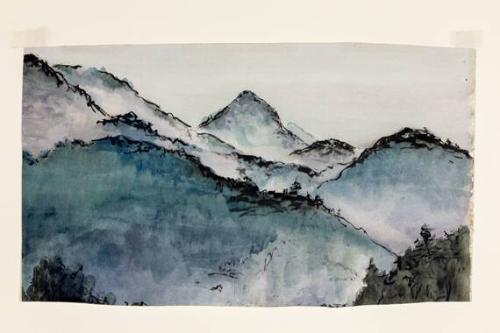
Martha painted over a thousand works in her lifetime, depicting the landscapes that her husband studied wherever they went. She gifted a painting to every one of her husband’s students when they graduated and hosted at least ten different one-woman art shows between 1941 and 1990. Eugene Odum told others that later in his career when the invitations to speak or study somewhere came often, he chose based on the sites his wife wanted to paint. They were an ecological team, he said, describing himself as “a landscape ecologist who studies the ‘essence of function’ of landscapes as living pulsing ecosystems” and Martha as “a landscape painter who was able to capture the ‘essence of place’ in her watercolors.”5
Eugene Odum was forced to retire from UGA in 1984 “kicking and screaming” after his seventieth birthday, according to Georgia law, but even afterwards he continued to be an active presence in the Institute of Ecology on campus until his passing in 2002 and provided yet another research opportunity for students within Athens. He was given emeritus status after retirement, keeping his office and working on committees and with graduate students while continuing to revise new editions of Fundamentals of Ecology, travel, guest lecture, and publish as much as possible. His publication list continued to grow well after his retirement from UGA, adding many papers and a few books about the importance of valuing our environmental resources, understanding them, and protecting them.
“[Eugene Odum’s] pioneering work in ecology has changed the way we look at the natural world and our place in it. Eugene Odum has had an important influence on the world by his insistence on the value of a quality environment.”
The Odum family was a formidable team when it came to ecology, as Eugene’s son William became a famous ecologist in his own right and Howard T., Eugene’s brother, was as prominent an ecologist as Eugene. It was Howard that had explained to Eugene the idea of energy as the uniting factor of an ecosystem and their trip together to study at Eniwetok Atoll focused on analyzing the flow of energy through a coral reef, even though neither of the brothers typically studied marine environments. When their research and detailed scientific analyses are combined with Martha’s landscape paintings of the study sites, a fuller picture of the ecosystem, as Odum taught us to see it, comes into view. The Odum family all worked together to bring Eugene’s modern ecology concepts to the forefront of biology, making it no longer just a niche topic of focus for researchers, but a fundamental area of biology taught to all students of the discipline. In Eugene, William, and Howard’s research and writings and Martha’s paintings the central principle of ecology as engraved on the bust of Dr. Eugene Odum at the University of Georgia becomes clear, “the ecosystem is greater than the sum of its parts.”
“The ecosystem is greater than the sum of its parts.”
Engraved on the bust of Dr. Eugene Odum at the University of Georgia
Notes
- Betty Jean Craige, 2001, Eugene Odum: Ecosystem Ecologist & Environmentalist
- Craige, Eugene Odum
- Craige, Eugene Odum
- Quote from Dr. Joe Pechmann in Betty Jean Craige, Eugene Odum
- UGA Research, “Eugene and Martha Odum: Capturing the essence”
Important resources outside of E.E. Reinke Archives documents for this project include Betty Jean Craige’s book, Eugene Odum: Ecosystem Ecologist & Environmentalist, published in 2001, the University of Georgia’s many webpages dedicated to the Odums’ contributions, the Georgia Museum of Art’s collection of Martha Anne Huff Odum’s artwork, and the book Holistic Science: the evolution of the Georgia Institute of Ecology (1940–2000), edited by Gary W. Barrett and Terry L. Barrett with a foreword by Eugene P. Odum.
To see more of Martha Anne’s paintings from the Odums’ travels, visit the Georgia Museum of Art’s collection.