
Notes from the Field · NFF·010 · Dendrochronology
Reading the Rings
A pencil-thin core, drawn by hand from a forest giant, holds a written record of every year the tree has lived. This is how we read it — and what Liam is listening for in the wood.
The film
Into the woods with the borer
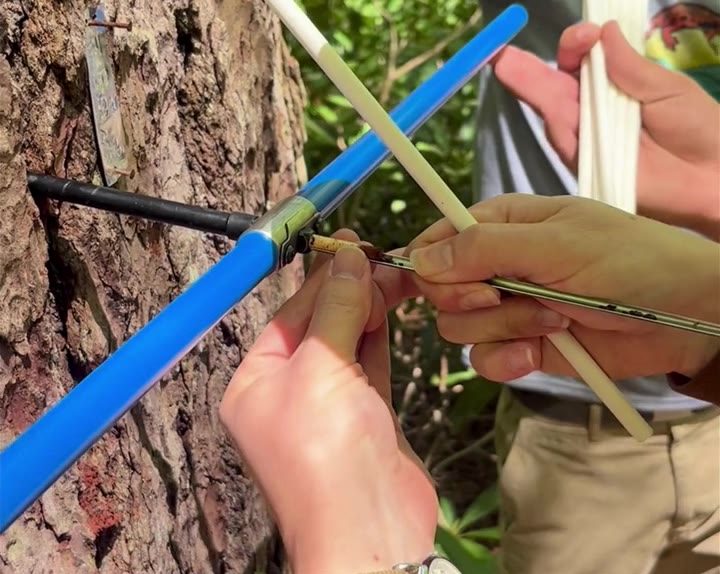
Follow a single core from start to finish: lining up the borer between the survey tags, threading it slowly toward the heart of the tree, and easing out a thin column of wood that no one in the group has seen the inside of before.
A field demonstration recorded at the Station. Liam narrates as he works; a teammate steadies the borer at the trunk.
The science, animated
How a core is read
The same steps Liam works through in the film, slowed down and drawn out: where the borer goes, why the rings appear, and how one tree's record joins with hundreds of others to stretch back across centuries.
Use the playback bar to scrub or pause. An animated companion to the film.
Reading time, ring by ring
Six steps, one column of wood
Coring is a sequence, and each move protects the record in the wood. Here's the order — the same one the film and the animation follow.
-
Line up the borer
Choose a sound trunk and set the borer level, on the slope contour, between the survey tags. Aim is everything — the goal is a straight line to the center.
In the film — "as you would normally, on the slope contour" -
Thread it in by hand
Start the threads, mind the cutting edge, and have a second pair of hands hold the borer steady so it bites cleanly without wandering.
In the film — "keep it steady for me… watch out for the blade" -
Bore toward the center
Turn smoothly and don't rock the handle. A wobble snaps the core; the aim is one intact column running as close to the pith as the tree will allow.
In the film — "don't wiggle it back and forth too much… we want to keep the core intact" -
Extract & orient the core
Slide the extractor spoon under the core and draw it out whole, keeping track of the outer end so you'll know which side is the bark — and which is the oldest wood.
In the film — "slide these over the core… we'll know which end's the bark" -
Count & measure the rings
Each pair of light and dark bands is a single year. Wide rings mark good seasons; tight, crowded rings — like the ones in this tree — mark hard years, and great age.
In the film — "look at how small those little rings are" -
Cross-date against many trees
Match this tree's pattern of wide and narrow years against cores from many others. Aligned, they build one shared chronology that can reach back centuries.
In the film — "combine it with data from a lot of other trees and match them all together"
What the rings tell us
Liam's research
A core is small enough to hold between two fingers, but it carries a remarkably long memory. Once it's mounted, sanded, and read under magnification, every ring becomes a dated line in the tree's biography — a year of rainfall, temperature, competition, and recovery, recorded in the width of the wood.
That's what makes a tree like this one worth the careful work. Liam Stiefel, a University Program Associate at Highlands Biological Station, recently earned his master's in dendrochronology from the University of Georgia. The cores collected here add narrative to the history of our forests on the plateau.
The tree in the film is a hemlock, and the rings were tight enough that Liam guessed its age the moment the core came out. Read against samples from across the region, cores like these help researchers reconstruct how these forests have grown, weathered drought, and changed over a span far longer than any of us will witness directly.
Field notes — heard on the recording
"Look at how small those little rings are — oh my gosh."
"It's possible this is rotten at the center."
"Don't wiggle it back and forth too much, because we want to keep the core intact."
"This is gonna be a really old tree, guys. I'm really excited because I can see just how narrow the rings are."
"We'll combine it with data from a lot of other trees and match them all together."
Credits
The field team
Research & narration
Led the coring and read the wood in the field. HBS University Program Associate.
At the tree
Steadied the borer and assisted with the extraction.
At the tree
Assisted with the coring and extraction at the tree.
Film & edit
Shot and edited the film on the Station grounds.
Keep reading