
Notes from the Field · Citizen Science
One of Ten
Some discoveries announce themselves. Others are scarcely larger than a sesame seed, tucked among the leaves, waiting for someone to look a little closer.
Hold a white sheet beneath a leafy branch. Give the branch ten gentle taps, and watch.
At first, there may be nothing. Then, slowly, the white begins to stir. A spider gathers its legs. A caterpillar curls into itself. A beetle makes a hurried escape toward the edge.
It is remarkable how much life can be shaken from a single branch, and how much of it we might never have noticed otherwise.
Throughout the growing season, volunteers here at Highlands Biological Station spend their time doing just this. Branch by branch, leaf by leaf, they count and measure the tiny creatures they encounter, photograph what they can, and contribute their observations to Caterpillars Count!, a citizen science project based at UNC-Chapel Hill.
There is a larger question beneath all this small looking.
Caterpillars and other leaf-dwelling insects are an essential part of the food web, particularly for songbirds raising their young. Those hungry nestlings depend on a seasonal abundance of insects, and for generations, the rhythms of nesting and feeding have followed the turning of the seasons. But as our climate changes, so too might that delicate timing. Caterpillars Count! helps researchers understand whether the insects are arriving when the birds need them most.
Our surveys began in 2021, when Lauren Whitenack, a former Highlands Field Site student, brought the project to the Station alongside our bird banding work with the Blue Ridge Bird Observatory.
And every so often, among the many ordinary observations, something quite extraordinary turns up.
A very small discovery
This fall, the Caterpillars Count! team revisited more than 52,000 photographs submitted by volunteers, looking for the rarest observations tucked among them.
Twelve species stood out. As of November 2026, not one had been recorded more than 22 times on iNaturalist, the global biodiversity observation platform.
And one of those twelve was found right here at the Station.
Its name is Micrutalis dorsalis, a tiny treehopper photographed by our own Heather Pratt.
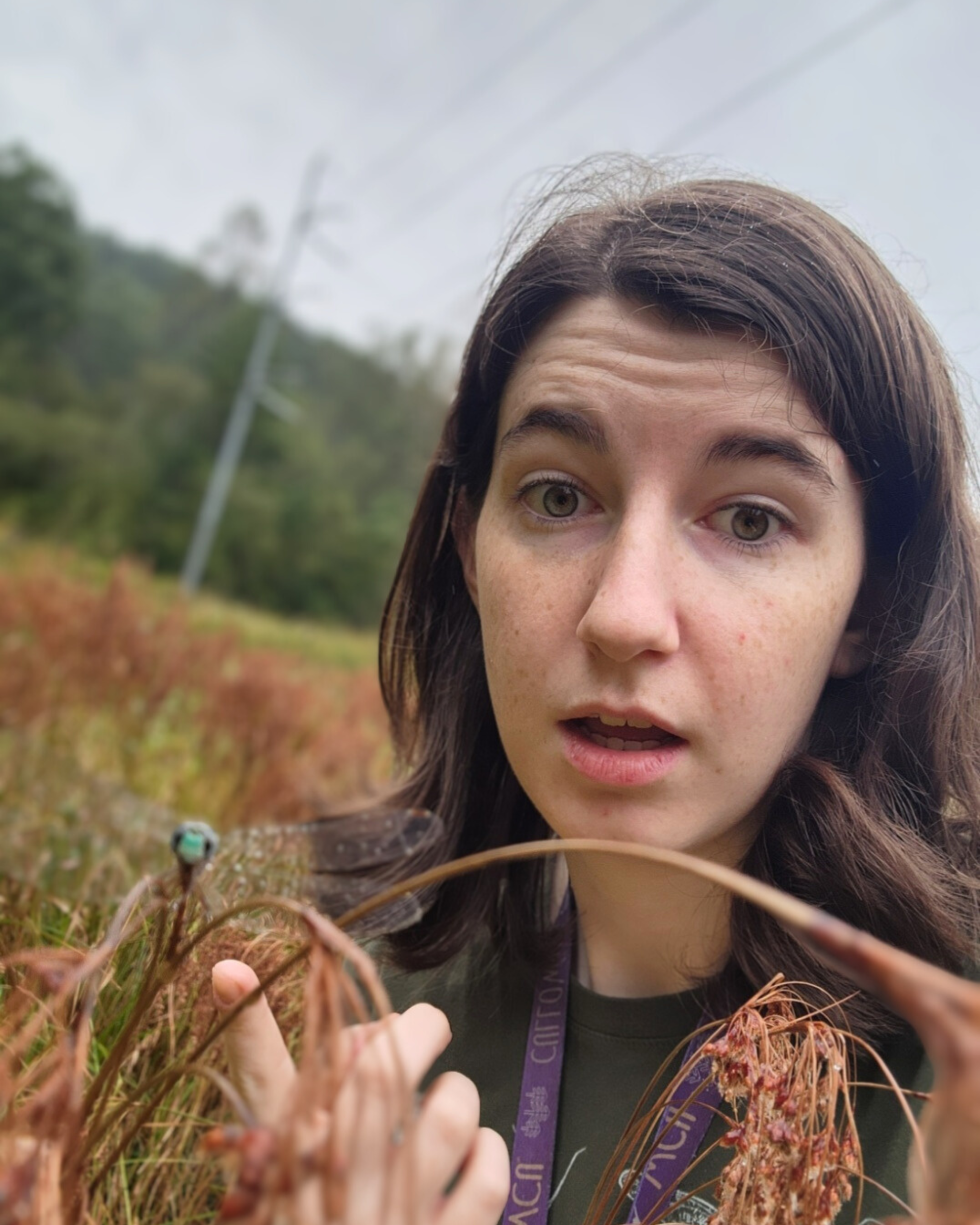
I have a particular fondness for discoveries like this. Heather has spent years lending her time and careful attention to research at the Station, and tucked into the thousands upon thousands of observations made by volunteers was this little creature, scarcely four millimeters long.
Treehoppers are curious insects, relatives of cicadas and leafhoppers, that spend their days feeding on plant sap. Many wear an enlarged shield over their backs, shaped in such a way that they disappear against the stems and thorns of the plants they inhabit.
Micrutalis dorsalis doesn’t even have a common name. At about the length of a sesame seed, it would be terribly easy to mistake for a bit of the branch itself.
And yet, there it was.
One of only ten records on iNaturalist.
Of course, ten observations do not necessarily mean ten encounters, or even that the insect itself is especially rare. It may simply mean that very few people have thought to look for it, or have looked closely enough to recognize what they were seeing.
I find something rather lovely in that distinction. The natural world has not necessarily been keeping its secrets from us. We may simply have been passing them by.
See our record on iNaturalist See every record on iNaturalist
The more we look
There is another piece of this story that I love.
Of the twelve rarest species identified in the project, six came from a single group of volunteers near Boston, called EarthwiseAware. Their observations were made with the same sort of patient attention, accompanied by close, careful photographs that allowed experts to identify even the smallest insects.
It makes me wonder just how much goes unseen in the places we think we know best.
We tend to imagine discovery happening somewhere far away, in places difficult to reach or scarcely explored. And sometimes it does. But sometimes discovery is a familiar branch, a white sheet, and the willingness to look twice.
The Caterpillars Count! team has an unofficial motto: the more you look, the more you see.
I suspect there is more truth in those few words than we realize.
Try a survey
Fifty leaves, a little patience
If you’re curious what these surveys actually involve, here’s a chance to try one yourself.
A visual survey asks you to examine fifty leaves on a single branch, looking at their upper surfaces, undersides, stems, and twigs. You record every arthropod you find, along with its length.
Some leaves may be crowded with life. Others may hold nothing at all.
Those empty leaves count, too.
There’s something worth remembering in that. Science is as much about what we don’t find as what we do, and even an ordinary observation becomes part of a much larger picture when enough people take the time to make it.
A visual survey
Take a careful look at fifty leaves on one branch, checking both sides, the stems, and the twigs. Record and measure the arthropods you encounter.A beat sheet survey
Hold a white sheet beneath a branch, strike the branch exactly ten times, and spend at least a full minute examining what has fallen. This is how our surveys at the Station first began.The rarest twelve
Seen only a handful of times
Twelve species. Thousands of submitted photographs. And an extraordinary collection of tiny lives that, until someone paused to photograph them, had scarcely appeared in the public record.
The map below follows those twelve observations to the places where they were made.
For a little perspective, the Asian lady beetle, that familiar autumn visitor to our windowsills, has nearly 600,000 observations on iNaturalist.
Our little treehopper has ten.
Volunteers and the data
The care behind the count
Of course, finding these tiny creatures is only half the work. Knowing what you’ve found can be another matter entirely.
The Caterpillars Count! team recently compared volunteers’ original identifications with those later agreed upon by the iNaturalist community. And the results were rather encouraging.
90.2% of volunteer identifications were confirmed as correct.
There were, naturally, a few tricky characters.
Nearly 40% of the insects initially called aphids turned out to be something else, while 60% of sawfly larvae were mistaken for caterpillars. If you’ve ever looked closely at a sawfly larva, you’ll understand why. The resemblance is convincing, even to a practiced eye.
Fortunately, a hungry songbird is unlikely to be terribly concerned with the distinction.
Spiders, ants, and caterpillars were generally identified correctly. It was often the very smallest creatures, the tiny bugs, beetles, and leafhoppers, that proved the most difficult.
And that seems fitting, somehow. The smaller the creature, the more it asks of our attention.
Even in a project built around looking closely, there is always another reason to look closer still.
Over the winter
When the leaves return
By December, the branches around the Station have given up most of their leaves. The little lives that filled them through summer have retreated into all the quiet places where winter is spent.
There are no leafy branches to survey just now, but Caterpillars Count! has an online game where you can practice spotting, identifying, and measuring arthropods from the warmth of home.
And when spring returns, so will the surveys.
If you’d like to join us, reach out to our Associate Director, Jason Love, at jlove@wcu.edu. New eyes are always welcome.
I keep thinking about Heather’s treehopper. Four millimeters of life, so easily mistaken for something else. It was there all along, going about its small business in a world that seldom notices it.
Somewhere among the coming spring’s leaves, there will be countless others.
And perhaps, with a little patience, we’ll find a few of them.