
Notes from the Field · Research Abroad
From Highlands to Tsukuba
Highlands Biological Station’s microplastics research traveled to the SETAC Asia-Pacific Biennial Conference in Japan, where four Station-affiliated projects joined the conversation.
- 600Researchers at the conference
- 45+Countries represented
- 4HBS-affiliated projects presented
- Sept. 20–23Tsukuba, Japan · 2026
Highlands Biological Station’s microplastics research has gone international! In September, HBS Associate Director Jason Love, UNC-Chapel Hill Highlands Field Site Director Dr. Rada Petric, and UNC-Chapel Hill undergraduate and 2025 HBS Institute for the Environment alumna Rachel Price joined colleague and collaborator Dr. Austin Gray (Virginia Tech) at the Society of Environmental Toxicology and Chemistry (SETAC) Asia-Pacific Biennial Conference in Tsukuba, Japan. Six hundred researchers from over 45 countries were represented at the conference. Four HBS-affiliated research projects were presented: Love presented work on microplastics in Asian Clams in the Little Tennessee and Tuckasegee Rivers, Dr. Petric spoke about microplastics found in earthworms and shrews at HBS, Price gave a talk about microplastics in Big Brown Bats, and Dr. Gray shared the findings from the Hurricane Helene study on microplastics.
“Plastic pollution is a global problem and many of the research projects presented at the conference focused on microplastics in the environment or were lab-based studies looking at microplastic impacts on organisms. It was nice to see how HBS research on microplastic dovetailed with some of these other research projects,” Love noted. “We are still one of the few places in the world that are actively measuring deposition of microplastics from the atmosphere, which I feel is something that is being overlooked, especially in the United States.”
Jason Love, Associate Director

Four projects, one thread
What the Station brought to Tsukuba
All four appear in the abstract book for the SETAC Asia-Pacific 15th Biennial Meeting, held September 20–23, 2026, in Tsukuba under the theme “Rethinking Environmental Balance for the Future.” Open any project to read its full abstract. Highlands Biological Station authors are shown in bold.
01
Poster 1.07.P–Mo021
Microplastics in Asian Clams
“Increase in Microplastic Concentrations in Golden Clams (Corbicula fluminea) Between 2018 and 2025 in the Little Tennessee Watershed, North Carolina, USA”
Presented by Jason Love · Associate Director, Highlands Biological Station
Using Golden Clams as living indicators at six sites in the Little Tennessee River basin, the team compared microplastics in 2018 and 2025. On average, both counts and concentrations rose, fibers made up more than 90 percent of what they found, and the levels rank among the highest ever recorded in bivalves, even in remote stretches of the river.
- 54.5%Rise in the average count per clam sample, 2018–2025
- 73.9%Rise per gram of clam tissue
- >90%Of particles in air, water and clams were fibers
Read the abstract
Institute for the Environment, University of North Carolina at Chapel Hill; Highlands Biological Station, Western Carolina University; Department of Biological Sciences, Virginia Tech; Warnell School of Forestry and Natural Resources, University of Georgia; USDA Coweeta Hydrologic Laboratory
Global plastic production continues to increase by ~8% annually despite growing concerns about its environmental and human health impacts. Recent studies have demonstrated that forested headwater streams in the Southern Appalachian Mountains of western North Carolina contain some of the highest concentrations of microplastics (MPs) ever recorded in freshwater systems; however, concentrations of MPs in rivers within this region and across different years have not been examined. We used Golden Clams (Corbicula fluminea) as biological indicators to assess changes in MP concentrations from 2018 to 2025 at six sites in the Little Tennessee River basin in western North Carolina, USA. For a more complete understanding of MPs in the whole freshwater system, atmospheric deposition and stream water samples were also collected and analyzed. Overall, from 2018 to 2025, we found a 54.5% increase in the mean number of MPs in our clam samples and a 73.9% increase in the mean MPs per gram of clam tissue, although those results varied among the six sites. Consistent with 2018 observations, fibers were the most prevalent type of MP, accounting for >90% of particles found in atmospheric samples, stream water samples, and clams. Our findings on counts and concentrations of MPs in Golden Clams are among the highest ever recorded from bivalves. We also found that MP counts and concentrations were high even in remote sections of the Little Tennessee River, which is considered a biodiversity hotspot for rare fish and freshwater mussels. Our findings support the need for further research into the pervasive nature and effects of MPs on freshwater systems and their influence on biodiversity, as native bivalve populations have experienced enigmatic declines in recent decades.
02
Poster 1.06.P–Tu019
Earthworms and shrews
“Microplastics in a Southern Appalachian Forest: Assessing Connections Between Atmospheric Deposition and Terrestrial Food Chains”
Presented by Dr. Rada Petric · Highlands Field Site Director, UNC-Chapel Hill
The first look at microplastics in wild shrews and the earthworms they eat. Shrews carried more microplastics per gram than earthworms, a hint that plastics may move up this forest food chain, and the highest levels turned up in the shrews’ lungs and hearts.
- 55%Higher concentration per gram in shrews than in earthworms
- 48.8Microplastics per gram in shrew lungs, the highest of any organ
- 19 & 30Shrews and earthworms examined
Read the abstract
Institute for the Environment, University of North Carolina at Chapel Hill; Department of Biological and Environmental Sciences, Georgia College and State University; Department of Biological Sciences, Virginia Tech; Highlands Biological Station, Western Carolina University
Microplastics (MPs, <5mm) are ubiquitous global contaminants, yet there is little information about their fate through terrestrial food webs. In the Southern Appalachian Forest of the United States of America, the atmosphere is a major source of MP pollution for the area. We provide the first assessment of MPs in wild shrews (Sorex cinereus, Sorex fumeus, Blarina brevicauda) and earthworms (a common shrew food source) collected. Following dissection, we harvested shrews heart, lungs, liver, kidneys, gut, and brain to examine MP presence and composition among organs, while earthworms were sampled as a whole organism. Thirty earthworm and organs of 19 shrews were digested with hydrogen peroxide, filtered, and examined microscopically to assess MP count, type, and color. A subset of samples was analyzed via Raman Spectroscopy to identify the type of plastic. We found that shrews had 55% higher MP concentrations per gram of tissue than earthworms. We also found differences in MP concentration across shrew organs, with the highest mean concentration in the lungs (48.8 MP/g) and heart (20.4 MP/g) and the lowest in the gut (4.1 MP/g). Fibers were the most common plastic morphology found in the samples. Our results suggest possible biomagnification or trophic transfer of MPs in this terrestrial food chain. Furthermore, differences in MP concentrations among tissues could be attributed to differences in cellular turnover rates. Our results demonstrate the ability for MPs to be accumulated and transferred up trophic levels in terrestrial ecosystems.
03
Talk 1.06.A.T03
Big Brown Bats
“Microplastics In The Organs Of Big Brown Bats (Eptesicus fuscus) From North Carolina: Associations With County-Level Urbanization”
Presented by Rachel Price · UNC-Chapel Hill undergraduate, 2025 HBS Institute for the Environment alumna
Microplastics turned up in every organ tested in 18 big brown bats from six North Carolina counties, most of all in the gut. Bats from more urban counties carried more microplastics in the gut, which points to eating as the main way they take them in.
- 18Big Brown Bats from six North Carolina counties
- 5 of 5Organs tested held microplastics
- GutHighest concentration; the lungs held the least
Read the abstract
Institute for the Environment, University of North Carolina at Chapel Hill; North Carolina Museum of Natural Sciences; Highlands Biological Station, Western Carolina University; Department of Biological Sciences, Virginia Tech
Plastic production has increased since the 1950s due to its low cost and versatility, raising concerns about environmental and health impacts. As plastics degrade, they form microplastics (MPs) that can be ingested or inhaled and subsequently accumulate in animal tissues. While the effects of MPs on marine organisms are relatively well studied, exposure pathways and impacts in terrestrial systems remain poorly understood.
Eptesicus fuscus (big brown bats) are widespread North American insectivores that can serve as bioindicators of MP exposure through airborne, aquatic, and insect-mediated pathways. In this study, we evaluated 18 bats across six counties in North Carolina, USA. We assessed MP presence in the heart, lungs, liver, kidneys, and gastrointestinal tract and tested whether urbanization predicts MP burden. An urbanization index was developed using population density, impervious surface cover, and tree canopy metrics. Specimens were obtained opportunistically as a byproduct of the rabies testing.
We found MPs in every bat organ tested with the highest concentration of MPs in the gastrointestinal tract and lowest in the lungs. Total MP burden per individual bat was not correlated with urbanization levels; however, urbanization levels were positively correlated with MP counts within the gastrointestinal tract. These findings suggest that the primary mechanism of MP exposure in big brown bats is via ingestion. This study highlights the potential for widespread terrestrial exposure and underscores the need to better understand alternative pathways of microplastic uptake in insectivorous wildlife.
04
Talk 2.08.B.T02
The Hurricane Helene study
“Influence of a Category 4 Hurricane on Microplastic Deposition in the Mountainous Southeastern United States”
Presented by Dr. Austin Gray · Virginia Tech
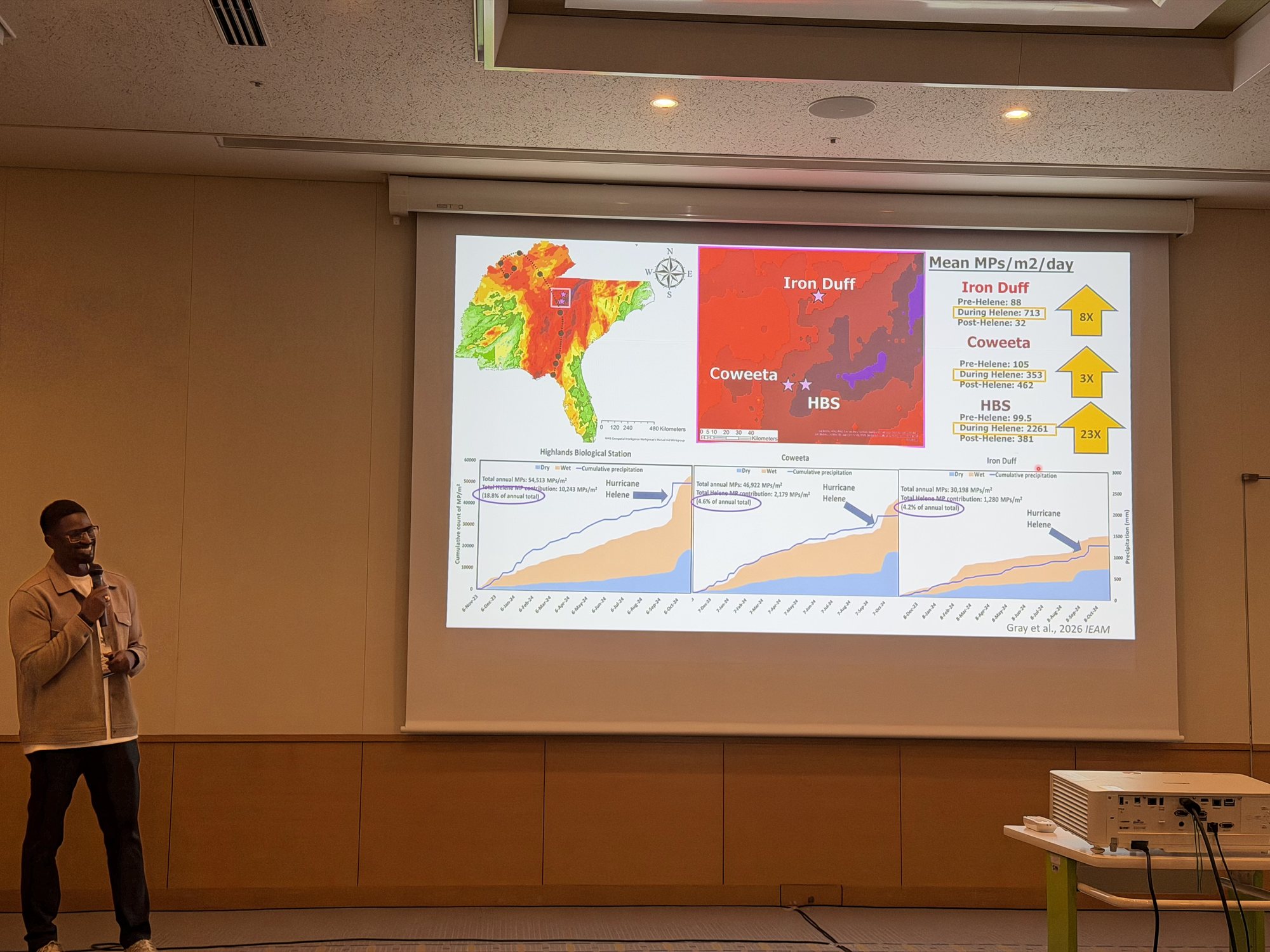
Samplers running before, during and after Hurricane Helene at Iron Duff, Coweeta and the Station caught a spike in microplastics falling from the sky. Here at HBS, the storm delivered nearly a fifth of the year’s deposition.
- 18.8%Of a year’s deposition at HBS fell with Helene
- 10,243Microplastics per square meter at HBS during the storm
- 385 quadrillionEstimated extra microplastics across the storm’s footprint
Read the abstract
Virginia Tech; Highlands Biological Station; Western Carolina University; University of North Carolina
Due to global warming, we can expect more intense hurricanes, leading to higher precipitation than previously observed. Historic storms, such as Hurricane Helene, that hit the southeastern United States in September 2024, deposited between 508 to 762 mm (20-30 in) of rainfall in rural, mountainous parts of Western North Carolina, causing catastrophic damage from flooding. Less known is the extent of microplastic (MP) deposition in these less-developed areas, as MP levels are largely influenced by development, population, and traffic. While there is insight into MP deposition due to typhoon events in the eastern parts of the world, in our assessment, we conducted the first-ever study assessing MP deposition in a severely affected region at multiple locations (Iron Duff, Coweeta Hydrologic Laboratory, and Highlands Biological Station (HBS) in the southeastern US, months before (January to September), during (September), and weeks post-storm (October to November). Our findings show that Hurricane Helene contributed to elevated MP deposition at all sites, where total storm MP deposition was 1,280, 2,179, and 10,243 MP/m² at Iron Duff, Coweeta, and HBS, respectively. This historic storm accounted for 4.2%, 4.6%, and 18.8% of the annual MP deposition at Iron Duff, Coweeta, and HBS, respectively. Using backward trajectory analysis, we found that air masses reaching our sampling locations differed between the Helene and pre- and post-Helene periods. Our regression model estimated that the total anomalous deposition over the area affected by Hurricane Helene (3,798,756.55 km²) was 3.85 × 10¹⁵ MPs (385 quadrillion MPs). Polyamide, polystyrene, polyethylene terephthalate, polypropylene, and polyethylene were the main polymers detected before and during Helene. Our findings underscore how extreme storms can produce short-term spikes in MP deposition above ambient levels in a region and highlight how abundant MPs are in the atmosphere.
Measured from the air
We are still one of the few places in the world that are actively measuring deposition of microplastics from the atmosphere.
Jason Love · Associate Director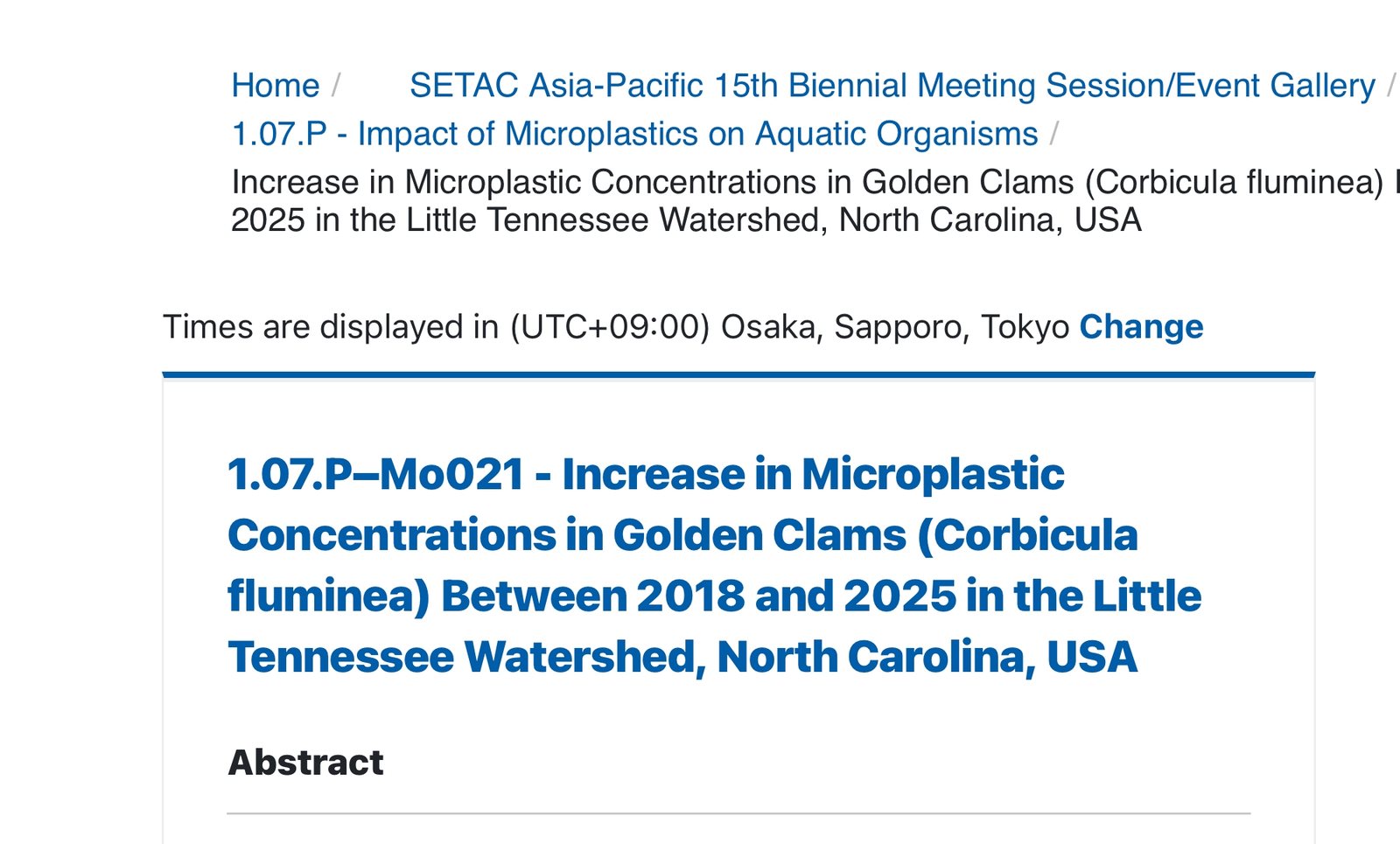
With thanks
Our thanks to the Highlands Biological Foundation for helping fund this trip, and for helping carry the Station’s research to colleagues around the world.
Keep reading