
Notes from the Field · Highlands Biological Station
Summer, Carried Through
The light falls differently across our mountains now. Along the rocky ridges surrounding Highlands, the familiar greens of summer have given way to brilliant crimsons and rusts. Among them are three blueberries whose histories reach far beyond the turning of the seasons.
By Sarah Vickery · Featuring research by Dr. Paul S. Manos of Duke University and colleagues
The things summer leaves behind
By late November, the afternoon sun barely seems to settle into the sky before beginning its descent. Its light spills across the exposed ridges, catching the pale lichens, the weathered trunks of pitch pines, and the remnants of autumn tucked between the rocks.
Here, low-growing blueberry shrubs have gathered into brilliant pools of crimson. Their berries, which ripened beneath the generous light of July and August, are long gone. Yet something of summer lingers in the landscape.
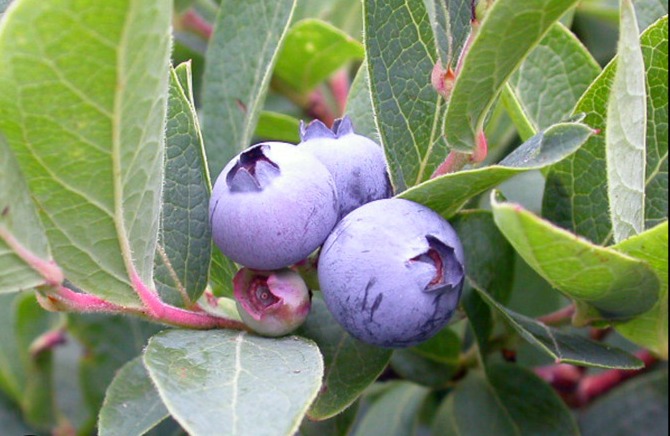
In a newly published study in Systematic Botany, Dr. Paul S. Manos of Duke University and his colleagues explore the evolutionary origins of three blueberries intimately acquainted with our Southern Appalachian landscape: Mountain Blueberry (Vaccinium simulatum), Hairy-fruited Blueberry (Vaccinium hirsutum), and Constable’s Blueberry (Vaccinium constablaei).
Their findings invite us to reconsider some of our most familiar botanical neighbors. The full paper is waiting at the end, but first, three blueberries worth meeting.
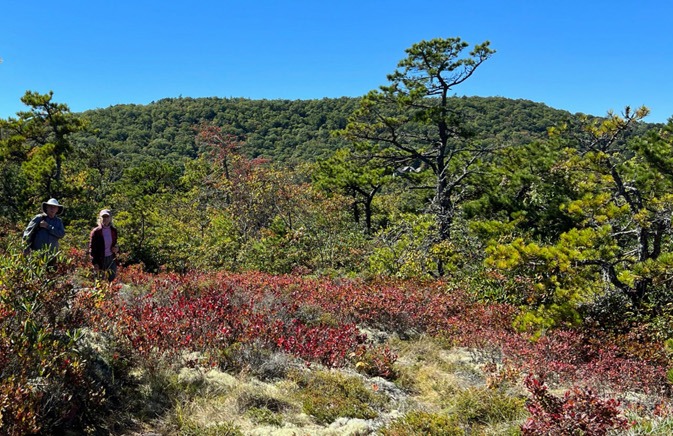
Three blueberries of the high places
Each occupies a slightly different corner of our mountain landscape. Each has inherited a different evolutionary history. And each offers something new to notice the next time we find ourselves wandering these familiar trails.
Mountain Blueberry
Vaccinium simulatumfour sets · 2n = 48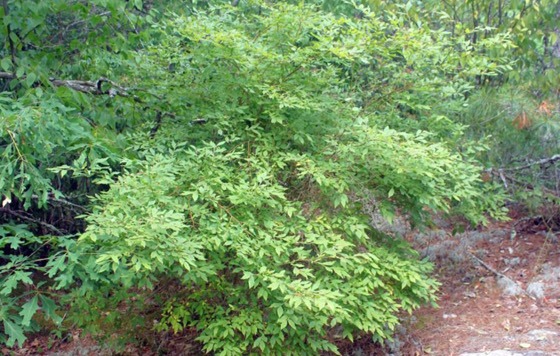
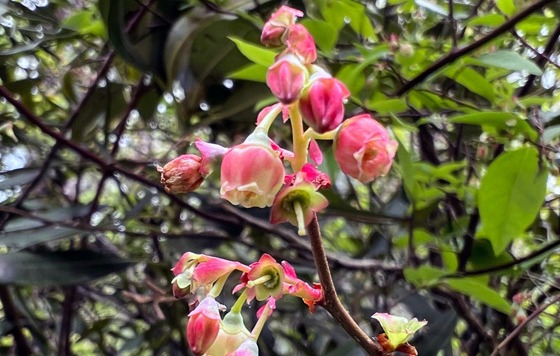
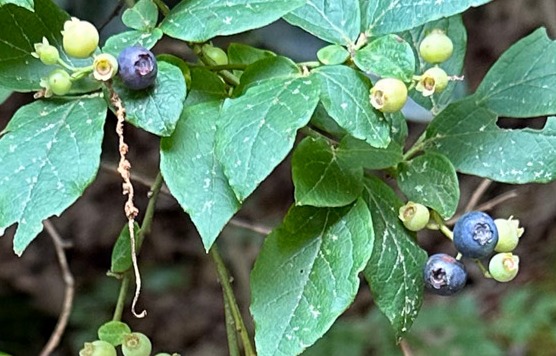
Left to right: a clump on Satulah Mountain (photo: Peter W. Fritsch); flowers and ripening fruit (photos: Dr. Paul S. Manos).
Of the three, the Mountain Blueberry is the most geographically adventurous. Its distribution stretches beyond the Southern Appalachians, reaching from southern Ohio to northeastern Mississippi. Here in our mountains, it finds itself at home among rocky ridges, windswept shrublands, hemlock forests, and high-elevation bogs.
Its closest genetic relative is Vaccinium pallidum. The similarities between the two are so pronounced that even genomic analyses struggle to fully separate them.
A closer look
- Chromosomes
- 48
- Height
- 0.6–3 meters
- Flowering
- Late March to early June
- Fruiting
- Late June to late August
- Typical elevation
- 300–1,950 meters
- Closest relative
- Vaccinium pallidum
Hairy-fruited Blueberry
Vaccinium hirsutumfour sets · 2n = 48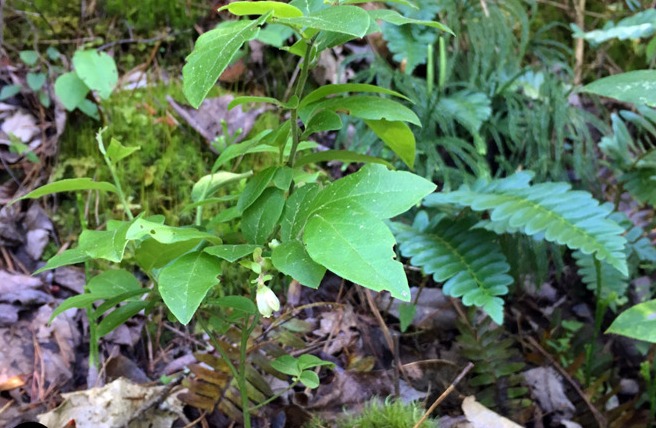
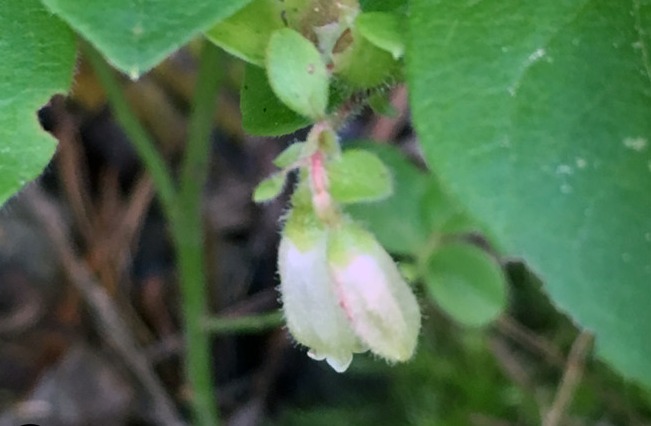
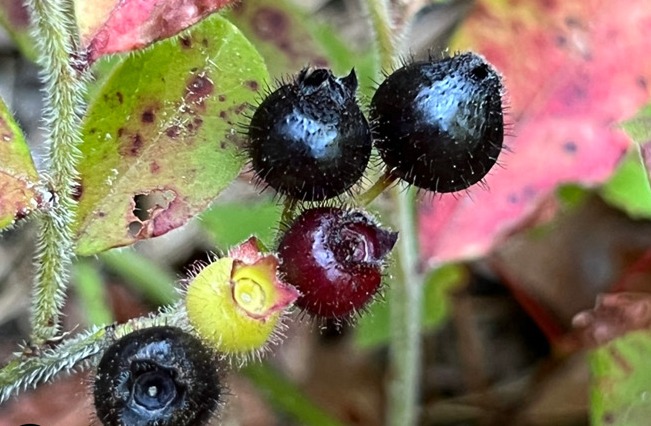
Left to right: habit and flower (photos: Andrew A. Crowl); the hairy black fruit (photo © Ashley M. Bradford, CC BY-NC, via iNaturalist).
There is something wonderfully peculiar about the Hairy-fruited Blueberry. Look closely at its ripe fruit and you will find what distinguishes it from every other member of the true blueberry group. Its glossy, almost black berries are adorned with delicate, gland-tipped hairs.
This diminutive blueberry inhabits rocky ridges, acidic woodlands, creek margins, and bogs across portions of western North Carolina, eastern Tennessee, and northern Georgia. It is also exceptionally rare.
A closer look
- Chromosomes
- 48
- Height
- 0.4–0.6 meters
- Flowering
- Mid-May to late June
- Fruiting
- Mid-July to late August
- Typical elevation
- 430–1,500 meters
- Probable ancestry
- A lineage resembling Vaccinium myrtilloides
Constable’s Blueberry
Vaccinium constablaeisix sets · 2n = 72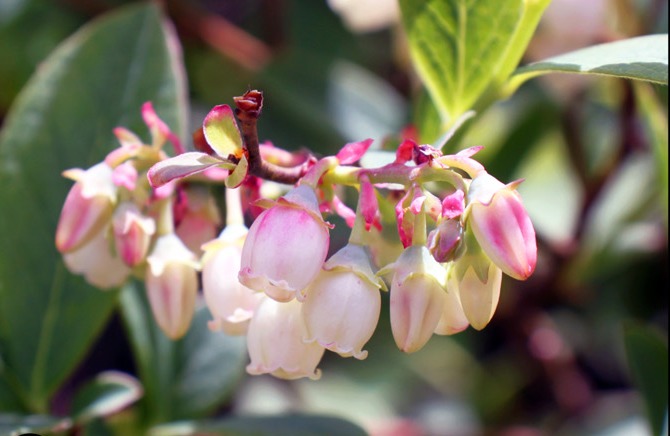
Big Fodderstack in autumn; flowers; fruit. Photos: Dr. Paul S. Manos.
If you have spent an autumn wandering the rocky outcrops surrounding Highlands, there is a good chance you have already made the acquaintance of Constable’s Blueberry. It is the blueberry that paints expanses of our exposed rock faces in brilliant shades of scarlet, weaving itself through crevices and around the weathered contours of our mountains.
And yet, despite its familiarity in our landscape, its evolutionary origins remain elusive. Researchers have yet to identify a living diploid species from which it originated. How remarkable that something so familiar beneath our feet can hold within its cells the genetic echoes of a plant we may never encounter.
A closer look
- Chromosomes
- 72
- Height
- 0.3–2.1 meters
- Flowering
- Late April to mid-June
- Fruiting
- Late July to mid-August
- Typical elevation
- Approximately 1,050–1,850 meters
- Ancestry
- An early-branching lineage whose precise origins remain unresolved
A story written in our own backyard
One of the particular joys of this research is recognizing the landscapes woven throughout it. Big Fodderstack, with its crimson expanses of Constable’s Blueberry. Satulah Mountain, where Mountain Blueberry grows among the rocks. Sunset Rock and Shortoff Mountain, whose plant populations contributed to the collections examined in this study.
During the spring of 2021, Dr. Paul S. Manos spent a sabbatical here in Highlands. In the acknowledgments of this publication, he recognizes the support of Highlands Biological Station, HBS Executive Director Dr. Jim Costa, and the generosity of the Sargent family: Hugh, Lydia, Cheryl, and Liz.
What the mountains keep
Soon, the last of the crimson blueberry leaves will give way to winter. Beneath the surface, roots will remain entwined with the mountainside, and within their cells these plants will carry forward an inheritance whose origins stretch far beyond our own histories here.
Perhaps next summer, when we find ourselves reaching for a blueberry along a familiar trail, we will linger a little longer.
There is so much more to a blueberry than the sweetness of its fruit.
An invitation
Read Dr. Paul S. Manos’s paper
The story above is only a glimpse. In the full publication, Dr. Paul S. Manos and his colleagues lay out the genetic evidence, the historical specimens, and a more comprehensive identification key for all seven true blueberry species recognized in the Southern Appalachians.
Manos, P. S., A. A. Crowl, G. P. Tiley, and P. W. Fritsch. 2026. Evolution and Taxonomy of the Polyploid True Blueberries (Vaccinium sect. Cyanococcus) Endemic to the Southern Appalachian Region. Systematic Botany.
Read the full publicationThis research represents a collaboration among Duke University, the Florida Museum of Natural History, Royal Botanic Gardens, Kew, North Carolina State University, and the Botanical Research Institute of Texas, with support from the National Science Foundation.
Photography by Dr. Paul S. Manos, Andrew A. Crowl, Peter W. Fritsch, and Ashley M. Bradford (via iNaturalist, CC BY-NC).
Words by Sarah Vickery for Highlands Biological Station.