
Notes from the Field · Dispatch · November 2026
Puzzling the Grassy Archipelago
Insights from Alfred Russel Wallace into the origin and maintenance of high-elevation grassy balds
Before the essay
From HBS to Roan Mountain: Reveling in Ecological Enigmas
Dr. Jim Costa, HBS Executive Director
I recently had the pleasure of speaking at the 64th Annual Roan Mountain Fall Naturalists Rally, one of four annual educational and fundraising events sponsored by the Friends of Roan Mountain. An organization that “fosters greater awareness and understanding of the natural, historical, and cultural significance of Roan Mountain,” the Friends of Roan Mountain has for many years provided volunteers and grants aiding Roan Mountain State Park, the U.S. Forest Service, and individuals and organizations undertaking scientific or conservation projects on Roan Mountain.
Located to the northeast of Great Smoky Mountains National Park, along the Appalachian Trail, the approximately 5,800′ – 6,300′ Roan Mountain massif is home to the largest and grandest of high-elevation grassy balds anywhere — an expansive and stunning landscape of native grasses and a host of botanical rarities including several relict species from the last Ice Age. It is also the locus of an enduring ecological puzzle: no mountains in the southern Appalachians extend above climatic treeline, so how do we account for the origin and persistence of these wide grassy expanses high on the mountaintops but otherwise surrounded by dense forest?
Among the most beautiful and rare of southern Appalachian biological communities, the ecological enigma of Roan only adds to its allure, and the place has drawn naturalists like a magnet for centuries. We here at HBS are no exception: more than a few HBS courses, my own included, make annual pilgrimages to Roan and the nearby and equally remarkable Gray Fossil Site to give our students boots-on-the-ground experience — a hallmark of our field courses — to help them grasp the remarkable lessons these sites teach us about the ecology and evolution of the southern Appalachian landscape.
In doing research for my Roan Rally presentation I ferreted out some of the older literature on the ecology of Roan that I had not yet read, and came across papers that made me realize that the HBS-Roan connection goes way back, beyond field courses. New Zealand ecologist Alan Francis Mark (later Sir Alan, knighted for distinguished contributions to science and conservation) completed his Ph.D. at Duke University in 1958 under renowned plant ecologist W. D. Billings, writing his dissertation on the ecological puzzle of Roan Mountain. Mark’s research resulted in important scientific papers published in 1958 and 1959, both of which acknowledge the financial support of Highlands Biological Station.
“It was thrilling to realize that early and significant research on the ecology of Roan Mountain was supported in part by HBS.”
Dr. Jim Costa, HBS Executive Director
Mark was thus one of the earliest beneficiaries of the now nearly 70-year-old HBS Research Grant-in-Aid program. HBS Grants-in-Aid got their start in the late 1950s with support from the National Science Foundation, and have been funded by the Highlands Biological Foundation, Inc. and a set of named scholarships that organization administers ever since. This signature program of HBS has yielded hundreds of scientific publications and dozens of graduate theses and dissertations over the decades, and it was thrilling to realize that early and significant research on the ecology of Roan Mountain was supported in part by HBS.
A thread from 1958 to today
HBS Grants-in-Aid got their start in the late 1950s with support from the National Science Foundation.
Mark completed his Ph.D. at Duke University in 1958 under plant ecologist W. D. Billings, writing his dissertation on the ecological puzzle of Roan Mountain. His papers of 1958 and 1959 both acknowledge the financial support of Highlands Biological Station. He was later knighted, as Sir Alan, for distinguished contributions to science and conservation.
The program has been funded by the Highlands Biological Foundation, Inc. and a set of named scholarships that organization administers ever since. It has yielded hundreds of scientific publications and dozens of graduate theses and dissertations.
My return to Roan Mountain for the Fall Naturalists Rally was an opportunity to revel in the wonders of the place with kindred spirits, an enthusiastic audience of naturalists, conservationists, and dedicated volunteers. I recounted the leading hypotheses for the origin and maintenance of the grassy balds, including insights from Mark and others, and offered up some new perspectives — not least, insights from 19th century naturalist Alfred Russel Wallace that may help flesh out the leading explanatory model for the balds that ecologists have been discussing in recent years.
Readers of the HBS newsletter being equally kindred spirits who marvel in the ecological wonders of our region may enjoy this essay version of my presentation: Puzzling the Grassy Archipelago.
Read the essay Download the PDF (opens in a new tab)
The HBS Research Grants-in-Aid are funded by the Highlands Biological Foundation, Inc. Meet the 2026 recipients.
An ecological riddle
A Riddle Still
Roan Mountain looms large literally and figuratively — literally as home to the largest and most spectacular of the southern Appalachian high-elevation grassy balds, and figuratively in posing perhaps the greatest ecological mystery of our region. In his renowned 1932 book The Natural Gardens of North Carolina, B. W. Wells commented that “No plant communities in the state have been more puzzling to the ecologist than those that come under the designation of mountain balds.” Moreover, not until “intensive studies...are made and continued over many years,” Wells further reflected, “will ecological science begin to solve the riddle of the balds.” Ninety-four plus years and many “intensive studies” later, however, the origin and evolution of Roan’s grassy mantle is an ecological riddle still.
“...will ecological science begin to solve the riddle of the balds.”
B. W. Wells, The Natural Gardens of North Carolina, 1932
Some southern Appalachian grassy balds are known to be relatively recent and anthropogenic in origin. Roan and several others, however, are clearly ancient — home to a plethora of sun-loving grasses and forbs that include, tellingly, native grasses and a number of rare endemic and disjunct glacial relicts — plant species more typical of the far north. These largely treeless grasslands lie below climatic treeline — collectively you might think of them as an archipelago of grassy islands in the great forest sea. But was Roan and similar balds once forested to their summits like their neighboring mountain peaks? If so, how and when did the trees disappear? And, just as importantly, not re-appear? Why, as Wells put it, “this hesitancy to go back to forest when forests are all around them?” Over the years a range of natural and anthropogenic causes have been hypothesized to account for the origin and maintenance of the balds. Perhaps they are communities shaped by certain qualities of the soil, frequent fire, or relentless high-elevation winds, snow, and ice? Or are they relics of Native American and then settler activity: regular burning, tree girdling, and later, livestock grazing?
Look closely
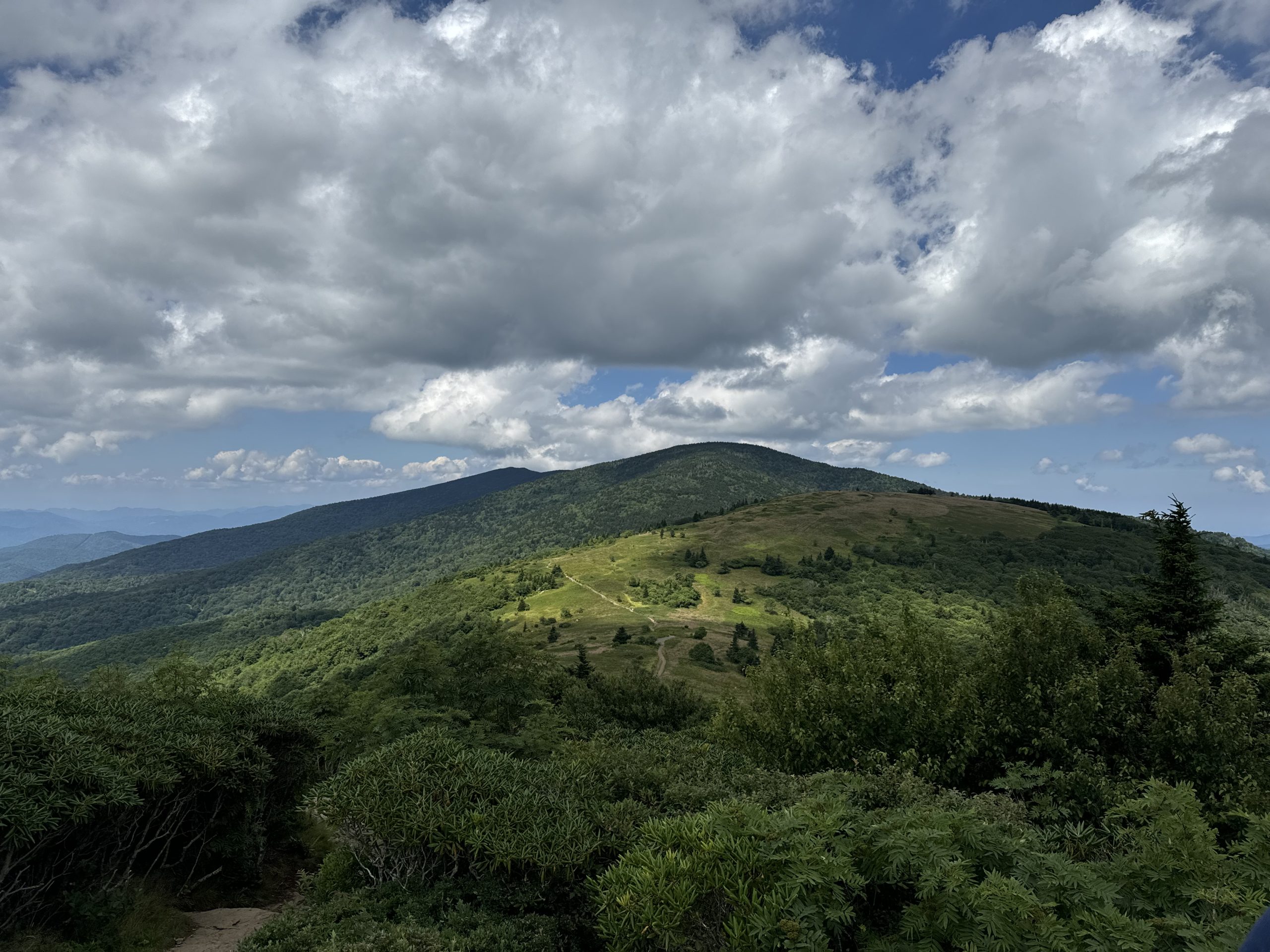
Roan Mountain, looking toward Round Bald
Before reading on, spend a minute with the view. Select any numbered marker to notice something in the landscape.
Where to look
Choose a marker above to read what it might tell us.
A first idea, tested
Can Trees Grow Here?
The first idea that might come to mind is a logical one: maybe woody trees and shrubs just can’t grow there. This is precisely what ecologist Dalton Brown set out to investigate at Roan in the 1930s. As part of his doctoral research, Brown created several plots consisting of transplanted red spruce and Fraser fir tree seedlings atop Round Bald and tracked their growth and survivorship over several years. As the plot remnants visible today some 9 decades later attest, these trees can indeed survive and even (very slowly) grow. But they do not thrive, nor reproduce, apparently: the Brown plots today seem frozen in time, huddled trees like lonely islands in a sea of grass. Yet there is evidence of slow but steady encroachment of woody vegetation from the periphery, with blueberry and blackberry in the vanguard and rhododendron, spruce and fir close behind.
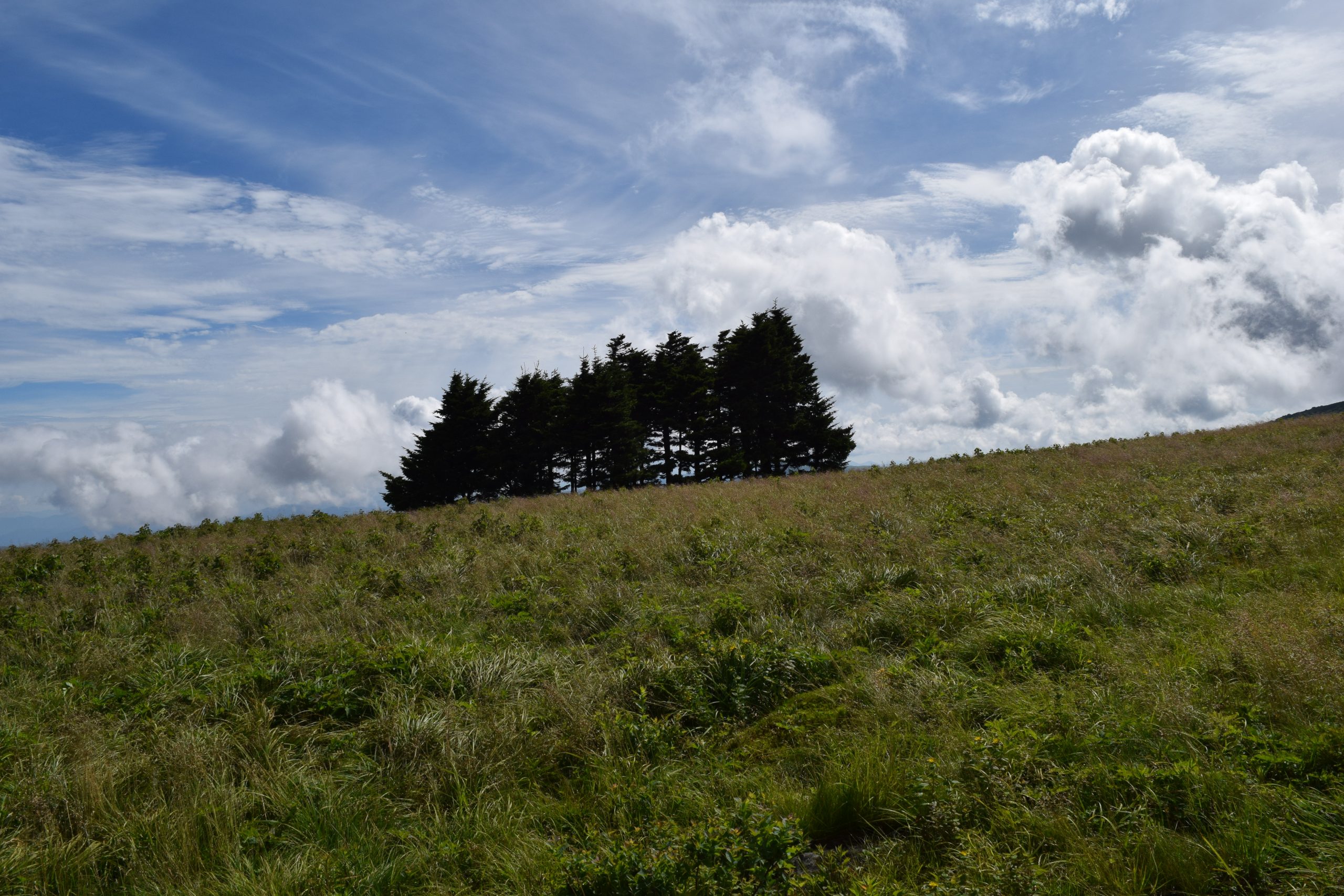
It is estimated that Roan’s grassy balds have shrunk to less than 25% of their historical extent owing to the slow march of woody vegetation. Do these changes offer any insights into the nature of the balds? They may suggest that something has acted to maintain the open grasslands over the centuries, removing woody vegetation or preventing it from getting established to begin with — some kind of regular disturbance perhaps.
- <25%of their historical extent remains in Roan’s grassy balds, owing to the slow march of woody vegetation
- 94+years since B. W. Wells called for intensive studies to solve the riddle of the balds
- 1858the year Wallace wrote that grasses, once established, cannot be reconquered by forest
Ideas considered
Many Explanations, Held Lightly
Over the years, a range of natural and human causes have been proposed. Take them one at a time. Each tab gathers what the essay says about that idea.
Dalton Brown transplanted red spruce and Fraser fir seedlings atop Round Bald and tracked them over several years. The trees can indeed survive and even, very slowly, grow, but they do not thrive or apparently reproduce. Woody growth is also advancing slowly from the edges, so the grass is not simply closed to trees.
Perhaps the balds are communities shaped by certain qualities of the soil. This is one of the natural causes that has been hypothesized to account for their origin and maintenance. Wallace, writing of tropical grasslands, observed that climate or soil would not account for them.
Frequent fire is another natural cause proposed for the balds. The essay also notes the regular burning of Native American and then settler activity, discussed in its own tab, as a human version of the same idea.
Perhaps the balds are shaped by relentless high-elevation winds, snow, and ice. Yet the balds lie below climatic treeline, so climate alone is not the whole story.
Some balds are known to be relatively recent and anthropogenic in origin. For others, people have been proposed as the cause: relics of Native American and then settler activity, with regular burning, tree girdling, and later, livestock grazing. Roan and several others, however, are clearly ancient.
The “Climate-Herbivore Hypothesis” of ecologists Peter Weigl and Travis Knowles holds that grazers have long kept the grassy balds open. Early records show settlers around Roan used the balds as summer pasture, and modern management that mimics grazing, from goats to weed-whackers, has been shown to benefit the sun-loving grass and forb species. Follow that idea through time in the next chapter.
A model of environment and disturbance
Grazers Through the Ages
One compelling model incorporating both environment and disturbance, the “Climate-Herbivore Hypothesis” of ecologists Peter Weigl and Travis Knowles, posits that the grassy balds initially formed in the transition from tundra as the last glacial period waned, and were afterward maintained as grassland by grazers — first megaherbivores (such as mastodons, mammoths, musk oxen, giant ground sloths, and others, evidence for which has been found at nearby sites in Tennessee and Virginia), and later “meso” herbivores such as bison, elk, and deer. With the subsequent decline of those second-tier grazers (the last recorded elk taken by hunters in North Carolina was in the late 1700s), did settlers’ goats, sheep, and cattle take their place as the herbivores keeping the grassy balds...well, bald? Plenty of early records show that settlers around Roan and some other high-elevation balds of the region did indeed use the balds as summer pasture, and more recent management efforts to mimic their ecological role — namely knocking back woody vegetation by various means, from goats to weed-whackers — have been shown to have a positive effect on the sun-loving grass and forb species of the balds.
Walk through the story, one era at a time
As the last glacial period waned
The grassy balds are thought to have formed in the transition from tundra. Grasslands of the southern Appalachians are thought to have increased in abundance through the Pliocene, and would have naturally succeeded tundra at higher elevations as climate warmed in post-glacial times.
Megaherbivores
Grazers such as mastodons, mammoths, musk oxen, giant ground sloths, and others are proposed as the first to maintain the grassland. Evidence for these animals has been found at nearby sites in Tennessee and Virginia.
“Meso” herbivores
Later, bison, elk, and deer may have kept the grasslands open. The last recorded elk taken by hunters in North Carolina was in the late 1700s, marking the decline of these second-tier grazers.
Settlers’ goats, sheep, and cattle
Did settlers’ livestock take the place of the herbivores before them? Plenty of early records show that settlers around Roan and some other high-elevation balds of the region used the balds as summer pasture.
Management that mimics the role
More recent management efforts mimic the grazers’ ecological role, knocking back woody vegetation by various means, from goats to weed-whackers. These efforts have been shown to have a positive effect on the sun-loving grass and forb species of the balds.
A moment to sit with it
If grazers once kept the balds open, what does it mean that the grazers are gone?
The essay returns to this later: disturbance, past and present, from grazing herbivores to today’s weed-whacking and bush hogging, appears necessary to maintain the open character of the balds. And so their long-term persistence, with the botanical rarities they hold, lies in our hands.
A notebook from 1858
A Naturalist Who Never Saw a Bald
An important but often overlooked ecological dynamic central to the Climate-Herbivore Hypothesis was first suggested in the late 1850s by a naturalist who never studied, or indeed even laid eyes on, a grassy bald: the renowned 19th century traveler-naturalist Alfred Russel Wallace, famed as the author of the travel memoir The Malay Archipelago, co-discoverer with Darwin of the principle of natural selection, and discoverer of the eponymous Wallace Line that delimits the Indo-Malayan and Austral-Asian biogeographic realms. While traveling in tropical southeast Asia Wallace was struck by another kind of anomalous grassland: grassy tropical plains such as those of lowland Halmahera Island in Indonesia, or the llanos of the Orinoco River in South America. Much like the grassy balds, these too are island-like treeless grassland communities, surrounded by forest yet somehow remaining treeless. “Climate or soil will not account for it,” Wallace observed in his field notebook. He proposed an explanation: if low-lying areas were uplifted relatively rapidly by geological processes, the newly exposed plains might be colonized far more quickly by grasses than other species, given how abundant grass seeds are relative to those of woody plants, and how much faster and further they are dispersed. Once established, the grasses have an edge: “seeds of grasses carried by the wind or by birds will vegetate immediately & cover it, then forbidding the advance of forest,” Wallace wrote, continuing: “Ground once taken possession of by grasses cannot be reconquered by forest even if surrounded by it.”
Three islands of grass
Halmahera
Grassy tropical plains on a lowland island in Indonesia, treeless though surrounded by forest.
The Orinoco llanos
Island-like treeless grassland communities of the Orinoco River in South America.
The southern Appalachian balds
An archipelago of grassy islands in the great forest sea, with Roan Mountain the largest.
“Ground once taken possession of by grasses cannot be reconquered by forest even if surrounded by it.”
Alfred Russel Wallace, species notebook, 1858
Wallace was essentially describing what modern ecologists call competitive exclusion, where one species has an edge over others and excludes them from an area, or bars them from getting a foothold to begin with. Intriguingly, Wallace dated this notebook entry January 20, 1858, just a few weeks before his “eureka moment” discovering the principle of natural selection. It seems likely that ruminating on the competition dynamic inherent in anomalous grassy “islands” surrounded by forest, much like grassy balds, may have helped inspire his great insight into the evolutionary process itself. It is interesting to note that the idea of dense, grass-dominated vegetation inhibiting the establishment of woody plant seedlings in balds was later suggested by several 20th-century botanists and ecologists, though these naturalists had no way of knowing that Wallace had proposed such a process in the previous century.
“Climate or soil will not account for it.” … “seeds of grasses carried by the wind or by birds will vegetate immediately & cover it, then forbidding the advance of forest.”
Quoted in the essay from Wallace’s field notebook.
Climate, competition, herbivores
Bringing the Ideas Together
The dispersal/competition dynamic Wallace proposed to explain the puzzle of low-elevation tropical grasslands surely applies to high-elevation grassy balds as well. Grasslands of the southern Appalachians are thought to have increased in abundance through the Pliocene, and would have naturally succeeded tundra at higher elevations in the southern mountains as climate warmed in post-glacial times — much like today’s pajonal or grass páramo, high-altitude grasslands, are found just below the treeless zone in the high Andes. In certain places, facilitated by climate, the grasses may have become well enough established to form a near-impenetrable barrier to tree and shrub seeds. Natural grazing may have later helped maintain such grasslands, followed later still by the grazing of domesticated livestock. A dynamic of this sort could explain why grasslands like those of Roan are highly resistant to woody invasion from within the bald but less so on its periphery, and why disturbance past and present, from grazing herbivores to today’s weed-whacking and bush hogging, appears necessary to maintain their open character. This might be dubbed the “climate-competitive exclusion-herbivore” hypothesis.
Three ideas, one landscape
Which part of this story feels most convincing to you, and which part still feels unfinished?
There is no single right answer yet. The essay says plainly that puzzles remain, and the next section names the largest one.
Needless to say, puzzles remain. A major one is why we don’t see extensive balds in high-elevation areas seemingly more accessible than Roan and other grassy balds to both natural grazers and humans with their livestock. We may never fully understand the factors behind the formation and maintenance of high-elevation grassy balds, but it is clear that the woody encroachment noted at Roan by D. M. Brown nearly 75 years ago has continued. As seedlings at the interface of the balds and surrounding forest become established, Brown observed, “ultimate natural forestation of the entire bald is not improbable.” Which means that regardless of how they formed, the long-term persistence of the balds and their botanical rarities lies in our hands.
Conservation
Held in Our Hands
The conservation imperative that the balds present us with would have surely resonated with Wallace, an early voice for conservation. Lamenting the pace of environmental degradation and species extinction in his time, Wallace likened species to letters that make up the volumes of Earth history, their extinction an irresponsible and irrevocable loss of that record, disrupting the continuity and mutual interactions of species in the web of life. In failing to take action now, Wallace wrote in 1863, “future ages will certainly look back upon us as a people so immersed in the pursuit of wealth as to be blind to higher considerations.”
“...future ages will certainly look back upon us as a people so immersed in the pursuit of wealth as to be blind to higher considerations.”
Alfred Russel Wallace, 1863
Fortunately, thanks to the cooperative efforts of governmental agencies such as National Park Service and the U.S. Forest Service and volunteer conservation organizations like the Southern Appalachian Highlands Conservancy and Friends of Roan Mountain (opens in a new tab), action has been and is being taken: the management of the balds continues, ensuring the continuity of a unique southern Appalachian biological community — especially majestic Roan Mountain, the largest “island” in the grassy bald archipelago, as beautiful as it is puzzling.
For further reading
References
- Brown, D. M. 1953. Conifer transplants to a grassy bald on Roan Mountain. Ecology 34(3): 614–617.
- Costa, J. T. 2013. On the Organic Law of Change: A Facsimile Edition and Annotated Transcription of Alfred Russel Wallace’s Species Notebook of 1855-1859. Cambridge, Mass.: Harvard University Press, pp. 244–246.
- Costa, J. T. 2023. Radical By Nature: The Revolutionary Life of Alfred Russel Wallace. Princeton, NJ: Princeton University Press.
- DeSantis, L. R. G. and S. C. Wallace. 2008. Neogene forests from the Appalachians of Tennessee, USA: Geochemical evidence from fossil mammal teeth. Palaeogeography, Palaeoclimatology, Palaeoecology 266: 59–68.
- Donaldson, J. T., N. Schubert, and L. C. Huff. 2010. Management of grassy bald communities in the Roan Highlands. In: Proceedings of the Conference on the Ecology and Management of High-Elevation Forests in the Central and Southern Appalachian Mountains, May 14-15, 2009 (GTR-NRS-P-64), p. 234.
- Mark, A. F. 1959. The flora of the grass balds and fields of the southern Appalachian Mountains. Castanea 24(1): 1–21.
- Rossell, I. M. and C. H. Roberson. 2026. Two decades of blackberry management in a southern Appalachian grassy bald. Natural Areas Journal 46(2): 142–148.
- Stokes, C., and J. L. Horton. 2022. Effects of grassy bald management on plant community composition within the Roan Mountain Massif. Castanea 87(1): 105–120.
- Weigl, P. D. and T. W. Knowles. 1995. Megaherbivores and southern Appalachian grass balds. Growth and Change 26: 365–382.
- Weigl, P. D. and T. W. Knowles. 2014. Temperate mountain grasslands: A climate-herbivore hypothesis for origins and persistence. Biological Reviews 89: 466–476.
- Wells, B. W. 1932. The Natural Gardens of North Carolina. Chapel Hill, NC: University of North Carolina Press.
Notes from the Field
Thank you for taking your time
This essay first appeared in the Fall 2026 newsletter of Friends of Roan Mountain, and we are grateful to share it with readers of Notes from the Field.
Visit Friends of Roan Mountain (opens in a new tab) Back to Notes from the Field Return to the beginning