
Highlands Biological Station · Lindenwood Lake
What the Lake Reveals
A bittern at the water’s edge, a beaver beneath the trail, and the hidden life of a small mountain lake.
A garden, first
It started, as so many good days at the Highlands Biological Station do, with a garden.
This week, horticultural consultant Sonya Carpenter was helping reintroduce several perennial species to the pollinator garden at Lindenwood Lake. Monarda, purple coneflower, milkweeds, and other plants were finding their way back, returning flowers, function, and habitat to a landscape that is always in some stage of becoming.
Later, while tucking the new plantings in with a little mulch, I nearly stumbled on something I never expected to find.
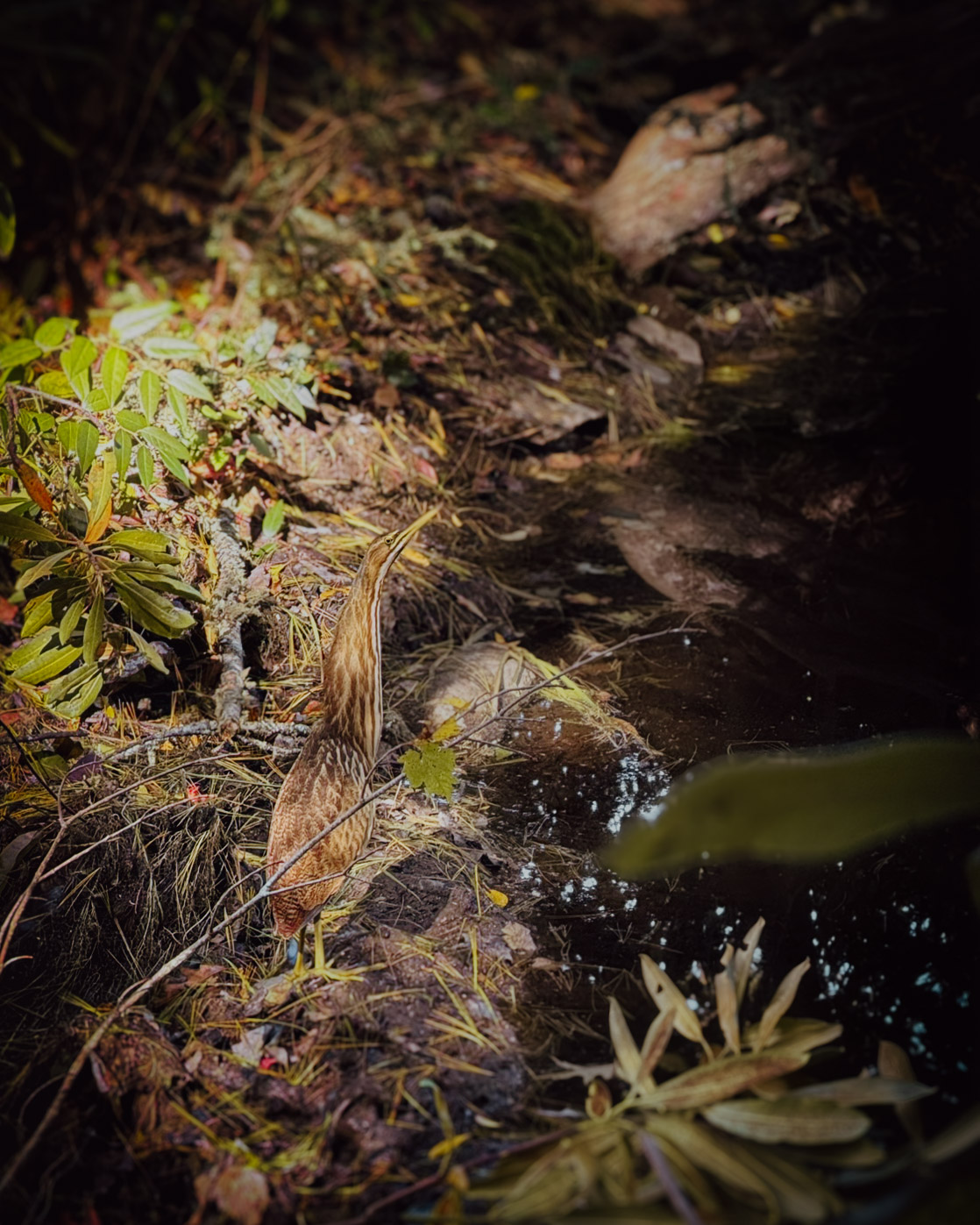
An American Bittern.
A quiet visitor
I knew the bird from travels along the coastal wetlands of Alabama and Florida, where I had occasionally searched for them among reeds and marsh grasses. Even there, they were elusive. Bitterns have one of those remarkable adaptations that make you question whether you are looking at a bird at all. Their streaked plumage seems borrowed from the vegetation itself, and when they stand motionless among reeds, they can nearly disappear into the landscape.
This one had stopped at Lindenwood Lake during fall migration.
Perhaps tired from its journey, it didn’t seem particularly interested in me. It simply continued along the shoreline, moving slowly through the vegetation, giving me the rare privilege of watching rather than chasing.
It was mesmerizing.
I didn’t know then that this was the first recorded sighting of an American Bittern at HBS, or that it was only the second sighting in Macon County since 2014. I knew only that I was standing at the edge of a small mountain lake, watching a bird I had rarely seen, in a place where I certainly hadn’t expected to find it.
- 1st
- recorded sighting of an American Bittern at Highlands Biological Station
- 2nd
- sighting in Macon County since 2014
Word travels
I sent a photograph to Associate Director Jason Love, an avid and respected birder in our community. He confirmed the identification.
And then I had to leave.
A Gardens & Grounds Committee meeting was beginning in five minutes.
I reluctantly headed toward the meeting, but apparently news of the bird had already traveled. Along the way I encountered several committee members, binoculars in hand, heading toward the dam.
I guess I had finally discovered how to sidetrack a meeting.
For the rest of the day, the bittern seemed to hover at the edges of our conversations—a rare visitor, a small piece of wildness that had suddenly made itself visible.
Movement at the edges
The next morning, I returned to the pollinator garden, secretly hoping he might still be there.
He wasn’t.
Instead, the garden was full of movement. Fall migrants flickered through the willows and edge vegetation—Rose-breasted grosbeaks, vireos, sparrows—appearing and disappearing among the leaves. The season was changing around us, and Lindenwood seemed to be receiving its annual procession of travelers.
I returned to my work.
Later that day, a guest came to tell me that the bittern had been seen near the beaver dam.
Of course. We’ve been admiring the evolving ecology around the fledgling dam this summer, so it’s no wonder the bittern was feeding there.
Beneath the trail
I made my way along the trails, heading toward the bog edge as quickly as I could. But before I reached the lake, someone called out:
“Hey, Canty! There’s a big, freshly dug hole over here on the east side trail.”
Apparently it hadn’t been there two hours earlier.
The people who regularly walk the grounds at HBS are part of the landscape in their own way. They notice things. They see what changes from morning to afternoon, what appears overnight, what has moved, bloomed, emerged, or disappeared.
I followed them to the hole.
At first, I thought it might be a yellowjacket nest—or perhaps the work of a bear. But the opening was deeper than I expected. Then I noticed something else: the hole continued laterally beneath the trail.
I crouched down and shone the tiny flashlight on my phone into the darkness.
Nothing.
I needed a stick.
I reported the discovery to Jason, who is also our chief wildlife biologist and had been through the area only a few hours earlier without noticing anything. He suggested it might be a bear, but when I mentioned the tunnel beneath the trail, his curiosity was piqued.
He went to investigate.
The answer was waiting beneath our feet.
Beaver.
The tunnel led directly toward the lake.
Suddenly, the landscape rearranged itself in my mind. The trail wasn’t simply a trail anymore. The bank wasn’t simply a bank. Somewhere beneath us was a hidden passage connecting the woods to the water, part of a world that had been operating quietly beneath our awareness.
“Tricky beaver,” I thought.
I headed back toward the pollinator garden.
The bittern, again
And there, in almost exactly the same place between two patches of pickerelweed, was the bittern.
Again.
He moved slowly along the shoreline, sometimes so sinuously that he seemed almost serpentine, then rose to his full height, his plumage lifting in the breeze.
Read a description of this film
A twenty-second clip. In dappled sunlight on the muddy bank, the bittern begins hunched and low, then slowly stretches its neck, higher and higher, until it stands at full height with its bill pointed to the sky. There is no speech; only the soft ambient sound of the lake.
For a moment, he was perfectly still. Only the wind stirred his soft feathers, an act of mimicry amongst the shoreline grasses.

“Their hoarse croakings, as if their throats were filled with water, were heard on every side.”
A small theater
I was able to show him to several guests. Some already knew the bird; others had never seen an American Bittern before and could hardly believe they were standing there looking at one.
I called an old friend who has always loved a “rare-bird alert” and tried to keep the bittern in sight until she could arrive. But working at HBS means that there is always another question waiting.
What flower is that?
What are the snapping turtles doing?
Where does this trail go?
My attention wandered, as it always does here.
And each time I looked back, somehow, I found the bittern again.
Eventually my friend arrived, and we stood together watching him.
More guests came and went. More people stopped. For a little while, the shoreline became a small theater, and this remarkably elusive bird was the star.
Then, without ceremony, he lifted into the air.
He flew gracefully over the boardwalk, past the Sto Pavilion, and disappeared into the marsh on the other side of the lake.
There was something almost perfectly fitting about that final glimpse. He flew past a place so closely associated with an old friend who taught me so much about birds. Looking back, I can’t help feeling that moment was somehow sent to me by Sto.
I will always be grateful for it.
Passing through, and here all along
The bittern and the beaver have stayed with me.
One arrived from somewhere far beyond these mountains, pausing here on its journey south. The other has been quietly living beside us all season, moving beneath the trail and through the lake, largely unseen.
Both reminded me that there is far more happening around us than we usually notice.
One was passing through.
One had been here all along.
And both reminded me how little of the living world we actually see.
The company Lindenwood keeps
Passing through
- American BitternFirst recorded at HBS
- Rose-breasted GrosbeaksFall migrants in the willows
- VireosFlickering through the edge vegetation
- SparrowsAppearing and disappearing among the leaves
Returning to the garden
- MonardaReintroduced to the pollinator garden
- Purple coneflowerReintroduced to the pollinator garden
- MilkweedsReintroduced to the pollinator garden
- Other perennialsFlowers, function, and habitat coming back
Here all along
- BeaverTunneling beneath the trail toward the lake
- Snapping turtlesBasking, and busy with their own questions
- PickerelweedAlong the shoreline, where the bittern stood
- SeedsWaiting
Learning to notice
The garden we tend is also habitat. The lake we pass is also a wetland. The trails we walk are corridors for creatures moving through a landscape that belongs to all of us. And sometimes, if we slow down long enough, the landscape lets us in on one of its secrets.
We tend to think of a garden as something we plant and maintain. A lake as something we walk around. A trail as something that carries us from one place to another.
But Lindenwood Lake keeps reminding me that these places have lives of their own.
Birds arrive and depart.
Beavers build unseen passages.
Migrants move through the trees.
Turtles bask.
Plants return.
Seeds wait.
And beneath it all, an intricate web of relationships continues whether we notice it or not.
Perhaps stewardship is partly about learning to notice.
To recognize that when we care for a garden, we are also caring for the creatures that depend upon it. That when we restore a patch of habitat, we may be creating a resting place for a traveler we will never see. That when we walk these trails with curiosity, the landscape sometimes answers.
The bittern came to Lindenwood because it found something it needed.
The beaver stayed because it had made something it needed.
And for a few brief days, both gave us a glimpse into the hidden life of this place.
I can’t wait to take another walk and see what Lindenwood reveals next.