
The bridge to North Campus
Leave it to Beaver
In July something started stacking sticks against our spillway. We pointed a trail camera at it and left. Four weeks of what the camera kept, below.
The bridge on the path to North Campus crosses a small, unhurried stream — the kind of water most people walk over without looking down. In mid-July, the water stopped behaving, and we went looking for the reason.
What we found is one of the more satisfying things a field station gets to document: a single animal, working almost entirely in the dark, rebuilding a piece of the landscape a stick at a time. Nobody supervised it. Nobody had to. A beaver hears water moving through a narrow gap and responds to that sound the way we respond to a smoke alarm — as a problem with an obvious solution.
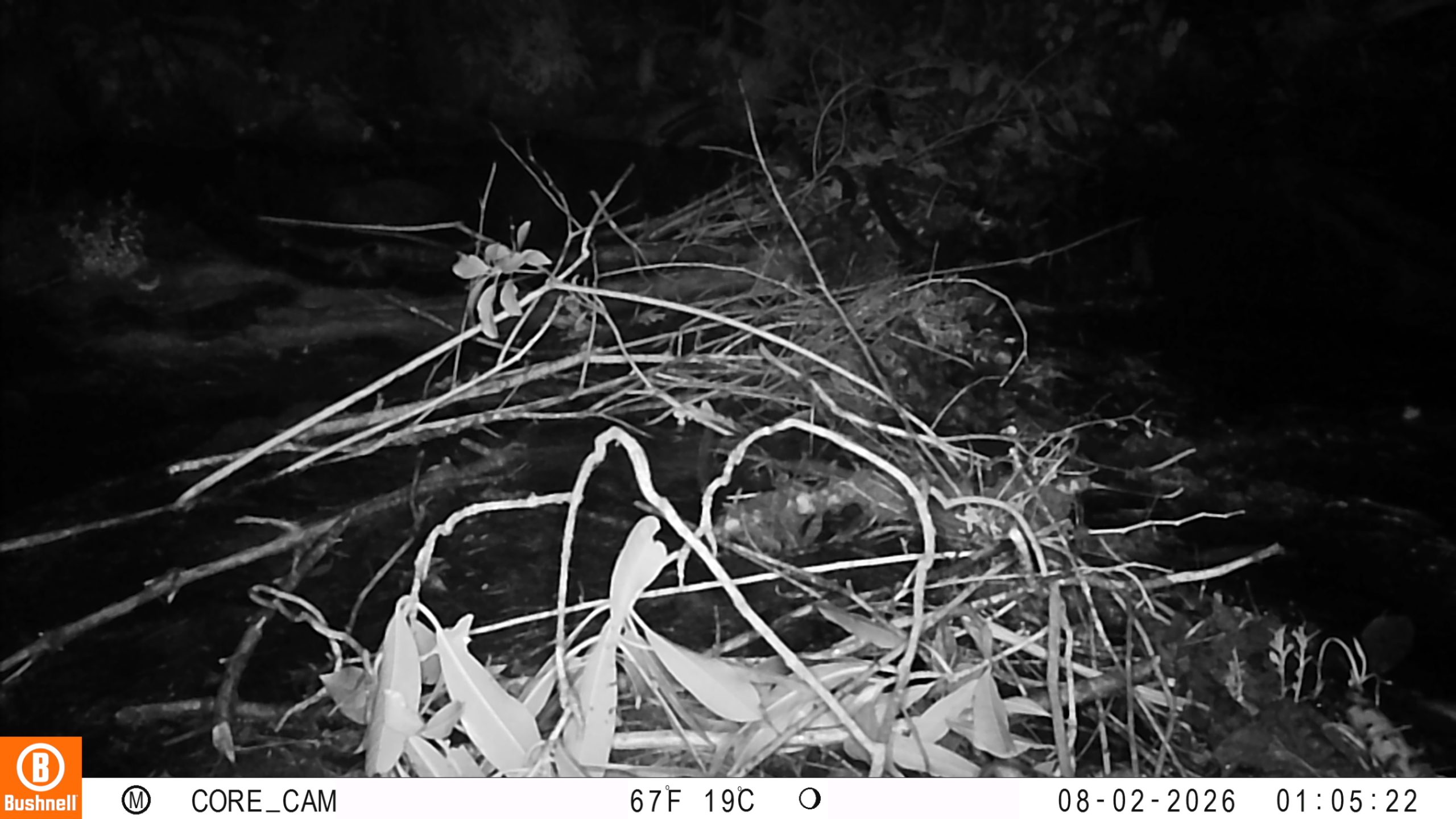
So we strapped a trail camera to a pole on the bank, aimed it at the spillway, and left the beaver to it. Everything below is what came off the card between July 14 and August 10. Because the camera never moved, the frames line up exactly — the dam is the only thing in the picture that changes.
Four weeks at the crossing
Drag the handle, tap play, or use the arrow keys. One fixed camera, one fixed frame — everything that moves is the beaver's doing. Except once: one of these frames is not a beaver at all, but a river otter passing through. See whether you can pick it out.
Day 0
July 14
Trail camera, Highlands Biological Station.
What the dam is actually doing
A dam is not a wall. It is a leaky, deliberate slowing-down — porous enough to pass water, tight enough to raise it. Tap a number to see each piece, or switch the dam off and watch the stream fall back to what it was.
Five pieces, one system
Choose a number on the drawing to read what that part does.
Six things about the builder
Tap a card to turn it over.
Everything else the camera kept
The camera fires on movement, so some days it saved more than one frame. August 2 alone produced six. Select any photograph to enlarge it.
Come and see it
The crossing sits on the walking route between the main campus and North Campus, a few minutes from Coker Laboratory. Early morning and the last hour of light are the best odds for activity, though the builder keeps its own hours and owes us nothing.
Watching well
- Stay on the path and the bridge deck.
- Leave the dam exactly as you find it — pulling sticks only means a night of rebuilding.
- Keep dogs leashed and give the water a wide margin.
- Photographs are welcome. Send yours to the Station and we may add them here.
Photographed at Highlands Biological Station, July–August 2026.